
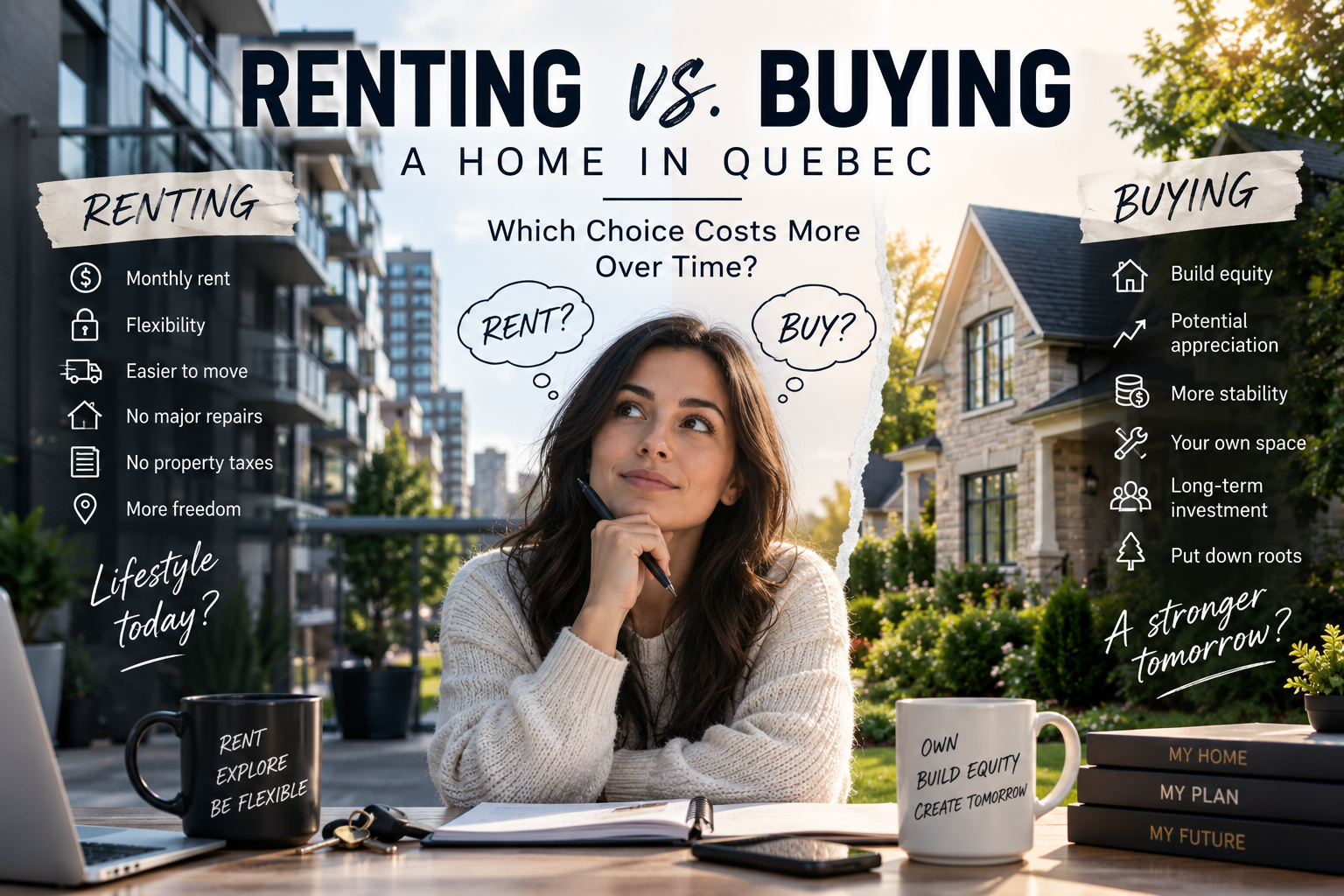
Renting vs. Buying a Home in Quebec: Which Choice Costs More Over Time?
Should you keep renting or buy a home?
It sounds like a simple financial question.
Rent goes to a landlord.
A mortgage can help you build equity.
So buying must always be better, right?
Not necessarily.
But the opposite argument is not automatically true either.
You may hear that renting gives you more flexibility, avoids maintenance costs and leaves more money available to save or invest.
That can absolutely be true.
The problem is that most renting vs. buying comparisons begin with the wrong question.
They ask:
“Is renting cheaper than owning?”
Or:
“Is buying a better investment?”
I would start somewhere else:
“Which option puts you in the stronger position based on your finances, timeline and what you are trying to accomplish?”
Because rent is not automatically wasted money.
And a mortgage payment is not automatically an investment.
Both choices have costs.
Both choices have advantages.
And both choices have opportunity costs.
The expensive mistake is choosing the wrong one for your situation.
In Saint-Laurent, for example, someone comparing a rental with a condo or family home is not making the same financial decision as a buyer considering a detached property on the South Shore.
Is Renting Really Throwing Money Away?
No.
Rent pays for something very real.
Housing.
You are paying for the right to live in a property without taking responsibility for many of the costs and financial risks that come with owning it.
If the roof needs replacing, that is generally not your capital expense.
If the foundation develops a major problem, you are generally not receiving the repair bill as the owner.
You are also not directly responsible for property taxes, building insurance and many of the larger capital expenses associated with the property.
That has value.
Renting can also provide flexibility.
If your career changes, your family situation changes or you decide you want to live somewhere else, leaving a rental may be considerably simpler than selling a property.
For a renter in Côte-des-Neiges or Villeray, that flexibility can matter if work, family or lifestyle changes could make another neighbourhood more practical within a few years.
So I would never tell someone:
“You are throwing your money away because you rent.”
But there is another side to the equation.
Your rent normally does not create ownership in the property.
You can live there for five years.
Ten years.
Twenty years.
The property still belongs to the owner.
That is the financial difference worth understanding.
The better question is:
“What am I receiving in exchange for renting, and what am I giving up by not owning?”
What Does Buying Give You That Renting Does Not?
One of the most important financial advantages of homeownership is the ability to build equity.
A mortgage payment typically contains two important components.
Interest is the cost of borrowing the money.
Principal reduces the amount you owe.
The portion applied to principal gradually increases your equity in the property.
Over time, your equity can potentially grow in two ways.
You pay down the mortgage.
And the market value of the property may increase.
That second part matters.
But so does the word:
“May.”
Real estate values can increase.
They can remain relatively flat.
They can decline.
There is no guaranteed annual appreciation rate.
You should not buy a home because someone convinced you:
“It will definitely be worth more next year.”
But principal repayment creates an important structural difference between renting and owning.
Part of your mortgage payment can gradually convert debt into ownership.
Rent does not do that.
For someone who is financially ready and expects to remain in the property long enough, that difference can become significant over time.
Comparing Rent With a Mortgage Payment Is the Wrong Calculation
Suppose your rent is $2,000 per month.
That is $24,000 per year.
Someone might tell you:
“You are losing $24,000 every year.”
Then you find a property with a mortgage payment around $2,000 per month.
It becomes tempting to conclude:
“Why would I rent when I could pay the same amount and own?”
But that comparison is incomplete.
The mortgage payment is not the entire cost of ownership.
An owner may also have:
-
municipal and school taxes;
-
home insurance;
-
maintenance;
-
repairs;
-
condo fees when applicable;
-
utilities that may differ;
-
mortgage insurance when applicable;
-
other property-related expenses.
And not every dollar of the mortgage payment creates equity.
Interest is a financing cost.
Now go too far in the opposite direction and the comparison becomes misleading again.
If you add every homeowner expense together and compare that amount directly with rent, you ignore the fact that part of the mortgage payment reduces principal.
So the useful comparison is not:
Rent versus mortgage payment.
It is closer to:
“What are the unrecoverable costs of each option, what equity could I build by owning, and what could I do with the money I keep available by renting?”
That is a much more useful financial conversation.
There Is an Opportunity Cost on Both Sides
This is where the comparison becomes more interesting.
Suppose you continue renting.
You do not use $75,000 as a down payment.
You avoid certain acquisition costs.
And perhaps your monthly housing expenses remain lower than they would be if you purchased.
What happens to that money?
If you save and invest it consistently, renting may allow you to build substantial wealth outside real estate.
That matters.
But now consider the other side.
Suppose you actually want to become a homeowner eventually.
You wait three years.
During those three years, the type of property you want becomes more expensive.
Now the down payment you need may be larger.
The mortgage required may be larger.
And you did not participate in the equity growth that occurred while you were renting.
That is also an opportunity cost.
Neither outcome is guaranteed.
Property prices do not always rise.
Investments do not always rise.
And nobody knows with certainty which will outperform the other over your exact timeline.
That is why I would not ask:
“Which investment always wins?”
I would ask:
“What are you likely to do with your money under each scenario?”
A renter who consistently invests can be in a very different position from a renter who spends everything left over.
And a homeowner who buys far beyond a comfortable budget can be in a worse position than a disciplined renter.
Ownership is a tool for building wealth. It is not a guarantee of wealth.
What Are the Real Costs of Owning a Home in Quebec?
The purchase price is only one part of the cost.
Before buying, I would want someone to understand the complete ownership budget.
Down Payment
Your down payment determines how much money you need upfront and influences the financing required.
For eligible purchases, the minimum down payment can begin at 5%. The required percentage changes as the purchase price increases, and mortgage loan insurance is typically required when the down payment is below 20%.
You can review the current federal requirements directly through the Financial Consumer Agency of Canada.
Mortgage loan insurance protects the lender, not the buyer, and the premium adds to the cost of financing.
If you are considering purchasing with less than 20% down, my guide to CMHC mortgage loan insurance in Canada explains how the down payment, insurance premium and other costs fit together.
So the question should not simply be:
“What is the minimum amount I need to buy?”
It should also be:
“How much money should I have left after I buy?”
Mortgage Interest
Not every dollar of your mortgage payment becomes equity.
A portion goes toward interest.
Your rate, amortization, term and mortgage structure all affect how much interest you pay and how quickly the principal declines.
This is why two buyers purchasing properties at the same price can experience very different financing costs.
My guide to using a mortgage calculator in Quebec can help you test different purchase prices, down payments and financing scenarios while looking beyond the mortgage payment alone.
Property Taxes
Homeowners are responsible for municipal and school taxes.
These vary according to the property and municipality.
Someone comparing ownership in LaSalle or Lachine, for example, should use the costs associated with the actual properties being considered rather than assuming the ownership budget will be identical from one area to another.
Maintenance and Repairs
A house keeps costing money after you receive the keys.
Roofs age.
Windows fail.
Appliances break.
Drains clog.
Heating and cooling equipment eventually need attention.
A condo changes some of those responsibilities, but it introduces other considerations such as co-ownership fees and the possibility of special assessments.
Maintenance should therefore be part of the budget before you buy.
Not a surprise after you own.
Insurance
Property insurance also belongs in the ownership budget and will normally be required when the purchase is financed.
Acquisition and Closing Costs
Buying can also involve:
-
inspection fees;
-
notary fees;
-
land transfer duties;
-
adjustments at the notary;
-
moving expenses;
-
mortgage insurance costs when applicable;
-
immediate repairs or improvements.
These expenses are easy to underestimate when most of your attention is focused on the down payment and mortgage.
My guide to buying a home in Quebec explains several of the costs and steps buyers should understand before taking possession.
This is why buying a $500,000 property does not mean the only question is:
“Can I afford the mortgage on a $500,000 property?”
The better question is:
“Can I comfortably afford to own this $500,000 property after everything else is included?”
Qualifying for the mortgage and comfortably owning the property are not necessarily the same thing.
Renting Has Costs Too
Renting avoids many ownership expenses.
But your housing costs do not necessarily remain unchanged forever.
In Quebec, rent increases and changes to a residential lease are governed by specific rules.
The Tribunal administratif du logement explains the process that applies when a landlord proposes a rent increase and the rights available to tenants.
Regardless of what happens to the rent, however, paying rent for a longer period does not gradually increase your ownership in the property.
That creates an important long-term difference.
A renter may need to deliberately build wealth somewhere else.
A homeowner may gradually build equity through principal repayment while living in the property.
Neither automatically creates the better financial outcome.
But they build wealth in very different ways.
Does Owning Give You More Stable Housing Costs?
Sometimes.
But this needs qualification.
If you have a fixed mortgage rate, that rate applies during the mortgage term.
It does not mean your housing costs are frozen for the entire amortization period.
Your mortgage may eventually renew at a different rate.
Property taxes can change.
Insurance premiums can change.
Condo fees can change.
Maintenance can be unpredictable.
A homeowner can therefore experience rising costs too.
The difference is that an owner has a long-term ownership interest in the property.
You are not simply paying for access to housing.
You are gradually acquiring more of the asset as the mortgage principal is reduced.
What About Home Appreciation?
This is where homeownership can become financially powerful.
Imagine you purchase a property.
Over many years, you reduce the mortgage principal.
The property appreciates.
You maintain it.
And eventually, you own a substantially larger portion of an asset that may itself be worth more than when you purchased it.
That combination can create meaningful wealth.
There can also be favourable Canadian tax treatment when a property qualifies as your principal residence.
But appreciation should still be treated as a possibility.
Not a promise.
A responsible buying decision should not depend entirely on:
“This house will be worth much more next year.”
The purchase should make sense based on your finances and plans even without an aggressive appreciation assumption.
Your Timeline Matters More Than Most Buyers Realize
Buying and selling real estate involves transaction costs.
That makes time important.
If you purchase a property and need to sell it again shortly afterward, there may not be enough time for principal repayment or appreciation to offset the costs of entering and exiting the transaction.
Buying can involve:
-
an inspection;
-
notary fees;
-
land transfer duties;
-
mortgage insurance when applicable;
-
moving expenses;
-
immediate repairs.
Then selling creates another set of expenses.
This does not mean there is a magic number of years that guarantees buying will be better.
There is not.
It means your expected timeline belongs in the decision.
Someone expecting to remain in Boucherville or Varennes for many years is evaluating homeownership very differently from someone who may relocate next year.
Is Buying Better If Home Prices Keep Rising?
Potentially.
But fear is a terrible buying strategy.
The thought process can quickly become:
“If I do not buy now, I will never be able to buy.”
Then the buyer starts making compromises they would never have considered otherwise.
Stretching beyond a comfortable budget.
Using too much of their savings.
Ignoring repair risks.
Buying a property that does not actually fit their needs.
Making an emotional offer because they are afraid of missing out again.
Becoming a homeowner is not the objective at any cost.
Becoming a homeowner under conditions that make sense for you is.
Missing one property is disappointing.
Buying the wrong property at the wrong price can be much more expensive.
What If You Are Waiting for Home Prices to Fall?
This is the opposite trap.
“I will wait until prices drop 10%, then I will buy.”
Maybe prices will decline.
Maybe they will not.
And even if they do, other things can change at the same time.
Interest rates.
Inventory.
Competition.
Your income.
Your employment.
The neighbourhood you want.
The type of property you are trying to purchase.
You could correctly predict a price decline and still discover that the property you actually want has not become meaningfully easier to buy.
Instead of trying to identify the perfect bottom of the market, I would ask:
“Can I comfortably afford the right property today, and does buying support what I want to accomplish over the next several years?”
That question gives you something you can actually work with.
Is It Better to Rent and Save for a Larger Down Payment?
Sometimes.
Renting intentionally while strengthening your financial position can be an excellent strategy.
You might spend another year:
-
building an emergency fund;
-
paying down expensive debt;
-
improving your credit;
-
increasing your down payment;
-
learning where you actually want to live;
-
stabilizing your career;
-
preparing for the expenses that come with ownership.
That is very different from waiting indefinitely because buying feels intimidating.
If another year of renting makes you a substantially stronger buyer, that year may be extremely valuable.
The important part is having a reason for waiting.
And a plan for what you will accomplish during that time.
First-Time Buyers Have Tools That Can Help
For some buyers, the largest obstacle is accumulating enough money to purchase comfortably.
Several programs can help eligible first-time buyers save more efficiently or reduce certain costs.
My guide to first-time home buyer programs in Canada explains the FHSA, Home Buyers’ Plan, tax credits and other measures that may apply to a Quebec purchase.
Two federal programs are particularly important to understand.
First Home Savings Account
The First Home Savings Account, or FHSA, allows eligible first-time home buyers to save toward a qualifying first home.
Contributions are generally deductible and qualifying withdrawals can be tax-free.
Home Buyers' Plan
The Home Buyers' Plan allows eligible participants to withdraw funds from their RRSP to buy or build a qualifying home, subject to the program's rules.
These programs can be valuable.
But a program does not make an unaffordable property affordable.
And access to a down payment does not eliminate the need for emergency savings, closing costs and a sustainable monthly budget.
The question remains:
“Does buying make sense after everything is included?”
Can You Buy With 5% Down?
For some eligible purchases, yes.
The minimum down payment can begin at 5%, depending on the purchase price and applicable mortgage requirements.
But I would not stop at:
“Can I qualify?”
I would ask:
“What happens to my finances the day after I become the owner?”
How much cash remains?
Can you absorb an unexpected repair?
Can you handle the taxes and insurance?
What happens if another major expense appears next month?
Can you still save?
Can you still live comfortably?
A lender determining that you qualify for financing does not automatically mean the purchase is comfortable for you.
Those are two different standards.
The OACIQ Buyer’s Guide is also a useful resource for understanding the residential buying process in Quebec.
When Renting May Actually Be the Better Choice
There are situations where I would be very cautious about encouraging someone to buy.
For example:
-
you expect to relocate soon;
-
your employment is unstable;
-
the purchase would eliminate virtually all of your savings;
-
you have significant high-interest debt;
-
you do not know where you want to live;
-
comparable ownership costs are substantially above your current rent;
-
flexibility is extremely important to you;
-
you are not ready for the financial responsibility of maintaining a property.
In those situations, continuing to rent can be the stronger decision.
Homeownership is not a test you need to pass by a certain age.
Buying before you are financially or personally ready can cost considerably more than renting for another year or two.
When Buying May Make More Sense
Now look at the opposite situation.
Your income is reasonably stable.
You have an appropriate down payment.
You can pay the acquisition costs without emptying your accounts.
You have an emergency fund.
Your monthly budget can comfortably absorb the real cost of ownership.
You expect to remain in the area for a meaningful period.
You have found a property that fits your actual needs.
And you genuinely want the responsibilities that come with owning.
For someone planning to settle in Sainte-Julie or Saint-Hubert for a meaningful period, for example, the long-term calculation can look very different from that of someone who expects to move again within a year or two.
At that point, the argument for buying becomes much stronger.
Because now you are not simply replacing rent with a mortgage.
You are using part of your housing payment to gradually build an ownership stake in an asset you control.
That is something renting cannot provide inside the rent payment itself.
And over a long enough period, that distinction can become financially significant.
Renting vs. Buying Is Not Just About the Monthly Payment
Imagine your rent is $2,000 per month.
Then you find a property with a mortgage payment around $2,000.
It is tempting to conclude:
“The payment is the same. Buying is obviously better.”
Not yet.
Add property taxes.
Insurance.
Maintenance.
Condo fees if applicable.
Utilities that may differ.
Repairs.
And the possibility of a different mortgage rate at renewal.
Now the ownership cost may be substantially higher.
But do not make the opposite mistake either.
Part of that mortgage payment is reducing principal.
That money is not economically identical to rent.
You need the complete picture. Not the easiest comparison.
What About the Freedom of Owning Your Home?
Not every advantage appears in a spreadsheet.
Ownership can give you considerably more control over the place where you live.
Renovate the kitchen.
Change the flooring.
Paint the rooms.
Improve the yard.
Adapt the property to the way you actually want to live.
There may still be municipal regulations, co-ownership rules and other restrictions to respect.
But generally, ownership gives you more control.
That has value.
Of course, control comes with responsibility.
When something breaks, it becomes your problem too.
Freedom and responsibility arrive together.
Renting Also Offers a Type of Freedom
Renters have an advantage that is sometimes underestimated.
Mobility.
Your career changes.
Your relationship changes.
Your family grows.
You want to experience another neighbourhood.
You receive an opportunity in another city.
Moving from a rental may be simpler than preparing, listing, negotiating and selling a property.
There are still lease obligations to respect.
But renting can offer a level of flexibility that ownership does not.
That flexibility has economic value.
This is why the answer cannot simply be:
“Owners build equity, therefore everyone should buy.”
Different people are trying to accomplish different things.
Renting vs. Buying in Greater Montreal and the South Shore
The financial comparison can change substantially depending on where and what you want to buy.
The relationship between rent, property prices, taxes, condo fees and available inventory can differ between Verdun, LaSalle, Lachine, Côte-des-Neiges and Villeray.
The same is true on the South Shore, where someone comparing Longueuil, Saint-Hubert, Boucherville, Varennes and Sainte-Julie may encounter very different property types, prices and ownership costs.
A condo in Verdun and a detached home in Sainte-Julie are not the same financial decision.
Neither are a duplex in Villeray and a townhouse in Longueuil.
That is why I would be careful with any calculator or article that gives you one universal answer for Quebec.
Your calculation needs to reflect the property and community you are actually considering.
The Question I Would Ask Before Telling a Renter to Buy
I would not begin with:
“How much rent are you wasting?”
I would ask:
“What are you trying to accomplish over the next five or ten years?”
Then I would want to understand:
-
your income;
-
your current rent;
-
your debts;
-
your savings;
-
your down payment;
-
your emergency fund;
-
where you want to live;
-
what type of property you actually need;
-
how long you expect to stay;
-
what monthly housing cost feels comfortable.
Then we can start comparing real scenarios.
Because sometimes the numbers will tell us:
“You are in a strong position to buy.”
Sometimes they will tell us:
“You could probably qualify, but I would not be comfortable with what this leaves you afterward.”
And sometimes they will tell us:
“Renting another year while you prepare could put you in a much stronger position.”
That is a much more useful conversation than trying to convince every renter that they should become a buyer immediately.
So, Is It Better to Rent or Buy a Home in Quebec?
There is no universal answer.
But there is a useful way to think about it.
If flexibility matters most, your timeline is uncertain or buying would put too much pressure on your finances, renting can be the better decision.
If your finances are ready, your timeline is long enough, you want the responsibilities of ownership and the right property fits comfortably within your budget, buying becomes much more compelling.
Because ownership can do something rent cannot.
It can gradually convert part of your housing payment into equity.
That does not make buying automatically better.
It makes buying potentially very powerful when the conditions are right.
So I would not ask:
“Is renting throwing money away?”
And I would not ask:
“Will buying make me rich?”
I would ask:
“Which decision leaves me in the stronger position five or ten years from now?”
That answer depends on what you buy.
What you pay.
How you finance it.
How long you stay.
What happens to the property's value.
What you would have done with your money if you kept renting.
And whether the purchase leaves enough room in your finances to continue living comfortably.
If you are renting in Greater Montreal or on the South Shore and wondering whether buying now actually makes sense, I would not start by trying to sell you a house.
I would start by understanding your situation.
What are you paying now?
What could you realistically afford?
How much money would you have left after buying?
How long do you expect to stay?
What are you trying to accomplish over the next several years?
What would owning allow you to do that renting does not?
Then we can compare the numbers.
Maybe the answer is that you are ready.
Maybe another year of preparation would put you in a much stronger position.
Or maybe renting is currently doing exactly what you need it to do.
The objective is not to buy as quickly as possible.
It is to buy when becoming an owner actually improves your position.
The right decision. At the right time... For the right reasons.
Jonathan Cabana
Residential and Commercial Real Estate Broker
eXp Québec
Greater Montreal | South Shore
(514) 476-0730