
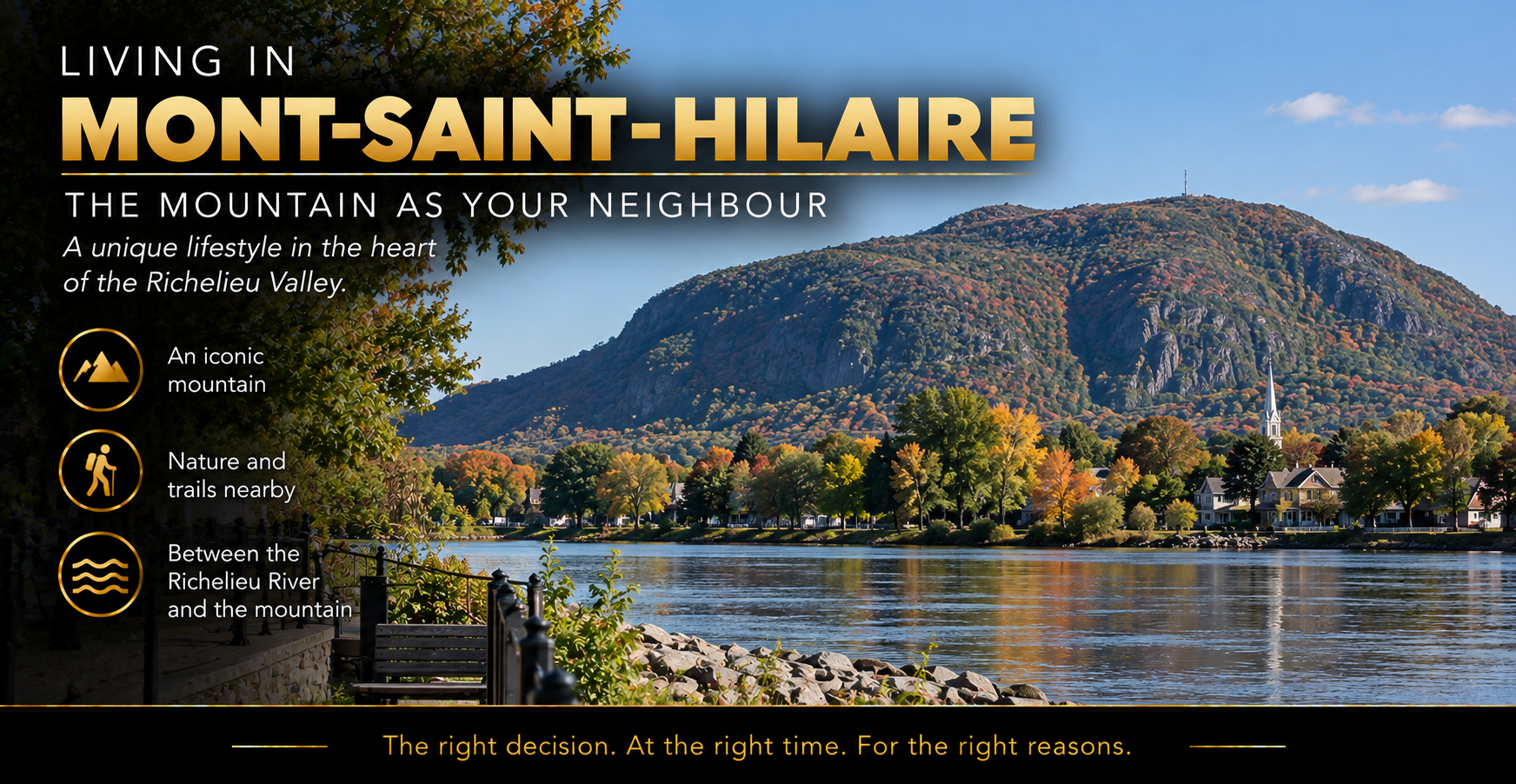
Living in Mont-Saint-Hilaire: Real Estate, Transportation, Nature and Quality of Life
You find a house in Mont-Saint-Hilaire.
The mountain rises behind the neighbourhood.
There are mature trees around you.
The street feels quieter than what you are used to.
Maybe this is exactly why you started looking here.
But before asking:
“Is Mont-Saint-Hilaire a good place to live?”
ask something more useful:
“Does this particular property actually give me the life I am moving to Mont-Saint-Hilaire for?”
Because you are not buying the mountain.
You are buying an address.
A house or condo.
A street.
A lot.
A commute.
An environment.
Maintenance responsibilities.
And the compromises that come with that location.
Mont-Saint-Hilaire has an identity that is genuinely difficult to separate from its landscape.
But a beautiful municipality does not automatically make every property within it a good purchase.
Understand the location. Then analyze the property.
Why Do People Consider Living in Mont-Saint-Hilaire?
For many buyers, the answer starts with one thing.
The mountain.
Mont Saint-Hilaire is not simply a scenic backdrop carrying the same name as the municipality.
The mountain and surrounding natural environment are fundamental parts of the area's identity.
The UNESCO Mont Saint-Hilaire Biosphere Reserve has been recognized since 1978. UNESCO describes the mountain as one of Quebec’s remaining areas of old-growth deciduous forest and notes the presence of numerous rare and endangered species.
That creates a very different setting from choosing a more urbanized part of Greater Montreal.
But “close to nature” can mean completely different things to different buyers.
One person wants hiking trails.
Another wants mature trees outside the kitchen window.
Someone else wants a larger lot.
Another simply wants more separation from dense urban development.
Before paying for what Mont-Saint-Hilaire represents to you, determine whether the property actually delivers it.
Do not buy the idea of Mont-Saint-Hilaire. Buy the address that gives you the parts of Mont-Saint-Hilaire you actually want.
For a buyer comparing Mont-Saint-Hilaire, Beloeil, McMasterville and Saint-Bruno-de-Montarville, the natural environment may be one of the first differences that attracts attention. But the specific street, lot and daily commute will determine how much that difference actually matters once you live there.
The Mountain Is More Than an Attraction
In many city guides, the local attraction is mostly tourism content.
Mont Saint-Hilaire is different.
The mountain helps define the landscape, conservation priorities and identity of the area.
Its protected natural environments include mature forests and habitat for numerous plant and animal species.
For residents who genuinely use the trails or simply value living near protected nature, that can have real quality-of-life value.
But proximity should still be examined practically.
Ask yourself:
-
How often will I actually use the mountain?
-
How far is this property from the places I want to access?
-
Does this street give me the natural environment I am expecting?
-
Am I comfortable with the characteristics of this particular lot?
-
Does the property actually have the view or surroundings that attracted me?
-
Are there environmental, topographical or municipal constraints relevant to this address?
A mountain view can be beautiful.
It does not replace due diligence.
What Is the Real Estate Market Like in Mont-Saint-Hilaire?
Mont-Saint-Hilaire offers different types of residential properties, including single-family homes, condominiums and other housing options.
You may search:
“Mont-Saint-Hilaire house prices”
or:
“Average home price in Mont-Saint-Hilaire.”
Those statistics can provide useful market context.
But they should remain context.
Prices change.
Inventory changes.
Interest rates change.
The mix of properties sold changes.
Most importantly, a municipal median does not tell you what one specific house should be worth.
Property value can be influenced by:
-
the precise location;
-
lot size and characteristics;
-
living area;
-
age;
-
condition;
-
renovations;
-
garage;
-
basement;
-
configuration;
-
views and surroundings;
-
proximity to transportation and services;
-
recent comparable sales.
A municipal median is not an appraisal of your house.
When you are preparing to buy, analyze the property against genuinely comparable recent transactions.
Buying Near the Mountain Requires Looking Beyond the View
This is where Mont-Saint-Hilaire deserves more property-specific analysis than a generic “beautiful place to live” article might suggest.
Trees.
Elevation.
Views.
Natural surroundings.
These may be exactly what attracts you to a property.
They can also make it particularly important to understand the physical characteristics of the lot.
Depending on the address, questions may include:
-
How does water move across the property?
-
How is the land graded around the house?
-
Are there retaining structures?
-
What is the condition and location of mature trees?
-
Are there easements or servitudes?
-
Are there environmental or municipal restrictions affecting the property?
-
Are there drainage considerations?
-
What renovations or additions would actually be permitted?
The City of Mont-Saint-Hilaire zoning information is particularly relevant here. Municipal zoning documentation includes information dealing with landslide and rockfall risk areas, flood zones, conservation woodlands and other particular zones.
That does not mean every property near the mountain is affected by one of these constraints.
It means you should verify the specific property rather than assume.
The more you love the surroundings, the more important it becomes to understand them.
For a property in Mont-Saint-Hilaire, these lot-specific questions can also make the comparison with Beloeil or McMasterville more meaningful. Two homes at a similar price can involve very different terrain, surroundings and future maintenance.
And once you understand the lot, you still need to understand the building. My guide to pre-purchase home inspections in Quebec explains what an inspection can help you understand before the property’s problems potentially become your responsibility.
Is Mont-Saint-Hilaire a Good Place for Families?
Mont-Saint-Hilaire can offer characteristics many families value.
But “family-friendly” is too broad to make a housing decision.
A family with toddlers may prioritize daycare, parks and elementary school.
A family with teenagers may care much more about transportation, activities, independence and travel time.
Instead of asking whether Mont-Saint-Hilaire is generally good for families, ask:
-
Which school serves this address?
-
How will the children get there?
-
Where are their activities?
-
How much driving will the household require?
-
Can the children eventually reach certain destinations independently?
-
Does the property have the space you will need later?
-
Does the street work with the routine your family actually has?
The municipality also has nearly 30 public parks distributed throughout different parts of the city, but once again, the important question for a buyer is which facilities are actually useful from the address being considered.
A municipality can suit many families without every address being right for yours.
For a family comparing Mont-Saint-Hilaire with Beloeil or Saint-Bruno-de-Montarville, the practical difference may come down to the school serving the property, the location of regular activities and how much driving the household will actually need to do.
How Is the Commute From Mont-Saint-Hilaire to Montréal?
This deserves serious attention before buying.
Mont-Saint-Hilaire has an exo commuter rail station on the Mont-Saint-Hilaire line connecting the area with Gare Centrale in downtown Montréal.
Exo currently indicates an approximate train travel time of 50 minutes between Mont-Saint-Hilaire and Gare Centrale.
Current train service is offered Monday through Friday, with no train service on Saturday or Sunday.
Schedules and service can change, so verify the current schedule if the train is an important part of your buying decision.
But even 50 minutes does not represent your full commute.
Your commute begins at your front door.
It can include:
-
driving or walking to the station;
-
parking;
-
waiting;
-
the train ride;
-
walking or taking another form of transportation after arriving in Montréal;
-
doing everything again on the way home.
Your destination matters enormously.
Working near Gare Centrale is one scenario.
Working in Saint-Laurent is another.
Brossard is another.
The West Island is another.
A hybrid work schedule changes the calculation again.
Do not buy a theoretical commute. Test the one you are actually going to live with.
For someone working in Saint-Laurent, the commute from Mont-Saint-Hilaire may need to be evaluated very differently from the commute of someone working in Brossard or Longueuil. The destination matters just as much as the municipality you are leaving from.
Can You Live in Mont-Saint-Hilaire Without Depending Heavily on a Car?
That depends on your address and your routine.
Having commuter rail service does not automatically make every property convenient without a vehicle.
Look at your entire week.
How will you:
-
get to work?
-
buy groceries?
-
bring children to activities?
-
attend appointments?
-
visit friends and family?
-
handle evenings and weekends?
-
reach the train station?
A household with one remote worker may evaluate the same address very differently from two adults commuting in different directions every day.
Your transportation pattern matters more than somebody else's livability score.
What Should You Know About Safety?
I would not choose a property based on a broad statement such as “Mont-Saint-Hilaire is safe” without looking at current and relevant information.
Safety is more specific than a municipal reputation.
If this is important to you, examine current information from appropriate public authorities and investigate the exact area you are considering.
Then visit it yourself.
During the day.
After dark.
Walk the street.
Look at traffic.
Observe lighting.
Understand what is nearby.
Evaluate the environment you are actually buying, not simply the reputation attached to the municipality.
What Can Online Discussions Tell You About Mont-Saint-Hilaire?
Online forums and community discussions can be useful.
Residents may raise things a municipal website or real estate listing never mentions.
Traffic.
Train reliability.
Winter driving.
A particular intersection.
Restaurants.
Schools.
Hiking.
Construction.
Or simply what they personally enjoy and dislike about living there.
That can be valuable.
But there is an important distinction:
A forum is a source of questions. Not proof.
Use community experiences to discover what you should investigate.
Then verify factual issues involving zoning, infrastructure, transportation, municipal projects or a particular property with the appropriate source.
Mont-Saint-Hilaire or Beloeil?
This is one of the most natural comparisons for buyers searching the area.
The municipalities are neighbours.
But choosing between them should not become a contest over which one is “better.”
Compare actual properties instead.
Perhaps one address gives you better access to the services you use.
Another gives you the lot you want.
Another reduces your commute.
Another puts you closer to the natural environment you value.
And the same budget may buy something quite different in each municipality.
Ask:
“What does my budget buy in Mont-Saint-Hilaire versus Beloeil, and how would my daily life change?”
That is much more useful than comparing municipal reputations.
Mont-Saint-Hilaire or Saint-Bruno-de-Montarville?
This comparison can be particularly interesting for buyers who want access to nature while still considering their connection to Greater Montreal.
The searches may begin with similar priorities.
Trees.
Outdoor activities.
Residential neighbourhoods.
Access to services.
But the geography is different.
Your workplace may make one location significantly more practical.
The type of property available within your budget may also differ.
If you work downtown, in Saint-Laurent, Longueuil or Brossard, test the commute from the actual properties you are considering.
A municipality should fit into your life. Your life should not have to reorganize itself around the municipality.
Mont-Saint-Hilaire or McMasterville?
McMasterville is another comparison worth making because of its proximity.
A municipal boundary should not prevent you from considering a property that better satisfies your criteria.
Compare:
-
purchase price;
-
property type;
-
lot;
-
condition;
-
commute;
-
access to the train;
-
schools when relevant;
-
services;
-
future maintenance;
-
neighbourhood environment.
A property a few minutes away may solve a compromise you were about to accept simply because your original search filter said “Mont-Saint-Hilaire.”
Choose your criteria before choosing your postal code.
Is Mont-Saint-Hilaire Affordable Compared With Montréal?
There is no useful universal answer.
It depends entirely on what you compare.
A Montréal condo and a detached home in Mont-Saint-Hilaire are fundamentally different purchases.
Even when two properties have similar prices, their total costs can differ because of:
-
taxes;
-
transportation;
-
maintenance;
-
energy;
-
renovations;
-
insurance;
-
condominium fees;
-
the number of vehicles your household requires.
Moving farther from Montréal may give you access to a different type of property.
That does not automatically make your overall lifestyle less expensive.
Compare total ownership and transportation costs. Not simply asking prices.
For someone comparing Mont-Saint-Hilaire with Saint-Bruno-de-Montarville or a property closer to Montréal, transportation costs and the number of vehicles required can materially change the financial comparison even when the purchase prices appear similar.
Is Mont-Saint-Hilaire a Good Place to Invest in Real Estate?
The municipality's natural setting and residential appeal do not automatically make every property a good investment.
Analyze the asset itself.
Consider:
-
acquisition price;
-
financing;
-
expected income;
-
operating expenses;
-
taxes;
-
maintenance;
-
vacancy assumptions;
-
applicable rental rules;
-
property condition;
-
exit strategy;
-
realistic comparable properties.
Do not build an investment case around:
“Mont-Saint-Hilaire is desirable, so values will rise.”
That is not an investment analysis.
Instead ask:
“Does this property work at this price under realistic assumptions?”
The municipality provides context.
The numbers determine whether the property fits your strategy.
Thinking About Selling a Home in Mont-Saint-Hilaire?
The mountain, natural environment and identity of the municipality can influence buyer interest.
They do not determine the value of your property by themselves.
Suppose another home nearby sells for an impressive price.
Before applying that result to your house, determine whether it is genuinely comparable.
Consider:
-
exact location;
-
lot;
-
view;
-
size;
-
condition;
-
renovations;
-
garage;
-
basement;
-
architecture;
-
proximity to the mountain or services;
-
competing properties;
-
recent comparable sales.
Then ask one of the most important pricing questions:
At my asking price, what else can the buyer purchase?
Your property is not competing against a municipal average.
It is competing against real alternatives available to buyers with a similar budget.
For a seller in Mont-Saint-Hilaire, those alternatives may include properties in Beloeil, McMasterville or Saint-Bruno-de-Montarville, depending on the buyer’s budget, commute and priorities.
That is the same principle I explain in my guide to pricing your home to sell in Quebec.
What Should You Check Before Buying a House in Mont-Saint-Hilaire?
Beyond the legal and building due diligence appropriate to any Quebec real estate purchase, pay particular attention to the characteristics that attracted you to the property.
If you love the lot, understand it.
If you love the view, understand what surrounds it.
If you love the trees, understand their condition and location.
If you love the quiet street, visit it at different times.
If you are relying on the train, test the entire trip.
If proximity to the mountain matters, determine how often you will actually use it.
There is a simple principle behind all of this:
The features that make you emotional about a property deserve the most rational verification.
10 Questions to Ask Before Moving to Mont-Saint-Hilaire
Before making an offer, ask yourself:
-
Does the exact address give me the natural environment I am expecting?
-
What will my real commute look like on a normal workday?
-
How dependent will my household be on one or more cars?
-
Do I understand the terrain and physical characteristics of the property?
-
Are there municipal, environmental or property-specific restrictions I need to investigate?
-
Does the street work for my family's actual routine?
-
Is the asking price supported by genuinely comparable properties?
-
What maintenance or renovations should I expect?
-
Would Beloeil, McMasterville or another nearby municipality solve one of my major compromises?
-
Will this property still work if my job, family or transportation needs change?
That last question is easy to ignore.
It should not be.
A house can remain in the same place for decades.
Your life probably will not.
So, Is Mont-Saint-Hilaire a Good Place to Live?
Mont-Saint-Hilaire offers a combination that is genuinely distinctive.
The mountain.
Protected natural environments.
Established residential areas.
The Richelieu Valley.
A commuter rail connection to downtown Montréal.
And a lifestyle that can feel distinctly removed from denser parts of the metropolitan region.
But none of those things makes every property a good decision.
Go there.
Walk the street.
Look at the mountain from the actual property.
Test your commute.
Understand the lot.
Compare Mont-Saint-Hilaire with Beloeil, McMasterville, Saint-Bruno-de-Montarville and other municipalities that fit your criteria.
Understand what you gain.
Understand what you give up.
And most importantly:
Choose an address, not simply the name of a city.
Because the right home is not the property that best represents Mont-Saint-Hilaire in a photograph.
It is the property that works with your finances, your routine and the life you actually want to live.
Understand First. Advise Second.
The right decision. At the right time... For the right reasons.
Jonathan Cabana
Residential and Commercial Real Estate Broker
eXp Québec
Greater Montreal | South Shore
(514) 476-0730