
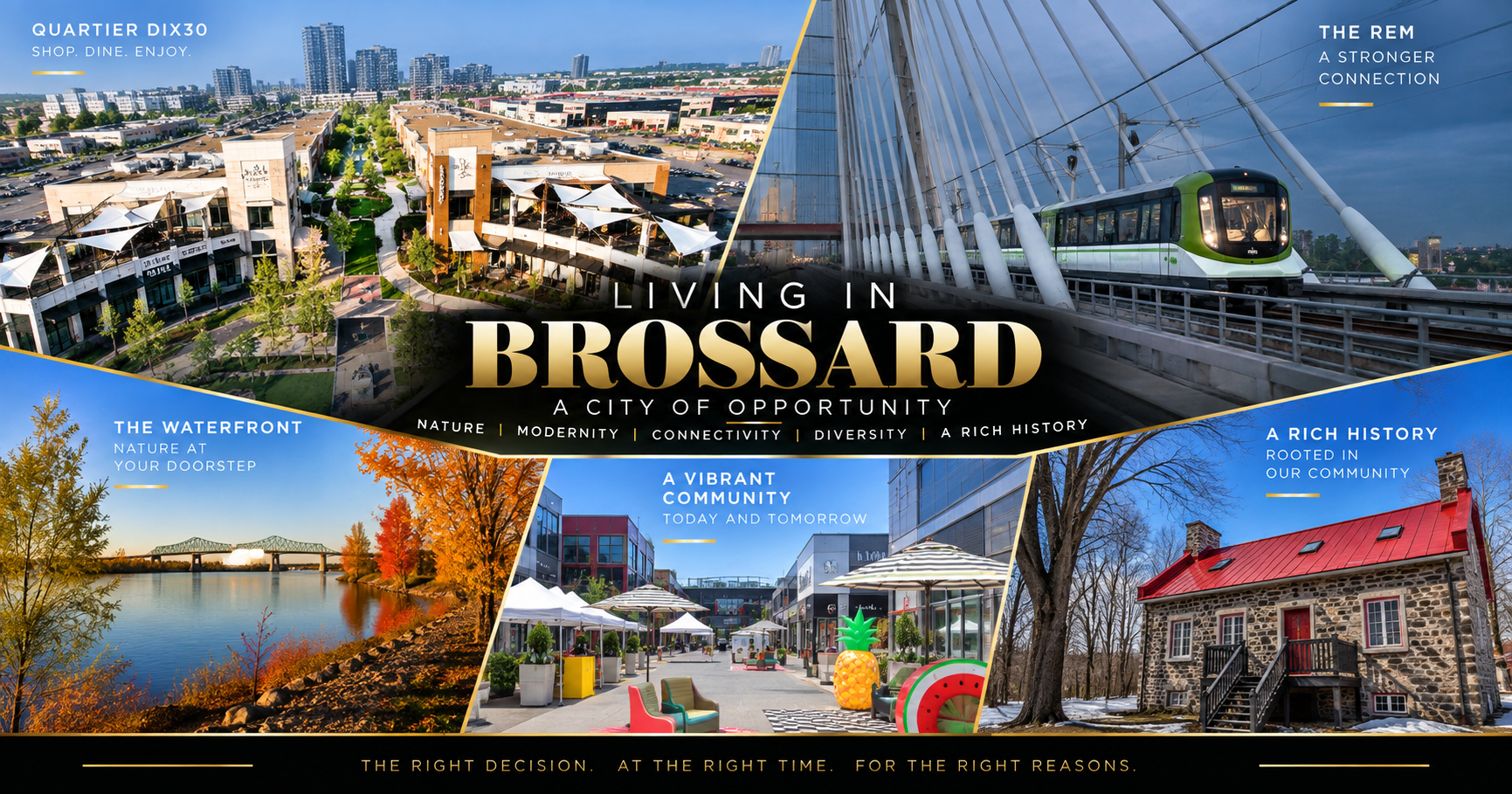
Living in Brossard on Montreal’s South Shore: Real Estate, REM, Neighbourhoods and Quality of Life
You are considering buying a property in Brossard.
Maybe the REM is part of the attraction.
Maybe you work in Montreal.
Maybe you want a house on the South Shore while remaining close to major transportation routes.
Or maybe you are considering a condo near Quartier DIX30.
All of those reasons can lead you to Brossard.
But they do not necessarily lead you to the same part of the city.
Because Brossard has several different faces.
Established residential streets with single-family homes.
Older areas with mature trees.
Condos.
Townhouses.
Newer residential developments.
A much more urban environment around Quartier DIX30.
Three REM stations.
Residential and commercial towers.
Taschereau Boulevard.
Highway 10.
And different ways of reaching Montreal and the rest of the South Shore.
Within a few kilometres, your experience of living in Brossard can change considerably.
That is why the right question is not simply:
“Is Brossard a good place to live?”
A much more useful question is:
“Does this particular property in Brossard actually work with my life?”
Because you are not simply buying Brossard.
You are buying an address.
A property.
A street.
A commute.
An environment.
Costs.
And the compromises that come with all of them.
Understand what attracts you to Brossard. Then determine whether the address actually gives it to you.
Why do buyers consider living in Brossard?
Brossard occupies a distinctive position on Montreal’s South Shore.
The city is immediately south of Montreal and provides access to several important destinations across the metropolitan region.
But geographic proximity is only part of the equation.
Buyers may consider Brossard because they are looking for:
-
a single-family home;
-
a condo;
-
an established residential area;
-
newer construction;
-
access to the REM;
-
proximity to Montreal;
-
proximity to Quartier DIX30;
-
shops and services;
-
access to major roads;
-
a practical location for different South Shore destinations.
Brossard is also highly multicultural.
That diversity is an important part of the city’s identity.
But diversity, Quartier DIX30 and the REM cannot tell you whether a particular property is right for you.
Do not simply identify the advantages of Brossard. Determine which ones actually matter in your daily life.
For a buyer comparing Brossard, Longueuil, Saint-Lambert and La Prairie, differences in property type, transportation, lot size and daily routine can quickly become more important than the municipality name.
Established Brossard and modern Brossard can offer two very different experiences
This is one of the more interesting characteristics of Brossard.
Some residential areas were established long before the arrival of the REM and the development of Quartier DIX30.
You can find single-family homes from different periods, mature streets and residential environments that can feel very different from newer developments.
Elsewhere, Brossard presents a much more modern face.
Residential towers.
Newer condos.
Shops.
Restaurants.
Offices.
Higher-density development.
REM stations.
New real estate projects.
These environments can exist in the same city while offering very different lifestyles.
One buyer may want a house and yard in an established residential area.
Another may prefer a condo near the REM and shopping.
Someone else may be looking for a compromise between the two.
Do not simply decide whether you want Brossard. Determine which version of Brossard fits your life.
The REM changed how buyers should analyze a property in Brossard
Brossard has three Réseau express métropolitain stations:
-
Panama;
-
Du Quartier;
-
Brossard.
The Réseau express métropolitain identifies these three South Shore stations in Brossard.
That represents an important change in how people can move through the city and the metropolitan region.
But for a real estate buyer, saying “Brossard has the REM” is not enough.
Instead, ask:
Which station would I actually use from this property?
Then ask:
-
How would I get there?
-
On foot?
-
By bicycle?
-
By bus?
-
By car?
-
How long would it take from my front door to the station?
-
What happens when I come home late?
-
Does the trip still work on weekends?
-
Is my actual destination convenient once I leave the REM?
Two properties in Brossard can have completely different relationships with the REM.
Having a station somewhere in the city does not mean every address benefits from transit in the same way.
For someone working in Saint-Laurent, for example, the station accessible from the property and the connections required can matter much more than they would for someone working in Brossard or Longueuil.
Panama, Du Quartier or Brossard: why the station matters
The three stations are not interchangeable.
Panama is integrated with an important public transit environment and bus connections. The REM currently identifies a 30-platform bus terminal serving RTL and exo routes at Panama. See Panama station access information.
Du Quartier is directly connected to the environment surrounding Quartier DIX30 and nearby residential development.
Brossard station is farther south and also serves as an important transportation hub.
For a buyer, this means it is no longer enough to ask:
“Am I close to the REM?”
Ask:
“How does this particular station fit into my week?”
That distinction matters.
Is living near Quartier DIX30 right for everyone?
No.
Quartier DIX30 provides a major concentration of shops, restaurants, entertainment and services.
For some households, that proximity can be extremely practical.
For others, it may have considerably less value.
Ask yourself:
-
How often would I actually use these businesses?
-
Can I reach them conveniently from the property?
-
Do I want a more urban or more residential environment?
-
What is traffic like around my address when I actually travel?
-
Does proximity to Du Quartier REM station materially improve my routine?
-
Am I paying for proximity that I will actually use?
Having a major commercial destination a few kilometres away is not automatically the same as having services that are convenient in your daily routine.
Theoretical proximity and practical convenience are not the same thing.
Do all parts of Brossard offer the same experience?
No.
That is one of the easiest mistakes to make when searching for a home in Brossard.
Depending on the address, you may find:
-
homes from different periods;
-
streets with mature trees;
-
different lot sizes;
-
condos;
-
townhouses;
-
denser environments;
-
newer residential projects;
-
areas that are more dependent on driving;
-
addresses that are much better connected to public transit.
The name “Brossard” does not tell you what your daily life will look like.
You choose Brossard once. You live your address every day.
A property in an established part of Brossard can therefore offer a very different experience from a condo near the REM, but also from a house in Saint-Lambert, Longueuil or La Prairie available within a comparable budget.
How should you analyze the Brossard real estate market?
Buyers naturally search for the average or median home price in Brossard.
Those statistics can provide market context.
They cannot determine the value of a specific property.
A single-family home in an established residential area and a newer condo near the REM may both be in Brossard.
That does not make them comparable properties.
When analyzing a price, consider:
-
property type;
-
specific area;
-
age;
-
living area;
-
lot;
-
condition;
-
renovations;
-
parking;
-
garage;
-
basement;
-
actual access to transportation;
-
recent comparable sales.
A municipal median describes a market. It does not appraise your house.
Comparable properties bring the analysis back to the actual home.
House or condo in Brossard?
This decision can completely change your budget and responsibilities.
With a house, you may be directly responsible for:
-
the roof;
-
foundation;
-
windows;
-
drainage;
-
lot;
-
landscaping;
-
mechanical systems;
-
general maintenance.
With a condo, some responsibilities become collective.
But that creates a different set of questions.
Review:
-
condo fees;
-
contingency fund;
-
contingency fund study;
-
financial statements;
-
insurance;
-
meeting minutes;
-
planned work;
-
rules;
-
possible special assessments.
A condo with a lower purchase price is not automatically less expensive to own.
A more expensive house is not automatically the worse financial choice.
Compare total cost and responsibility. Not just the asking price.
Established neighbourhood or newer development?
Brossard gives buyers access to both.
In an established residential area, you may value:
-
mature streets;
-
an already developed environment;
-
larger trees;
-
a clearer understanding of what surrounds the property;
-
certain home and lot configurations.
But an older property can also require additional investigation and maintenance.
Look carefully at:
-
foundation;
-
roof;
-
windows;
-
plumbing;
-
electrical systems;
-
insulation;
-
drainage;
-
renovations;
-
permits;
-
potential future work.
If an existing property is part of your search, my guide to pre-purchase home inspections in Quebec explains what an inspection can help you understand before those responsibilities become yours.
In a newer development, examine:
-
construction quality;
-
applicable warranties;
-
drainage;
-
lot configuration;
-
condo fees, when applicable;
-
taxes;
-
future phases;
-
nearby vacant land;
-
future traffic;
-
services that actually exist today.
Do not analyze only the neighbourhood that exists today. Try to understand the one that could exist tomorrow.
For a buyer comparing newer development in Brossard with a more established property in Saint-Lambert or Longueuil, that difference can become just as important as the purchase price itself.
Is Brossard a good fit for families?
Avoid the easy answer that Brossard is simply “family-friendly.”
A family does not buy a municipal reputation.
It buys a daily routine.
For a specific property, verify:
-
the school serving the exact address;
-
travel to and from school;
-
daycare logistics;
-
activities;
-
parks you would actually use;
-
space inside the property;
-
storage;
-
yard space;
-
trips to see family;
-
how independently children may be able to travel as they get older.
One property may provide plenty of space while creating a complicated week.
Another may be smaller but simplify transportation considerably.
A municipality can work for many families without every address working for yours.
For a family comparing Brossard with Longueuil, Saint-Lambert or La Prairie, the school serving the address, children’s activities and the transportation required each week may matter more than the municipality itself.
Can you live in Brossard with one car?
It depends entirely on your address and routine.
The REM can change the equation.
The RTL can too.
But the existence of public transit does not automatically mean a household can eliminate a vehicle.
Map a normal week:
-
work;
-
school;
-
daycare;
-
groceries;
-
appointments;
-
sports;
-
family;
-
social activities;
-
evening trips.
Then ask:
What happens when two people need to be in different places at the same time?
That question often reveals your actual level of car dependence.
If a particular property means your household needs a second vehicle, include that cost when comparing homes.
What is the real commute between Brossard and Montreal?
There is no single commute between Brossard and Montreal.
Everything depends on where you start and where you are going.
You may work:
-
in downtown Montreal;
-
in Saint-Laurent;
-
in the West Island;
-
in Longueuil;
-
elsewhere on the South Shore;
-
in Brossard itself.
You may also work on a hybrid schedule.
Analyze your trip door-to-door.
If you use public transit, include:
-
the trip to the station or bus stop;
-
waiting;
-
transfers;
-
the REM;
-
the final portion of the trip;
-
the evening return.
If you drive, test the route during the hours when you will actually use it.
Do not buy a theoretical commute. Test the one you are actually going to live with.
For someone working in Saint-Laurent, the commute from Brossard should therefore be evaluated very differently from the commute of someone working in downtown Montreal, Longueuil or Brossard itself.
Is proximity to Montreal always an advantage?
Not necessarily.
It can be extremely important for someone who travels into Montreal regularly.
It may matter much less to someone who works in Brossard, Longueuil or elsewhere on the South Shore.
Ask yourself:
“If Montreal were not my main criterion, what would still make me choose this property?”
The answer might be:
The type of house.
The neighbourhood.
The lot.
The REM.
The shops and services.
Proximity to family.
Or something else entirely.
The important thing is knowing what you are actually buying.
Brossard or Longueuil?
This comparison comes up frequently because both cities offer many real estate options on the South Shore.
But Longueuil covers a large territory and can provide very different residential experiences across Vieux-Longueuil, Saint-Hubert and Greenfield Park.
Brossard has its own combination of established areas, newer development, Quartier DIX30 and REM stations.
Compare:
-
actual properties within your budget;
-
age;
-
lot;
-
condition;
-
transportation;
-
commute;
-
services;
-
ownership costs;
-
maintenance;
-
future needs.
For the other side of this comparison, my guide to living in Longueuil on Montreal’s South Shore looks at Vieux-Longueuil, Saint-Hubert and Greenfield Park individually.
Do not compare two city names. Compare two possible lives.
Brossard or Saint-Lambert?
Saint-Lambert offers an established residential environment, mature streets, varied architecture and a distinctive local commercial core.
Brossard offers a different combination of properties, development and transportation infrastructure.
Your choice may depend on property type, budget, lot, transportation and your daily destinations.
My guide to living in Saint-Lambert on Montreal’s South Shore examines its mature housing stock, Victoria Avenue, transportation and some of the responsibilities that can come with older properties.
Ask:
“What does my budget actually buy in each municipality?”
Then compare the responsibilities and compromises attached to those properties.
Brossard or La Prairie?
La Prairie may also enter the search for someone considering Brossard.
Again, there is no need to declare a winning municipality.
Compare:
-
property;
-
budget;
-
lot;
-
age;
-
transit access;
-
actual distance to your destinations;
-
maintenance;
-
services;
-
ownership costs;
-
long-term needs.
For a closer look at that alternative, my guide to living in La Prairie on Montreal’s South Shore examines Old La Prairie, its residential environments, transportation and its relationship with Brossard.
For some buyers, immediate access to certain Brossard infrastructure will have considerable value.
For others, a different property in La Prairie may better satisfy their priorities.
Choose your criteria before choosing your postal code.
Is Brossard more affordable than Montreal?
This question cannot be answered properly with a universal yes or no.
Montreal contains very different real estate markets.
So does Brossard.
Instead, compare equivalent options.
For example:
A condo in Brossard and the Montreal condo you are actually considering.
Or a house in Brossard and a Montreal property that could meet the same household needs.
Then include:
-
financing;
-
taxes;
-
insurance;
-
heating and electricity;
-
maintenance;
-
condo fees;
-
renovations;
-
transportation;
-
number of vehicles.
For someone working in Saint-Laurent, transportation costs and commuting time can therefore materially change the comparison with a property located directly in Montreal.
Affordability is not simply the asking price. It is what the property does to your actual budget.
Is Brossard worth considering for real estate investment?
Proximity to Montreal, the REM and urban development can attract investor attention.
They do not guarantee property performance.
Analyze:
-
acquisition price;
-
financing;
-
realistic revenue;
-
expenses;
-
taxes;
-
condo fees;
-
maintenance;
-
applicable rules;
-
rental competition;
-
location;
-
exit strategy.
A condo near a REM station and a house in an established residential area do not represent the same investment strategy.
The municipality provides context. The numbers have to support the strategy.
Thinking about selling a property in Brossard?
For a seller, the city name alone cannot determine value.
Buyers will compare your property with real alternatives.
Those may include:
-
the same area;
-
the same property type;
-
similar living area;
-
a comparable lot;
-
similar age;
-
comparable condition;
-
renovations;
-
garage;
-
parking;
-
REM access;
-
competing listings;
-
recent sales.
Ask:
“At my asking price, what else can this buyer purchase in Brossard or nearby municipalities?”
Your property is not competing with a statistical average.
It is competing with real options.
In Brossard, that can also mean a buyer comparing your property with a house or condo in Longueuil, Saint-Lambert or La Prairie, depending on their budget, commute and preferred property type.
That is the same principle I explain in my guide to pricing your home to sell in Quebec.
What should you check before buying in Brossard?
Before making an offer, analyze:
-
the property;
-
street;
-
specific area;
-
lot;
-
age of the building;
-
renovations;
-
ownership costs;
-
the REM station you would actually use;
-
other transportation options;
-
services;
-
schools when relevant;
-
future development;
-
applicable restrictions;
-
comparable sales.
Then test the life attached to the address.
Visit in the morning.
Return during rush hour.
Visit in the evening.
Try your commute.
Use the REM if it is part of your plan.
Make the trip to Quartier DIX30 if its proximity is part of your buying decision.
Go to the grocery store you would actually use.
Theoretical advantages become useful only when they work from your address.
10 questions to ask before moving to Brossard
Before buying, ask yourself:
-
Why do I want to live in Brossard?
-
Does this address actually give me what I am looking for?
-
Do I want a house, condo or another property configuration?
-
Which REM station would I actually use?
-
What is my real door-to-door commute?
-
How many vehicles will our household actually need?
-
What maintenance and responsibilities come with this property?
-
Is the asking price supported by true comparable properties?
-
Would Longueuil, Saint-Lambert, La Prairie or another South Shore municipality eliminate an important compromise?
-
Would this address still work if my job, family or transportation needs changed?
That last question matters.
Because a property does not move.
Your life does.
So, is living in Brossard a good idea?
Brossard has several characteristics that can matter in a real estate decision.
Established residential areas.
Newer developments.
Houses.
Condos.
Quartier DIX30.
Three REM stations.
Shops and services.
Proximity to Montreal and other important parts of the South Shore.
But none of those features is enough on its own.
Start with your daily life.
Your budget.
Your property requirements.
Your commute.
Your actual transportation needs.
Your tolerance for maintenance.
Your future plans.
Then compare.
If Longueuil, Saint-Lambert or La Prairie is also on your shortlist, compare the same budget and daily routine using my guides to Longueuil, Saint-Lambert and La Prairie.
Compare Montreal as well when proximity to work and transportation costs are part of your decision.
Choose an address, not simply the name of a city.
Because the REM can change a commute.
Quartier DIX30 can simplify certain routines.
An established residential area may provide the type of property you want.
But the address determines how all of those elements work together in your life.
The right decision. At the right time... For the right reasons.
Jonathan Cabana
Residential and Commercial Real Estate Broker
eXp Québec
Greater Montreal | South Shore
(514) 476-0730