
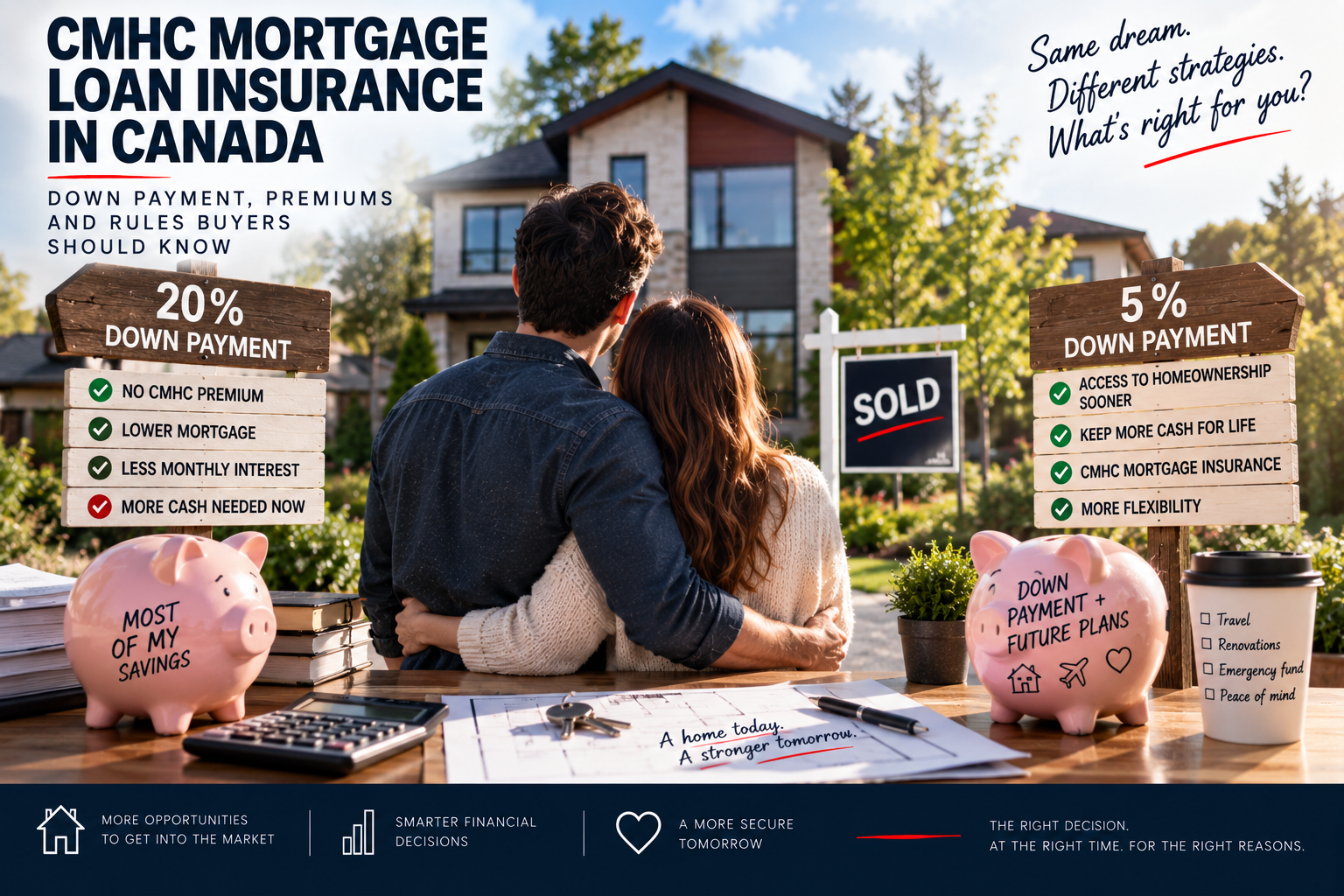
CMHC Mortgage Loan Insurance in Canada: Down Payment, Premiums and Rules Buyers Should Know
You find a property that fits what you are looking for.
The price seems realistic for your budget.
The financing looks possible.
Then your lender mentions mortgage loan insurance.
And a question comes up quickly:
“Why am I paying for insurance if it mainly protects the lender?”
That is probably the best place to start.
In Canada, when a buyer makes a down payment of less than 20% of the purchase price, the mortgage generally needs to be insured.
The Canada Mortgage and Housing Corporation, better known as CMHC, is one provider of this insurance.
But there is an important distinction to understand immediately.
CMHC mortgage loan insurance primarily protects the lender against the risk of mortgage default.
It does not replace your home insurance.
It does not automatically pay your mortgage if you lose your job.
And it is not life or disability insurance.
For buyers, the main benefit is different.
Mortgage loan insurance can make it possible to purchase a property without first saving a 20% down payment.
That can substantially reduce the amount of money you need to accumulate before becoming a homeowner.
But that flexibility comes with a cost.
So the real question is not simply:
“Can I buy with less than 20% down?”
A better question is:
“What down payment allows me to buy while still being financially comfortable after the transaction?”
Because qualifying to buy and being comfortable once you own the property are not necessarily the same thing.
For a buyer in Saint-Laurent, for example, that distinction can become particularly important when the property price moves the required down payment into another calculation bracket.
What Is CMHC Mortgage Loan Insurance?
Mortgage loan insurance reduces the lender’s risk when a buyer finances a large percentage of a property’s value.
CMHC explains mortgage loan insurance for homebuyers, including the basic down-payment and eligibility requirements.
When insurance is required, your lender generally arranges it as part of the mortgage approval process.
You normally do not contact CMHC yourself to purchase an insurance policy.
And although people commonly use the term “CMHC insurance” to describe insured mortgages, CMHC is not the only mortgage insurer in Canada.
Private mortgage insurers also operate in the Canadian market.
Do You Need Mortgage Insurance With Less Than 20% Down?
Generally, yes.
When your down payment is less than 20% of the home’s purchase price, your mortgage will generally need mortgage loan insurance.
That does not necessarily mean CMHC will be the insurer.
The insurer can depend on your lender, mortgage product and application.
For buyers, the basic principle is simpler:
Less than 20% down generally means an insured mortgage.
And that insurance comes with a premium that should be included in your calculations before you make an offer.
What Is the Minimum Down Payment in Canada?
Your minimum down payment depends partly on the purchase price of the property.
The Financial Consumer Agency of Canada explains the current minimum down-payment requirements.
Homes priced at $500,000 or less
The minimum down payment is generally:
5% of the purchase price.
For a $450,000 property:
5% of $450,000 = $22,500
Your minimum down payment would therefore be $22,500.
Homes priced above $500,000 but below $1.5 million
The calculation changes.
The minimum down payment is generally:
-
5% of the first $500,000;
-
10% of the portion above $500,000.
Suppose you purchase a property for $800,000.
5% of the first $500,000 = $25,000
10% of the remaining $300,000 = $30,000
Total minimum down payment:
$55,000
This distinction matters because a buyer may assume that buying an $800,000 property simply requires 5% of the entire purchase price.
It does not.
To compare that calculation with your actual mortgage payment and the other costs of ownership, my guide to the mortgage calculator in Quebec goes beyond the down payment alone.
What Happens at $1.5 Million?
The maximum purchase price for a high-ratio insured mortgage is below $1.5 million.
For a home priced at $1.5 million or more, the minimum down payment is generally 20%, and standard high-ratio mortgage loan insurance is not available.
This becomes particularly important when your search is close to that threshold.
A relatively small increase in the purchase price can suddenly create a much larger cash requirement.
So this is not simply a technical mortgage rule.
It can directly affect your home search and the maximum price you should realistically consider.
In markets such as Saint-Laurent or Rosemont-La Petite-Patrie, where two properties meeting similar needs can fall on different sides of an important financing threshold, that difference is worth calculating before you make an offer.
How Is the CMHC Mortgage Insurance Premium Calculated?
The premium depends largely on the loan-to-value ratio, often abbreviated as LTV.
In simple terms:
The smaller your down payment, the larger the percentage of the property you need to finance.
And as the loan-to-value ratio increases, the insurance premium can increase as well.
For many standard owner-occupied mortgages, CMHC’s premium schedule includes rates such as:
| Loan-to-Value Ratio | Premium on Total Loan |
|---|---|
| 65% or less | 0.60% |
| 65.01% to 75% | 1.70% |
| 75.01% to 80% | 2.40% |
| 80.01% to 85% | 2.80% |
| 85.01% to 90% | 3.10% |
| 90.01% to 95% | 4.00% |
Your actual premium can depend on the mortgage structure, down-payment source, amortization and insurance product.
CMHC also provides an official mortgage loan insurance premium calculator.
Example: Buying a $500,000 Home With 5% Down
Suppose you purchase a property for:
$500,000
A 5% down payment would be:
$25,000
Your mortgage before the insurance premium would therefore be:
$475,000
You are financing 95% of the property’s purchase price.
Using a 4% premium:
$475,000 × 4% = $19,000
Your mortgage insurance premium would be approximately:
$19,000
That premium can generally be added to the mortgage.
Your financed amount could therefore increase from approximately:
$475,000
to:
$494,000
before considering other applicable costs.
That is why looking only at the down payment gives you an incomplete picture.
Your down payment determines how much you initially need to borrow. The insurance premium can then increase that mortgage balance.
Do You Have to Pay the CMHC Premium in Cash?
Not necessarily.
The mortgage insurance premium itself can generally be added to your mortgage.
You then repay it over time as part of the loan.
But if you are buying in Quebec, there is another cost you need to understand.
Quebec Buyers Also Need to Plan for Tax on the Insurance Premium
In Quebec, mortgage insurance premiums are subject to the provincial tax on insurance premiums.
The current rate is 9%.
For premiums paid after December 31, 2026, Quebec has announced that the rate will increase to 9.975%.
You can verify the current tax on insurance premiums with Revenu Québec.
The mortgage insurance premium itself can generally be added to the mortgage. The provincial tax on that premium, however, should be included in the cash you are preparing for the transaction.
Example of Quebec Tax on a $19,000 Premium
Using our previous example:
Mortgage insurance premium:
$19,000
At a 9% tax rate:
$19,000 × 9% = $1,710
That $1,710 is separate from the premium that may be added to the mortgage.
And it is exactly the type of expense that can surprise a buyer who prepared only for the minimum down payment.
Can an Insured Mortgage Have a 30-Year Amortization?
In certain situations, yes.
CMHC mortgage loan insurance can be available with an amortization period of up to 30 years for eligible first-time homebuyers or buyers purchasing a newly built home.
This is an important change from the older rule many buyers still remember.
CMHC’s mortgage calculator allows buyers to compare payments under different amortization periods and incorporates the current insured-mortgage rules.
A longer insured amortization can also affect the applicable insurance premium.
Is a 30-Year Amortization Automatically Better?
No.
A longer amortization can reduce your regular mortgage payment because repayment is spread over more years.
That can make the monthly payment easier to carry.
But it does not automatically make the property less expensive.
All else being equal, you generally repay the principal more slowly and can pay more interest over the full life of the mortgage.
So the question should not simply be:
“Can I get a 30-year amortization?”
It should be:
“Does a 30-year amortization genuinely improve my financial plan, or does it simply allow me to buy a more expensive property?”
Those are two very different things.
Does CMHC Insurance Protect the Buyer?
Not in the way many buyers initially assume.
Mortgage loan insurance primarily protects the lender if the borrower defaults.
It does not replace your home insurance.
It does not replace life insurance.
It does not replace disability insurance.
And it does not replace employment-loss protection.
You pay the premium because the insurance allows the lender to accept a mortgage with a higher loan-to-value ratio.
For you, that can make purchasing with less than 20% down possible.
Is It Better to Put 20% Down and Avoid CMHC Insurance?
Not automatically.
This is one of the more useful financial questions to analyze before buying.
Putting 20% down can allow you to avoid mortgage default insurance.
But it also requires significantly more cash.
Suppose you have saved exactly enough to make a 20% down payment.
Before putting nearly all of those savings into the property, ask yourself what will remain afterward.
You may still need money for:
-
Quebec’s land transfer tax, commonly called the welcome tax;
-
notary fees;
-
the building inspection;
-
moving expenses;
-
renovations;
-
furniture;
-
unexpected repairs;
-
an emergency fund.
If this is your first purchase, it is also worth understanding how programs such as the FHSA and Home Buyers’ Plan fit into your overall strategy. My guide to first-time home buyer programs in Canada explains the main federal and Quebec measures buyers should examine.
You could successfully avoid an insurance premium but leave yourself with very little financial flexibility once you own the home.
On the other hand, paying an insurance premium simply to keep a large amount of cash that you do not actually need is not automatically the best choice either.
The right down payment is not necessarily the amount that eliminates mortgage insurance.
It is the amount that works best within your overall financial situation.
For a buyer comparing, for example, a condo in Villeray with a house in Longueuil, the right down payment can therefore depend as much on the cash needed after the purchase as on the property’s asking price.
5%, 10%, 15% or 20% Down: What Are You Really Comparing?
When you compare different down payments, you are not simply comparing four percentages.
You are comparing different ways of structuring your purchase.
For each scenario, ask:
-
How much cash do I need upfront?
-
What mortgage insurance premium applies?
-
How much will I actually finance?
-
What will my mortgage payment be?
-
How much cash will remain after closing?
-
Will I still have an adequate emergency fund?
That is where the decision becomes much more meaningful.
Because the scenario with the largest down payment is not automatically the one that leaves you in the strongest financial position.
Can a Larger Down Payment Reduce Your CMHC Premium?
Yes.
Because the premium is tied to the loan-to-value ratio, increasing your down payment can move the mortgage into a lower premium bracket.
That can create an interesting opportunity.
Suppose a few thousand additional dollars in your down payment are enough to move you below a premium threshold.
The useful question becomes:
“How much more do I need to put down, and how much would that actually save me?”
That calculation is worth doing before your financing is finalized.
Is CMHC the Only Mortgage Insurer in Canada?
No.
Although “CMHC insurance” is commonly used as a general expression for mortgage default insurance, CMHC is not the only provider.
Private mortgage insurers also operate in Canada.
In many transactions, the buyer does not personally choose the insurer.
The lender may determine which insurer and product are appropriate for the application.
From your perspective, the important things to understand are:
-
the premium;
-
the required down payment;
-
the amortization period;
-
the eligibility requirements;
-
the mortgage payment;
-
the total amount financed;
-
the cash you will have left after buying.
Can You Buy a Duplex, Triplex or Fourplex With CMHC Insurance?
Certain owner-occupied properties with two to four units can qualify for CMHC mortgage loan insurance.
The requirements differ depending on the number of units and the applicable CMHC product.
Under current CMHC homeowner requirements, one- and two-unit owner-occupied properties can qualify for loan-to-value ratios of up to 95%, while three- and four-unit properties generally have a minimum equity requirement of 10%.
A duplex you plan to occupy yourself is therefore not necessarily treated the same way as a fully rental property.
If you are considering a duplex, triplex or fourplex, do not assume the rules for a single-family house apply in exactly the same way.
Have your lender or mortgage broker confirm the requirements for your specific scenario before establishing your purchase budget.
That distinction can be particularly relevant for a buyer comparing a duplex in Rosemont-La Petite-Patrie or Montreal North with a single-family home in Brossard or Saint-Lambert.
Why Is CMHC Approval Not Guaranteed?
Having enough money for the minimum down payment does not guarantee that the mortgage will be approved.
Your lender and insurer still need to evaluate the application.
That can include factors such as:
-
your income;
-
existing debts;
-
credit history;
-
financial stability;
-
source of the down payment;
-
purchase price;
-
the property itself;
-
debt-service ratios;
-
lender and insurer requirements.
This creates an important distinction between:
the maximum price a lender might approve
and
the price you should personally feel comfortable paying.
Those numbers can be very different.
Your Minimum Down Payment Is Not Your Real Home-Buying Budget
Suppose you have exactly the minimum down payment required for a property.
On paper, the financing may work.
But what remains in your bank account after the transaction?
Can you comfortably cover the welcome tax?
The notary?
The inspection?
Moving expenses?
Repairs shortly after possession?
An unexpected expense a month later?
This is how a property can be eligible for financing without being comfortable for your budget.
And that distinction is worth understanding before you start making offers.
My guide on renting versus buying a home in Quebec looks at this broader question, including the costs of ownership, equity, opportunity cost and the importance of keeping enough financial flexibility after buying.
CMHC Mortgage Insurance in Greater Montreal and the South Shore
The same federal mortgage insurance rules can apply whether you are buying in Saint-Laurent, Villeray, Rosemont-La Petite-Patrie, Anjou, Montreal North, Brossard, Saint-Lambert, Longueuil or Châteauguay.
But their impact can look very different depending on the price range you are considering.
Someone purchasing a condo in Montreal may face a very different down-payment calculation from a family comparing houses in Brossard, Saint-Lambert, Longueuil or Châteauguay.
And once the purchase price moves above $500,000, the minimum down-payment calculation changes.
As the price approaches $1.5 million, it becomes increasingly important to know exactly:
How much cash do you need?
How much of the mortgage will need to be insured?
And how much will you actually finance?
Questions to Ask Before Choosing Your Down Payment
Before deciding how much money to put down, I would want to answer a few practical questions.
How much money will remain in your accounts after the transaction?
Have you budgeted for the welcome tax and other purchase expenses?
Will the property need renovations soon?
Will you still have an emergency fund?
What would your mortgage payment look like with 5%, 10%, 15% or 20% down?
How much would the mortgage insurance premium cost under each scenario?
Are you eligible for a 30-year amortization?
And most importantly:
Which payment allows you to remain financially comfortable after becoming a homeowner?
Because being approved to purchase a home and being financially comfortable after purchasing it are not necessarily the same thing.
Once you have a realistic budget and financing structure, my guide on buying a home in Quebec explains the important steps that still need to happen between an accepted offer and receiving the keys.
The Bottom Line
CMHC mortgage loan insurance can make it possible to purchase a property without waiting until you have accumulated a 20% down payment.
But it has a cost.
Before making an offer, make sure you understand:
-
the minimum down payment for your purchase price;
-
the approximate mortgage insurance premium;
-
the Quebec tax applicable to the premium;
-
whether the premium itself can be financed;
-
whether you may qualify for a 30-year amortization;
-
the total mortgage after the premium is added;
-
the other cash you will need to complete the transaction;
-
the effect of the mortgage payment on your life after the purchase.
Do not stop at this question:
“Can I buy with 5% down?”
Ask this instead:
“Once I account for the down payment, insurance premium, purchase expenses and mortgage payment, is this home still comfortable for me?”
Because the goal should not simply be to qualify for the property.
It should be to continue living comfortably after you buy it.
The right decision. At the right time... For the right reasons.
Jonathan Cabana
Residential and Commercial Real Estate Broker
eXp Québec
Greater Montreal | South Shore
(514) 476-0730