
Living in Longueuil on Montreal’s South Shore: Best Areas, Real Estate, Transportation and Cost of Living
You decide to look for a home in Longueuil.
That sounds specific.
It really is not.
Longueuil can change dramatically within a relatively short distance.
Historic architecture and established streets in Vieux-Longueuil.
The urban environment surrounding the metro and central Longueuil.
Large residential sectors in Saint-Hubert.
The distinct environment of Greenfield Park.
Major parks and green spaces.
Condos.
Plexes.
Single-family homes.
Older properties.
Newer developments.
A property in one part of Longueuil can create a completely different daily life from a property in another.
Even within the same borough, changing streets can change the property type, lot, transportation options, services and commute.
That is why asking:
“What is the best neighbourhood in Longueuil?”
is usually the wrong starting point.
A better question is:
“Which part of Longueuil gives me the property, commute and daily life I actually want?”
Because you are not buying Longueuil.
You are buying an address.
A property.
A street.
A lot.
A commute.
A set of nearby services.
And the costs and compromises that come with all of them.
Understand the area first. Then analyze the property.
Why do buyers consider living in Longueuil?
One of Longueuil’s biggest characteristics is variety.
Depending on where you look, you may find:
-
older single-family homes;
-
condos;
-
plexes and other income properties;
-
established residential streets;
-
denser urban areas;
-
more suburban environments;
-
different lot sizes;
-
access to parks and recreation;
-
different transportation options;
-
different relationships with Montreal and the rest of the South Shore.
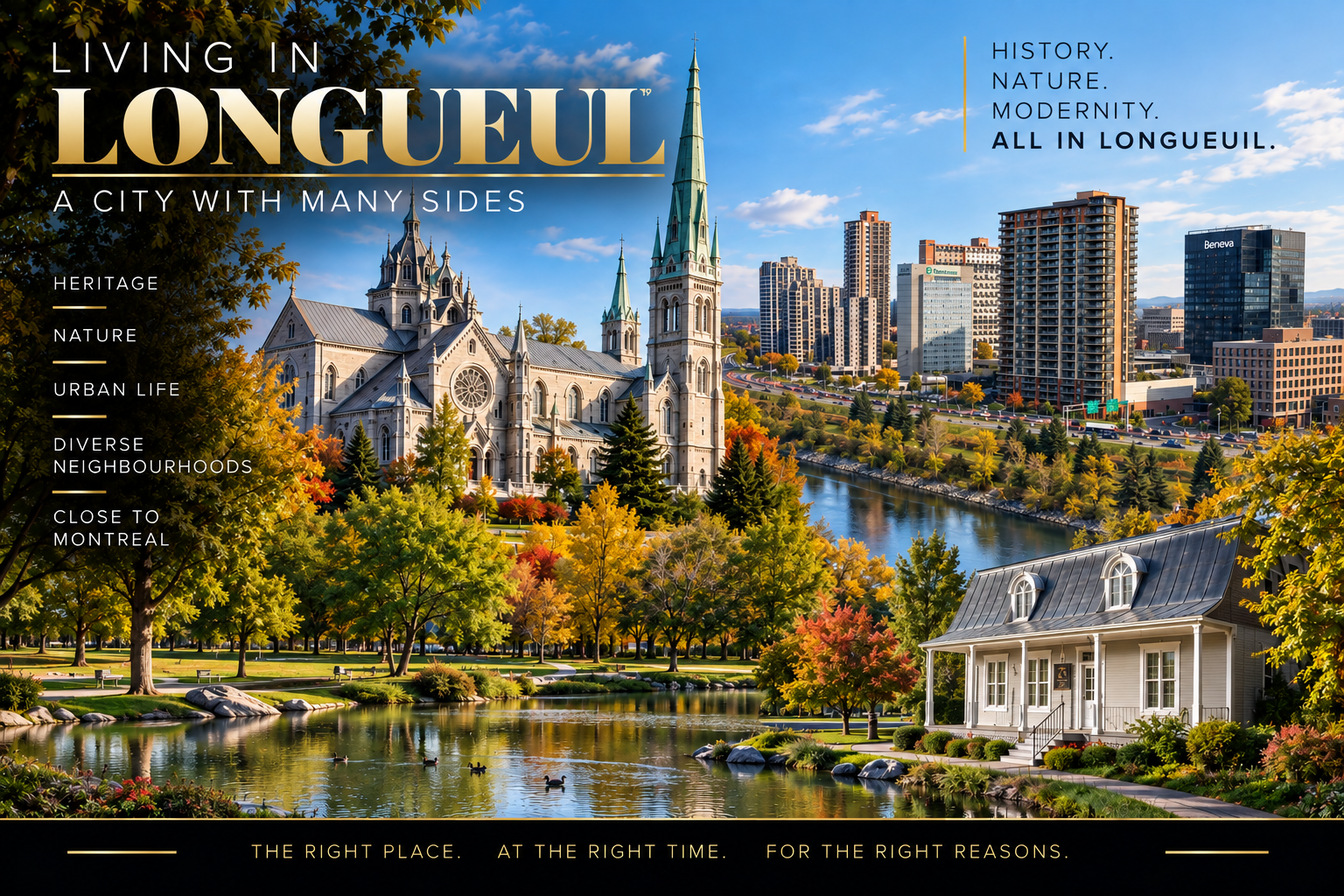
You can move from the historic environment of Vieux-Longueuil to the modern development surrounding the metro, then into established residential neighbourhoods and large green spaces without leaving Longueuil.
That variety creates options.
It also makes broad statements about “living in Longueuil” less useful.
The real question is not whether Longueuil fits you.
It is which address in Longueuil fits you.
For a buyer comparing Longueuil, Saint-Lambert, Brossard and Boucherville, the differences in property type, transportation, lot size and daily routine can quickly become more important than the municipality name.
Longueuil has three boroughs. Why does that matter when buying a home?
Longueuil is composed of three boroughs:
-
Vieux-Longueuil;
-
Saint-Hubert;
-
Greenfield Park.
The City of Longueuil’s history of the municipality confirms that these have been the city’s three boroughs since the municipal reorganization of 2006.
These are not simply administrative names.
For a buyer, they can represent different housing options, street environments, transportation patterns and relationships with surrounding municipalities.
Even within each borough, however, individual sectors can be very different.
That means your home search should not stop at “Longueuil.”
Start comparing actual areas.
Then actual streets.
Then actual properties.
What is it like living in Vieux-Longueuil?
Vieux-Longueuil can appeal to buyers looking for a more established urban environment.
Its identity includes historic architecture, mature residential streets, commercial activity and a relationship with central Longueuil that can feel very different from other parts of the city.
Depending on the sector and address, you may encounter older homes, condos, plexes and properties from very different eras.
Some buyers may value access to services and a closer relationship with central Longueuil and Montreal.
Others may discover that the type of house or lot they want is easier to find elsewhere.
If you are considering Vieux-Longueuil, ask:
-
What type of property am I buying?
-
How old is the building?
-
What renovations have been completed?
-
What maintenance could be coming?
-
How practical are my daily destinations from this address?
-
How does the street feel at the times I will actually use it?
-
What does my budget buy here compared with Saint-Hubert or Greenfield Park?
Do not buy the idea of Vieux-Longueuil.
Buy the address that gives you the parts of Vieux-Longueuil you actually want.
Historic Longueuil and modern Longueuil can exist surprisingly close together
This is one of the characteristics that makes Longueuil interesting.
The city has a long-established historic environment, including some of its most recognizable architecture in Vieux-Longueuil.
But central Longueuil also includes a much more urban environment surrounding the metro, transit infrastructure, offices, residential towers and institutional buildings.
For a buyer, that contrast matters.
Someone may want the character of an older residential street while still valuing access to major transportation infrastructure.
Another buyer may prefer a condo and a more urban lifestyle.
Someone else may want neither and focus instead on a quieter residential sector.
Do not decide whether you want Longueuil. Decide which version of Longueuil fits your life.
What is it like living in Saint-Hubert?
Saint-Hubert covers a large territory, which makes generalizations particularly dangerous.
One Saint-Hubert address may work extremely well for your routine while another creates considerably more driving.
Property types, development periods, street configurations and proximity to services can vary.
For buyers looking at Saint-Hubert, pay particular attention to:
-
the exact residential sector;
-
property age;
-
lot size;
-
access to major roads;
-
public transportation;
-
proximity to your regular destinations;
-
future development around the property;
-
realistic commuting patterns.
There is also a commuter rail station serving Longueuil–Saint-Hubert, but the usefulness of any transportation option depends on where you live and where you need to go.
Transportation infrastructure only matters when it works from your address to your destination.
For someone comparing Saint-Hubert with Brossard or Saint-Bruno-de-Montarville, the exact work destination and the amount of driving required during a normal week can materially change which property makes the most sense.
What is it like living in Greenfield Park?
Greenfield Park is Longueuil’s smallest borough geographically, but it has its own residential identity.
For some buyers, its location in relation to Saint-Lambert, Brossard and other parts of Longueuil may be particularly relevant.
Again, avoid reducing the decision to the borough name.
Look at the property.
Look at the street.
Look at where you shop.
Look at where your children need to go.
Look at where you work.
Then compare the same routine from properties in other parts of Longueuil.
A neighbourhood is useful only when it works with the life you actually live.
A buyer considering Greenfield Park may therefore compare the same budget and routine with properties in Saint-Lambert or Brossard, even though the municipal boundaries are different.
Which area of Longueuil is best?
There is no universally best area of Longueuil.
There is an area that may fit your priorities better.
If you prioritize a more established urban environment, one part of Vieux-Longueuil may deserve attention.
If you want a particular type of single-family home or lot, parts of Saint-Hubert may enter the search.
If Greenfield Park’s location works particularly well with your routine, that may change the calculation again.
If access to the metro and a more urban environment are priorities, another part of Longueuil may become more interesting.
Instead of searching for a ranking, define your criteria:
-
budget;
-
property type;
-
lot;
-
building age;
-
commute;
-
public transportation;
-
schools and daycare needs;
-
shopping;
-
recreation;
-
maintenance tolerance;
-
number of vehicles;
-
long-term plans.
Then compare addresses.
Choose your criteria before choosing your postal code.
How much does it cost to live in Longueuil?
There is no single useful “cost of living in Longueuil” number for a homebuyer.
Your largest costs can change dramatically depending on the property and household.
Consider:
-
purchase price;
-
down payment;
-
mortgage payments;
-
municipal and school taxes;
-
insurance;
-
electricity and heating;
-
maintenance;
-
renovations;
-
condo fees, when applicable;
-
transportation;
-
number of vehicles;
-
commuting costs.
A lower purchase price does not automatically mean a lower cost of living.
A property farther from your daily destinations may change your transportation expenses.
An older house may require additional maintenance.
A condo may have a lower purchase price than some houses while introducing monthly condo fees and possible special assessments.
Do not compare purchase prices alone. Compare the cost of the life attached to each property.
Is Longueuil cheaper than Montreal?
Sometimes a Longueuil property may have a lower asking price than a property a buyer is considering in Montreal.
That does not mean “Longueuil is cheaper than Montreal” is a useful rule.
Montreal itself contains very different neighbourhoods and property types.
Longueuil does too.
A meaningful comparison should use actual alternatives.
For example:
A condo in Vieux-Longueuil versus a condo in the Montreal neighbourhood you are considering.
A single-family home in Saint-Hubert versus the Montreal property that fits the same household.
Then include transportation, taxes, maintenance and other ownership costs.
For someone working in Saint-Laurent, for example, the transportation cost and commute attached to a Longueuil property may deserve just as much attention as the difference in purchase price.
Compare properties and lifestyles. Not citywide stereotypes.
House or condo in Longueuil?
The right choice depends on the responsibilities you want and the budget you actually have.
With a house, you may be responsible for:
-
roof;
-
foundation;
-
windows;
-
exterior;
-
landscaping;
-
drainage;
-
major systems;
-
ongoing maintenance.
With a condo, some responsibilities are shared.
But you need to understand:
-
condo fees;
-
contingency fund;
-
financial statements;
-
insurance;
-
meeting minutes;
-
planned work;
-
condominium rules;
-
potential special assessments.
Do not compare a $500,000 house with a $500,000 condo as though the financial obligations were identical.
Purchase price is only the beginning of the comparison.
Older property or newer construction?
Longueuil’s size and development history mean buyers can encounter properties from very different eras.
Neither older nor newer automatically means better.
With an older property, investigate:
-
foundation;
-
structure;
-
roof;
-
windows;
-
electrical system;
-
plumbing;
-
insulation;
-
drainage;
-
renovations;
-
available permits;
-
signs of previous water infiltration.
With newer construction, examine:
-
construction quality;
-
warranties when applicable;
-
drainage;
-
lot configuration;
-
remaining neighbourhood development;
-
nearby vacant land;
-
future phases;
-
taxes;
-
access and traffic patterns.
Do not choose between old and new. Compare the property and the responsibilities that come with it.
If an existing property is part of your search, my guide to pre-purchase home inspections in Quebec explains what an inspection can help you understand before you commit.
How is public transportation in Longueuil?
Transportation is one of the most important location questions for many Longueuil buyers.
But it should be analyzed door to door.
Depending on your address and destination, your routine may involve buses, the metro, commuter rail, cycling, driving or combinations of these.
Do not simply ask:
“Is there public transportation nearby?”
Ask:
“Can I reliably get from this property to the places I need to reach?”
Calculate:
-
time from your door to the first transit connection;
-
waiting;
-
transfers;
-
total travel time;
-
the final portion of the trip;
-
evening and weekend service;
-
what happens when your schedule changes.
Then test it.
Do not buy a theoretical commute. Test the one you are actually going to live with.
What if you work in downtown Montreal?
Downtown Montreal is only one commuting scenario.
Your workplace could be in:
-
downtown Montreal;
-
Saint-Laurent;
-
Brossard;
-
Longueuil;
-
the West Island;
-
another South Shore municipality.
Those destinations can completely change which Longueuil address makes sense.
A property that works extremely well for someone commuting downtown may be less practical for someone travelling somewhere else every day.
Hybrid work changes the calculation again.
If you commute twice a week rather than five times, you may accept a different property and location compromise.
Your workplace matters. Your frequency of travel matters too.
A buyer commuting to Saint-Laurent may therefore evaluate Vieux-Longueuil, Saint-Hubert and Greenfield Park very differently from someone whose daily destination is Brossard or downtown Montreal.
Can you live in Longueuil with one car?
Possibly.
But the answer depends much more on your address and household than on the word “Longueuil.”
Map your real week:
-
work;
-
daycare;
-
school;
-
groceries;
-
appointments;
-
sports;
-
family;
-
social activities;
-
evening travel.
Then ask:
What happens when two people need to travel at the same time?
If the answer consistently requires a second vehicle, include that cost when comparing properties.
A cheaper house that requires another vehicle may change your affordability calculation.
Is Longueuil good for families?
Instead of asking whether an entire city is “good for families,” evaluate whether a specific property works for yours.
Verify:
-
the school serving the exact address;
-
daycare logistics;
-
parks you would actually use;
-
sports and recreation;
-
travel time to activities;
-
property size;
-
bedroom configuration;
-
storage;
-
outdoor space;
-
transportation as children become more independent.
Longueuil has municipal parks, recreational facilities and other public amenities distributed across its territory. The city’s official directory lets residents search municipal locations by borough and facility type.
But proximity varies by address.
A city can offer many services without every address being equally practical for your family.
For a family comparing Longueuil with Saint-Lambert, Brossard or Boucherville, the school serving the exact address, the location of activities and the weekly transportation routine may matter more than the municipality itself.
What about parks and green space in Longueuil?
Green space can be an important part of Longueuil’s appeal.
Parc Michel-Chartrand is one of the city’s recognizable natural environments, but your everyday relationship with green space still depends on where you live.
Which park would you actually use?
Can you walk or cycle there?
Would your children need to cross a major road?
Does the property itself provide the outdoor space you want?
Would you still use the park in winter?
Do not simply count amenities.
Measure how they fit into your routine.
Vieux-Longueuil or Saint-Hubert?
This can be a useful comparison because the same buyer may find very different properties in each.
Rather than deciding based on reputation, compare:
-
property type;
-
age;
-
lot;
-
renovation needs;
-
transportation;
-
commute;
-
nearby services;
-
ownership costs;
-
long-term space requirements.
Then compare actual listings within your budget.
The question is not:
“Which borough is better?”
It is:
“Which property gives me the better fit for the compromises I am willing to make?”
Longueuil or Brossard?
These markets can overlap for buyers looking on the South Shore.
Your decision may come down to:
-
property type;
-
budget;
-
transportation;
-
work location;
-
lot;
-
building age;
-
nearby services;
-
maintenance;
-
daily destinations.
Brossard offers a different combination of established neighbourhoods, newer development, Quartier DIX30 and REM access. My guide to living in Brossard on Montreal’s South Shore examines those differences in more detail.
Do not assume that crossing a municipal boundary automatically improves or worsens your lifestyle.
Test the addresses.
Longueuil or Saint-Lambert?
Saint-Lambert can appeal to buyers looking for an established residential environment, mature streets and a distinct local commercial core.
Longueuil offers a much larger territory and broader range of residential environments.
That does not make one better.
It makes the comparison more specific.
My guide to living in Saint-Lambert on Montreal’s South Shore looks more closely at its mature housing stock, Victoria Avenue, transportation and the responsibilities that can come with older properties.
Ask:
What can I actually buy with my budget in each municipality?
Then compare the condition, lot, commute and ownership costs of those properties.
Longueuil or Boucherville?
Boucherville may also appear in a South Shore home search.
Again, your workplace and property priorities matter.
Instead of comparing municipal reputations, compare:
-
actual properties;
-
travel patterns;
-
total ownership costs;
-
services you use;
-
space;
-
maintenance;
-
future needs.
Compare the life attached to the property. Not simply the municipality attached to the address.
Is Longueuil a good place for real estate investment?
A large population and proximity to Montreal do not automatically make every Longueuil property a good investment.
Analyze the specific asset.
Consider:
-
acquisition price;
-
financing;
-
realistic rent;
-
operating expenses;
-
taxes;
-
insurance;
-
maintenance;
-
vacancy assumptions;
-
applicable rental and municipal rules;
-
competing units;
-
location within Longueuil;
-
exit strategy.
A plex in one part of Vieux-Longueuil and a condo elsewhere in the city are not the same investment simply because both have a Longueuil address.
The city provides context. The property determines the numbers.
Thinking about selling a property in Longueuil?
Longueuil’s size creates an important pricing problem for sellers.
A sale somewhere in Longueuil is not automatically a useful comparable.
The buyer considering your property may care about:
-
the same sector;
-
similar property type;
-
similar age;
-
comparable lot;
-
condition;
-
renovations;
-
parking;
-
garage;
-
basement;
-
transportation;
-
competing listings.
Ask:
“At my asking price, what else can this buyer purchase nearby?”
That is your real competition.
A municipal average cannot price a specific property.
In Longueuil, that competition may also include a property in Saint-Lambert, Brossard or Boucherville, depending on the buyer’s budget, commute and preferred property type.
If you are preparing to sell, my guide to pricing your home to sell in Quebec explains why the asking price needs to be built around the property, its competition and relevant comparable sales.
What should you check before buying a home in Longueuil?
Before making an offer, understand:
-
the borough;
-
the specific sector;
-
the street;
-
the property;
-
the lot;
-
building age;
-
renovations;
-
transportation;
-
schools when relevant;
-
nearby services;
-
ownership costs;
-
applicable restrictions;
-
comparable sales;
-
future development around the property.
Then test your assumptions.
Visit during rush hour.
Return in the evening.
Visit on a weekend.
Walk around.
Drive your commute.
Try the transit route you expect to use.
Go to the grocery store you would realistically use.
Analyze the property. Then test the life attached to it.
10 questions to ask before moving to Longueuil
Before buying, ask yourself:
-
Why am I considering Longueuil?
-
Which borough actually fits my priorities?
-
What type of property do I want?
-
What does my budget realistically buy in Vieux-Longueuil, Saint-Hubert and Greenfield Park?
-
What is my true door-to-door commute?
-
How many vehicles will our household actually need?
-
What maintenance or renovations could this property require?
-
Is the asking price supported by genuinely comparable properties?
-
Would Brossard, Saint-Lambert, Boucherville or another South Shore municipality eliminate an important compromise?
-
Will this address still work if my job, family or transportation needs change?
That last question deserves serious attention.
The property may remain exactly where it is.
Your life probably will not.
So, is Longueuil a good place to live?
Longueuil gives buyers something valuable.
Options.
Vieux-Longueuil.
Saint-Hubert.
Greenfield Park.
Historic architecture.
A modern urban core.
Older homes.
Condos.
Plexes.
Established streets.
Large green spaces.
Different transportation patterns.
Different relationships with Montreal and the rest of the South Shore.
But more options do not automatically make the decision easier.
They make comparison more important.
Do not begin by trying to identify the “best neighbourhood in Longueuil.”
Begin with your life.
Your budget.
Your property needs.
Your commute.
Your transportation.
Your tolerance for maintenance.
Your future plans.
Then compare actual addresses.
If Brossard or Saint-Lambert is also on your shortlist, compare the same budget and daily routine using my guides to Brossard and Saint-Lambert.
Compare Boucherville as well when its property types, commute and residential environment genuinely fit your criteria.
Choose an address, not simply the name of a city.
Because Longueuil is too large and too varied for the municipality alone to tell you what your daily life will look like.
Your address will.
The right property is the one that works with your finances, responsibilities, transportation and the life you actually want to live.
The right decision. At the right time... For the right reasons.
Jonathan Cabana
Residential and Commercial Real Estate Broker
eXp Québec
Greater Montreal | South Shore
(514) 476-0730