
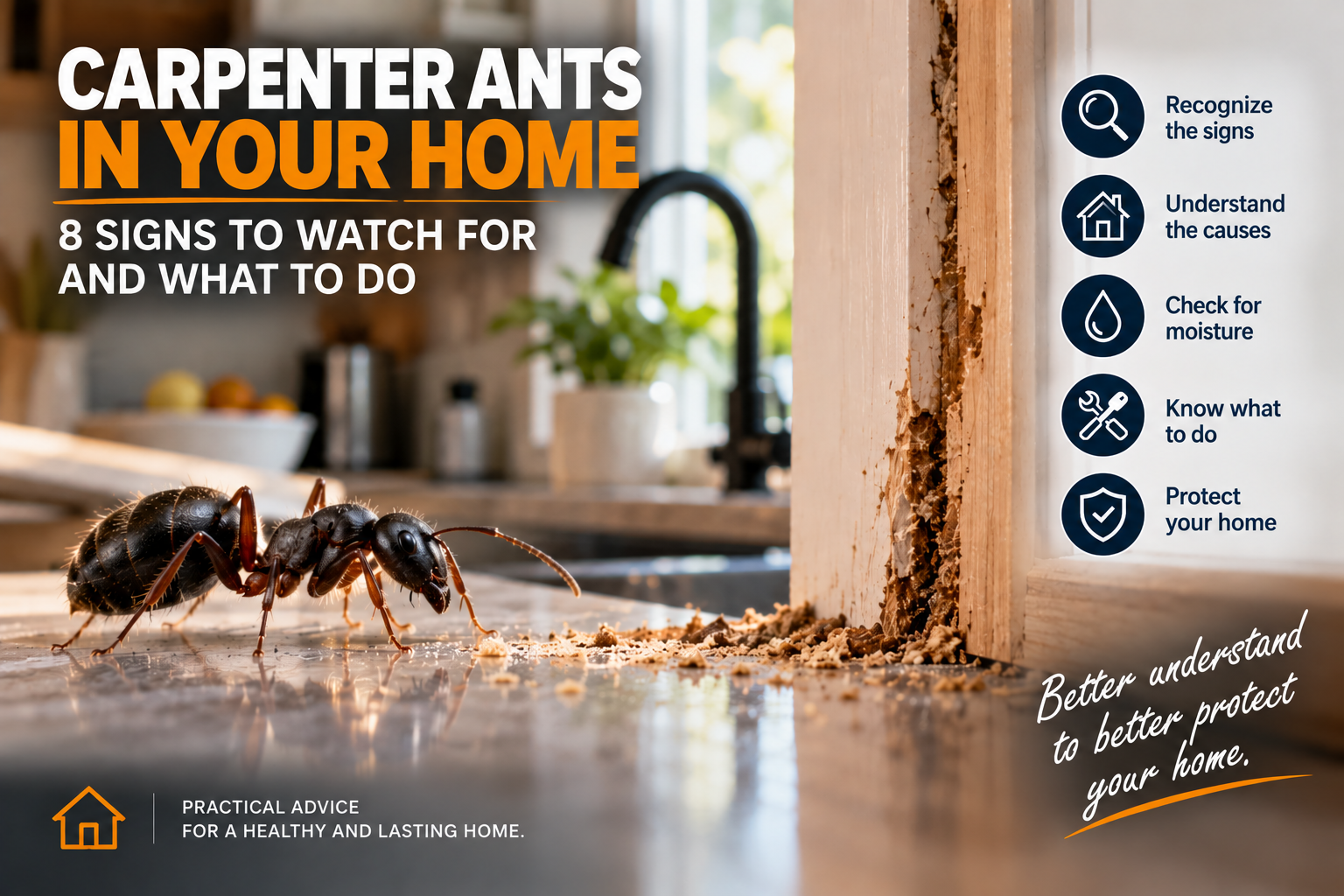
Carpenter Ants in the House: 8 Warning Signs and What to Do
You walk into the kitchen at night and notice a large black ant near the sink.
You get rid of it.
The next day, there is another one.
A few days later, you notice a small pile that looks like sawdust near a window.
You clean it up.
It comes back.
At that point, the question is no longer simply:
“How do I get rid of the ants?”
The better question becomes:
“Why are they in the house, and what is happening behind what I can see?”
That distinction matters.
Not every ant represents the same problem.
But when you are dealing with carpenter ants, their presence deserves closer attention.
According to Health Canada’s official guidance on carpenter ants, carpenter ants excavate wood to build their nests. Unlike termites, they do not eat the wood.
They can, however, damage wooden components when a colony becomes established.
For a homeowner, there is something even more important to understand:
Carpenter ants can be the problem. They can also be evidence of another problem.
They are often associated with moist or decaying wood.
A leak.
Water infiltration.
A problematic window.
Wood that stays damp.
That is why killing the ants you can see does not necessarily solve the real problem.
Here are 8 warning signs to watch for and what to do if you suspect carpenter ants in your house.
1. You Regularly See Large Ants Inside the House
One ant does not automatically mean a colony is living inside your home.
It may simply have come from outdoors looking for food.
What becomes more interesting is repetition.
You regularly see large ants.
In the same area.
Under the kitchen sink.
Near a window.
In the bathroom.
In the basement.
Near an exterior door.
Or you begin noticing a trail.
Health Canada reports that carpenter ants found in Canada can range from approximately 6 to 25 mm, depending on the individual.
But do not rely on size alone.
A large ant is not automatically a carpenter ant.
Frequency, behaviour and where you find the ants can tell you much more than one isolated insect.
If you start seeing them regularly, your next move should not necessarily be to crush every ant immediately.
Watch where they go.
In areas such as Saint-Laurent or Côte-Saint-Luc, where many properties have basements, windows, decks and wooden components, the specific location where the ants appear can provide a much more useful clue than their presence alone.
2. You Find Sawdust That Keeps Coming Back
You clean around a window.
There is a small pile that looks like sawdust.
You remove it.
Several days later, it is back.
That deserves attention.
Why?
Because carpenter ants do not eat wood.
They excavate it.
As they create galleries for their nests, they remove material that can look like sawdust or small wood shavings.
You may notice debris near:
-
a window frame;
-
trim or moulding;
-
a wall;
-
wooden stairs;
-
a door;
-
structural wood;
-
a crack or small opening.
A little sawdust by itself does not prove that carpenter ants are present.
There may be another explanation.
But if you repeatedly clean the same area and the debris returns, ask:
“Where is this coming from?”
Do not just clean up the symptom.
Look for the source.
In a home in Montreal West or Pointe-Claire, for example, sawdust that repeatedly appears around an older window or moulding deserves to be examined in context, particularly if there are also signs of moisture.
3. You See Winged Ants Inside
One winged ant can be confusing.
Several winged ants suddenly appearing in the same area deserve considerably more attention.
Health Canada identifies swarms of winged ants attempting to escape outdoors, typically in spring, as one possible sign of a carpenter-ant colony.
That does not automatically mean your home's structure is seriously damaged.
But if several winged ants appear indoors, it is worth investigating where they are coming from.
Do not simply vacuum them up and forget about them.
Look.
Where are they emerging from?
A window?
Moulding?
An opening?
A wall?
The ceiling?
The location where they appear can tell you more than the fact that they are there.
4. You Hear a Faint Rustling Sound Inside a Wall
This one surprises many homeowners.
The house is quiet.
You put your ear close to a wall.
And you hear something.
A faint rustling.
Not necessarily loud enough to be obvious.
But enough to make you wonder:
“Is that actually coming from inside the wall?”
Health Canada notes that an active carpenter-ant colony can produce a dry rustling sound that may be easier to hear at night when the ants are active and the house is quiet.
Of course, sounds inside a wall can have many causes.
A sound alone does not confirm carpenter ants.
But what if you have also noticed:
-
large ants;
-
sawdust-like debris;
-
winged ants;
-
damp wood;
-
signs of water infiltration?
Now the sound becomes much more interesting.
One clue raises a question. Several clues in the same place start telling a story.
5. The Ants Appear Near a Damp Area
This may be one of the most important clues for a homeowner.
Carpenter ants often prefer moist or decaying wood.
Health Canada specifically notes that carpenter ants found indoors can signal a moisture problem or decaying wooden structures.
That means finding carpenter ants should sometimes lead you to investigate beyond the insects themselves.
Ask a few questions.
Has there been water infiltration in this area?
Is a window leaking?
Is there a plumbing leak?
Does the wood around a door feel soft?
Is the basement unusually humid?
Is there significant condensation?
Has the roof leaked?
Are the gutters directing water properly?
Is wood remaining in contact with damp soil?
The Gouvernement du Québec’s guidance on basement moisture emphasizes the importance of identifying and correcting the cause of a humidity problem rather than relying only on temporary measures.
If that moisture has already caused stains, odours or signs of contamination, my article on mould in a Quebec home can help you understand another potential part of the problem.
This distinction can become particularly important in a property with a basement or wooden components exposed to moisture, including homes in Boucherville or Saint-Bruno-de-Montarville.
And this is where treating only the visible problem can become expensive.
You see ants.
You treat the ants.
They disappear.
Problem solved?
Not necessarily.
If water is still slowly entering behind the wall, you may have eliminated the clue without eliminating the cause.
Sometimes you need to answer two different questions:
Where are the ants?
And:
Why do they like this particular location?
6. You Find Them Near Windows, Doors, Foundations or Wooden Structures
Carpenter ants can enter a house in several ways.
Health Canada identifies possible access points including windows, foundation openings, ducts, cables, vegetation touching the building, attached wooden structures and firewood brought indoors.
That gives homeowners several areas worth inspecting.
Look around:
-
window frames;
-
exterior doors;
-
decks;
-
balconies;
-
wooden steps;
-
garages;
-
foundations;
-
branches touching the building;
-
firewood stored near the house.
Pay particular attention to places where two things meet:
Wood and moisture.
An older but dry deck does not necessarily present the same situation as a wooden component that stays damp against the building.
Context matters.
In areas with mature trees or wooded surroundings, including Beloeil or Mont-Saint-Hilaire, it can also be useful to look at branches touching the building, firewood stored near the house and exterior wooden structures.
7. You See More Ants After Sunset
You barely see any ants during the day.
Then evening arrives.
Suddenly, they appear.
That may not be a coincidence.
Health Canada notes that carpenter ants are particularly active after sunset.
If you are trying to determine where they are coming from, observing them in the evening may reveal much more.
And here is something slightly counterintuitive:
Do not immediately kill the first ant you see.
Watch it for a few minutes.
Where is it going?
Where did it come from?
Does it disappear under moulding?
Into a crack?
Under a cabinet?
Toward a window?
Back outdoors?
A moving ant may give you much more information than a dead one.
You are no longer simply looking for the insect.
You are looking for its route.
8. The Ants Keep Returning After Treatment
You spray the ants you see.
They disappear.
Several days later, they return.
You treat them again.
Same result.
Why?
Because you may have killed visible worker ants without eliminating the colony.
An established colony may also have a satellite colony inside the house connected to a parent colony elsewhere.
Health Canada explains that long-term control of an established colony generally requires locating and treating the actual nest. When a satellite colony is involved, locating the parent colony may also be necessary.
That is why killing a few ants on the kitchen counter can create the impression that the problem has been solved when it has not.
Where you see the ants is not necessarily where the problem is located.
Do Carpenter Ants Eat Wood?
No.
This is an important distinction.
Carpenter ants excavate wood to create galleries and nesting areas.
They then remove the debris.
That excavation is what can damage wood.
Carpenter ants are sometimes confused with termites, but they are different insects.
Finding carpenter ants therefore does not mean your house is literally being eaten.
But that does not mean their presence should be ignored.
The important question is:
Where is the colony, and what is the condition of the area where it has established itself?
Do Carpenter Ants Mean Your House Has Structural Damage?
Not necessarily.
Seeing carpenter ants does not automatically mean the structure of your home has been seriously compromised.
Health Canada notes that carpenter ants can establish nests in wall voids, attics, hollow doors and even some insulation without necessarily attacking structural lumber.
But here is the problem:
You cannot determine the extent of the situation simply by counting the ants you can see.
Imagine two houses.
In the first, a few workers from an outdoor colony enter the house looking for food.
In the second, a colony has been established for a long time near wood deteriorated by water infiltration.
In both houses, the homeowner may see a few ants in the kitchen.
What is visible looks similar.
What is happening behind the surface may be completely different.
So the right question is not:
“How many ants have I seen?”
It is:
“Where is the nest, how long has it been there, and what condition is the surrounding area in?”
Where Do Carpenter Ants Build Their Nests?
Outdoors, carpenter ants may establish nests in:
-
tree stumps;
-
dead trees;
-
logs;
-
decaying wood;
-
wooden elements around the property.
Inside a house, possible locations include:
-
walls;
-
window frames;
-
doors;
-
stairs;
-
attics;
-
wall voids;
-
wooden structures;
-
some types of insulation;
-
damp or poorly ventilated areas.
The nest may therefore be much less obvious than you expect.
And the ants you see in the kitchen do not necessarily live directly behind the kitchen cabinet.
They may travel some distance while searching for food.
Again:
Do not confuse where you see the ant with where the ant lives.
How Do You Find a Carpenter-Ant Nest?
Start by observing.
Do not automatically spray the first ant you see.
Follow its route.
Look particularly after sunset.
Watch for:
-
sawdust-like debris;
-
openings in wood;
-
ants repeatedly entering and leaving the same area;
-
damp areas;
-
deteriorated wood;
-
winged ants;
-
unusual sounds inside cavities.
Also inspect areas where wood stays damp or comes into contact with soil.
The goal is not simply to find an ant.
The goal is to understand the route and network it is using.
If you repeatedly see signs of activity but cannot locate the colony, professional intervention may be far more useful than repeatedly treating visible ants at random.
Can You Get Rid of Carpenter Ants Naturally?
Some non-chemical measures can make your property much less favourable to carpenter ants.
Priorities include:
-
removing decaying or infested wood when necessary;
-
correcting moisture problems;
-
keeping firewood away from the house;
-
trimming branches that provide direct access to the building;
-
removing food sources;
-
sealing appropriate entry points;
-
repairing deteriorated wooden components.
Health Canada also identifies diatomaceous earth as one non-chemical ant-control option for cracks and crevices. It remains effective while dry, but its dust should not be inhaled.
Be cautious, however, with miracle remedies found online.
Vinegar.
Essential oils.
Baking soda.
Lemon.
Peppermint.
Something that temporarily disrupts a few ants does not necessarily eliminate a carpenter-ant colony established inside a building.
Making ants disappear from your countertop and eliminating the colony are two different things.
Should You Use Pesticides for Carpenter Ants?
It depends on the situation.
If you use a pesticide, Health Canada recommends selecting a product registered for the pest and intended use, checking the label for a Pest Control Products registration number, and following all directions and warnings.
You can review Health Canada’s official carpenter-ant recommendations before choosing a treatment.
But when a colony is well established, randomly treating visible ants may not be enough.
The treatment needs to address the actual colony and its location.
If you cannot determine what is happening, repeatedly applying treatments at random may be less useful than having the problem properly assessed.
When Should You Call a Pest-Control Professional?
Professional help becomes particularly relevant when:
-
ants continually return;
-
you see significant activity indoors;
-
sawdust-like debris keeps appearing;
-
winged ants appear indoors;
-
you suspect a nest inside a wall;
-
you cannot locate the colony;
-
several areas appear affected;
-
previous treatments have not solved the problem.
Health Canada recommends professional pest-control assistance in difficult situations.
But getting rid of the ants may not always be the end of the story.
There may still be another question to answer.
When Should You Have the House Itself Inspected?
Suppose the pest-control professional locates the colony.
It is around a window.
The wood is damp.
The ants are treated.
Good.
But why was the wood damp?
That is where another type of expertise may become necessary.
If carpenter ants are associated with soft, wet or deteriorated wood, you should also determine why that wood is in that condition.
Depending on the situation, that could mean investigating:
-
water infiltration;
-
plumbing leaks;
-
roofing problems;
-
a leaking window;
-
significant wood deterioration;
-
drainage problems;
-
foundation problems;
-
potentially important building damage.
If repairs become necessary after the underlying cause has been identified, my guide to renovating a house in Quebec explains why water infiltration, moisture and structural issues should generally be addressed before cosmetic improvements.
In other words:
The pest-control professional looks for the colony. A building professional may need to determine why that location became favourable to the colony.
Depending on what you find, you may need one, the other, or both.
What If You Find Carpenter Ants Before Selling Your Home?
Do not simply cover the problem with paint.
And do not panic.
Start by understanding what is actually happening.
Correctly identify the insect.
Locate the colony when possible.
Have the infestation treated when necessary.
Determine whether there is an underlying moisture source.
Have damaged components evaluated and repaired when appropriate.
Keep invoices, reports and documentation related to the work.
Why?
Because a treated infestation, corrected water problem and documented repair tell a very different story from an active issue whose extent nobody understands.
For buyers, uncertainty can sometimes become more concerning than the problem itself.
The more you understand before listing the property, the fewer important questions remain unanswered when a buyer begins their inspection.
In a property in Saint-Constant or Boucherville, as elsewhere in Quebec, documenting what was discovered, treated and repaired can also help present the history of the problem more clearly when a sale is being considered.
If you are preparing the property for sale, my guide to the documents needed to sell a house in Quebec explains why previous inspection reports, expert assessments, contractor invoices, warranties and documentation of completed repairs can become important parts of the property's history.
What If You Discover Carpenter-Ant Signs While Buying a House?
Ask questions.
Do not automatically conclude that the house has major structural damage.
But do not assume that a little sawdust is meaningless either.
Try to determine:
-
where the ants were observed;
-
whether there has been a previous infestation;
-
whether the nest was located;
-
whether there has been water infiltration;
-
whether wood was replaced;
-
whether repairs were completed;
-
whether invoices or reports exist.
Depending on what is discovered, additional inspection or specialized expertise may be appropriate.
My guide to pre-purchase home inspections in Quebec explains the broader role of this verification before purchasing a property.
In markets such as Pointe-Claire, Saint-Bruno-de-Montarville or Mont-Saint-Hilaire, the presence of mature trees, decks or other wooden elements obviously does not mean a property has a carpenter-ant problem. The signs observed in the building and their context should guide the investigation.
And if an inspection has already revealed a potentially significant problem, there is an important distinction between identifying the issue and determining what your Promise to Purchase allows you to do. My article on canceling a Promise to Purchase after an inspection in Quebec examines that question separately.
This is exactly the type of situation where you should avoid two opposite reactions.
Panicking too quickly.
Or:
Minimizing the issue too quickly.
The objective is not to be afraid of a property problem.
It is to understand exactly what problem you are evaluating before deciding what to do.
Carpenter Ants in Greater Montreal and the South Shore
The principles are the same regardless of the city.
The building and its immediate environment matter much more.
In areas such as Saint-Laurent, Côte-Saint-Luc, Montreal West and Pointe-Claire, some older properties may have windows, additions, decks or other wooden components that deserve closer attention when moisture problems are present.
On the South Shore, in communities such as Boucherville, Saint-Bruno-de-Montarville, Beloeil, Mont-Saint-Hilaire and Saint-Constant, the same principles apply to homes with decks, garages, basements, mature trees and other potential access points.
But remember this:
Your postal code does not attract carpenter ants.
What matters is the combination of the building, wood, moisture and the property's immediate environment.
How Can You Prevent Carpenter Ants From Returning?
Once an infestation has been addressed, look at the property as a whole.
Outside the House
-
Keep firewood away from the building.
-
Remove decaying wood near the house.
-
Trim branches that touch the structure.
-
Inspect decks and wooden structures.
-
Monitor water drainage around the property.
-
Correct sources of water infiltration.
Inside the House
-
Monitor damp areas.
-
Repair leaks.
-
Inspect window and door frames.
-
Store food in sealed containers.
-
Clean crumbs and food residue.
-
Continue monitoring areas where activity was previously found.
Effective prevention is not only about stopping ants from entering.
It is also about making your house a much less attractive place for a colony.
The Real Problem May Not Be the Ant You Can See
This is probably the most important point.
An ant on the countertop is visible.
A slow leak behind the wall is not.
A small pile of sawdust is visible.
Damp wood behind the moulding may not be.
A few ants walking through the kitchen are visible.
The colony may be somewhere else entirely.
That is why carpenter ants should be treated as a clue to understand, not simply an insect to crush.
If you find them in your house, ask three questions:
Where are they coming from?
Where is the colony?
Why is that location attractive to them?
Answering only the first question may make a few ants disappear.
Answering all three can help you identify and solve the real problem.
Because sometimes the most important thing to find is not the ant you can see. It is what that ant has just revealed about your house.
The right decision. At the right time... For the right reasons.
Jonathan Cabana
Residential and Commercial Real Estate Broker
eXp Québec
Greater Montreal | South Shore
(514) 476-0730