
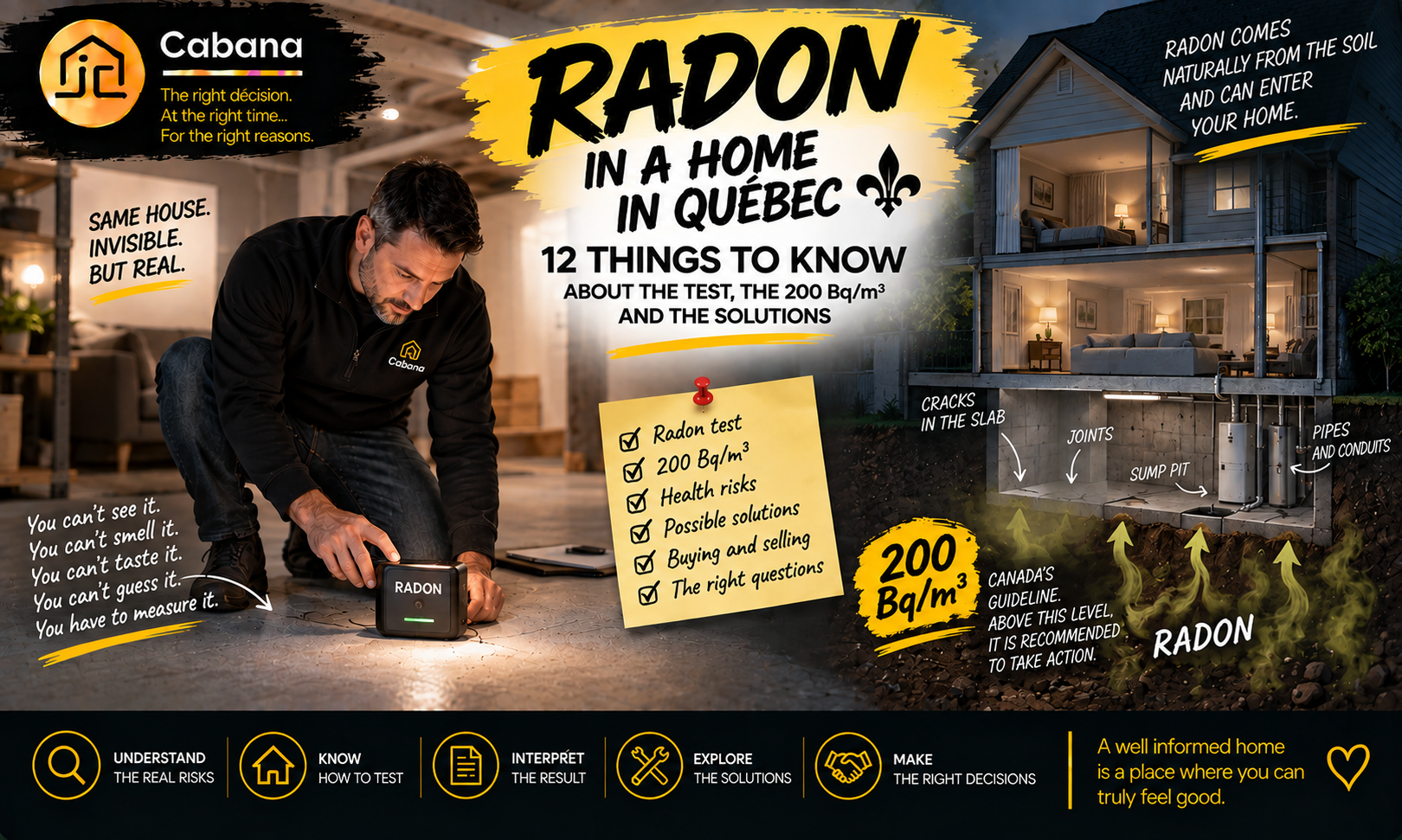
Radon in Quebec Homes: 12 Things to Know About Testing, the 200 Bq/m³ Guideline and Mitigation
You are viewing a house.
The basement is clean.
No strange smell.
No concerning cracks.
No obvious signs of water infiltration.
Everything looks normal.
Can you conclude that there is no radon problem?
No.
And that is exactly what makes radon different from many other issues you might encounter in a home.
You cannot see it.
You cannot smell it.
You cannot taste it.
A visual inspection cannot tell you its concentration.
Even the house next door can produce a completely different result from yours.
So how do you know?
You measure it.
That may be the single most important thing to understand about radon.
Do not guess.
Do not assume.
Do not look around the basement and conclude that everything seems fine.
Measure it.
Because in real estate, the absence of a visible sign can easily be mistaken for the absence of a problem.
With radon, those are two completely different things.
Here are 12 things to understand about radon in Quebec, particularly if you are a homeowner, buyer or seller.
1. What is radon?
Radon is a naturally occurring radioactive gas.
It comes from the breakdown of uranium that occurs naturally in soil and rock.
Outdoors, radon generally disperses into the air.
The concern arises when it enters an enclosed space such as a house and accumulates.
Radon can enter through:
-
cracks in concrete slabs;
-
cracks in foundation walls;
-
certain joints;
-
sump pits;
-
crawl spaces;
-
openings around pipes and conduits;
-
other points where the building comes into contact with the ground.
That is why the lower portions of a home are particularly important when discussing radon.
But be careful not to jump to a conclusion.
A basement without visible cracks is not automatically a basement without radon.
A house can look perfectly sound.
Its radon concentration cannot be determined by looking at it.
It has to be measured.
2. Why is radon a health concern?
The primary health risk associated with long-term radon exposure is lung cancer.
According to Health Canada, radon is the leading cause of lung cancer among non-smokers in Canada.
The risk depends largely on two things:
the concentration
and
the duration of exposure.
The higher the concentration and the longer the exposure continues, the greater the risk.
Smoking combined with radon exposure also substantially increases the risk of lung cancer.
But unlike some problems in a house, radon generally does not give you an immediate warning.
You do not wake up one morning and say:
“I think there is radon in my basement.”
You cannot smell it.
You cannot see it.
You cannot taste it.
And that is precisely why measurement matters.
Radon may be invisible. The risk is not.
3. What radon level is considered acceptable in Canada?
The Canadian guideline is:
200 becquerels per cubic metre of air, or 200 Bq/m³.
When the long-term average concentration exceeds 200 Bq/m³ in a normally occupied area, Health Canada recommends taking action to reduce exposure.
Health Canada recommends taking corrective action within one year when the radon level exceeds 200 Bq/m³, and taking action sooner as concentrations increase.
But there is an extremely important distinction to understand:
200 Bq/m³ is not a magical dividing line between “no risk” and “danger.”
The health risk associated with radon increases with exposure.
Even below the Canadian guideline, the risk is not considered absolutely zero.
The 200 Bq/m³ figure is therefore a guideline for corrective action.
It is not a line separating a perfectly safe home from a suddenly dangerous one.
And when mitigation is necessary, the objective is not simply to get the number down to 199 Bq/m³.
The objective is to reduce exposure as much as reasonably achievable.
4. How do you know if there is radon in your home?
You measure it.
Do not guess.
Do not rely on a map.
Do not ask your neighbour.
Do not simply inspect the foundation.
Measure it.
An appropriate radon measurement device can determine the concentration of radon in the air in Bq/m³.
Passive and electronic measurement devices are available.
But the duration of the test matters enormously.
For decisions about mitigation, Health Canada recommends a long-term radon measurement lasting at least 91 days. In general, testing for 3 to 12 months provides a better estimate of the home's annual average radon concentration.
Health Canada also recommends that at least 91 days of the measurement period take place during the heating season.
Why?
Because radon concentrations can change.
From one day to another.
From one season to another.
With ventilation.
With occupant habits.
With weather conditions.
With the way the building operates.
A test with fewer than 91 days during the heating season can underestimate the annual average radon concentration. If such a test produces a result below 200 Bq/m³, Health Canada recommends testing again during the heating season.
A result collected over a few hours or a few days therefore does not provide the same information as a long-term measurement when you are trying to understand long-term exposure.
Think about what that means.
You are potentially making a decision involving a home worth hundreds of thousands of dollars based partly on a number.
The more important the decision you want to make from that number, the more important it becomes to make sure the number actually represents the house.
5. Where should a radon test be placed?
Placement matters.
The measurement should be taken in a normally occupied area on the lowest lived-in level of the home.
Health Canada defines a normally occupied area as a space where someone spends more than four hours per day. A space that is not used every day may also qualify if its average use over the year reaches that level.
For example:
-
a bedroom;
-
a home office;
-
a family room;
-
a playroom;
-
a living room on a lower level.
Imagine a basement containing a home office where you work eight hours a day.
That space matters because radon is not simply a number attached to a building.
It is also an exposure question.
The basement is therefore not automatically the place where the device should be installed. It becomes relevant when it is the lowest lived-in level and contains a normally occupied area.
The device should also be installed according to the applicable placement instructions.
The goal is not to choose the location where you think you will obtain the most reassuring number.
The goal is to obtain a measurement that represents the occupants' actual exposure.
You are not testing to get a good-looking result.
You are testing to get useful information.
6. Can your neighbour's radon test tell you that your house is fine?
No.
It is one of the easiest assumptions to make.
Your neighbour says:
“I tested my house. My result was very low. You have nothing to worry about.”
That information may be interesting.
But it does not tell you the radon concentration in your house.
Concentrations can vary considerably between buildings that are very close to each other.
Why?
Because several factors can differ:
-
soil characteristics;
-
construction;
-
openings toward the ground;
-
air sealing;
-
ventilation;
-
pressure differences;
-
foundations;
-
renovations.
Two neighbouring houses can therefore produce very different results.
And that brings us back to the same rule:
Your neighbour's test measures your neighbour's house. Not yours.
7. Can a new house have radon?
Yes.
Radon is not simply an old-house problem.
A recently built home can also have an elevated concentration.
The age of the building therefore does not answer the question.
Certain construction techniques can make radon prevention or mitigation easier.
But they do not replace measuring the actual concentration inside the home.
The same logic applies to a renovated property.
New windows.
New insulation.
A renovated basement.
Changes to the ventilation system.
Foundation work.
These changes can affect how air moves through the building.
Health Canada recommends testing again during the next heating season after certain renovations affecting the home's structure or ventilation, major energy-efficiency upgrades, significant excavation or earthwork near the home, or certain new structural damage affecting parts of the building in contact with the ground.
A house can change. Its radon concentration can change too.
8. What should you do if the result is above 200 Bq/m³?
First:
Do not panic.
Second:
Do not ignore it.
A long-term average result above the Canadian guideline means action to reduce the concentration is recommended.
Health Canada recommends taking corrective action within one year when the radon level exceeds 200 Bq/m³, with greater urgency as concentrations increase.
One commonly used mitigation method is active soil depressurization, including sub-slab depressurization.
The basic principle is to collect radon from beneath the foundation and exhaust it outdoors before it can accumulate in occupied areas.
Health Canada identifies sub-slab depressurization as the most common method used to reduce radon in a home.
Depending on the property, other measures may also form part of the mitigation strategy.
But avoid turning a solution you found online into a universal solution.
Two houses can have the same radon concentration without necessarily requiring exactly the same intervention.
When concentrations are elevated, Health Canada recommends hiring a radon mitigation professional certified through the Canadian National Radon Proficiency Program, or C-NRPP, to determine the most appropriate approach for the building.
And after the work?
Test again.
Because the job is not finished simply because a system has been installed.
Its effectiveness needs to be verified.
Health Canada also recommends retesting a home with an active soil depressurization system every five years to confirm that the system continues to function as intended.
9. Is sealing the cracks enough to solve a radon problem?
Not necessarily.
Sealing certain cracks and openings can be part of a mitigation strategy.
But you should not assume that a tube of sealant will automatically transform a home with elevated radon into one with a low concentration.
Radon can enter through multiple pathways.
Its movement is also influenced by pressure differences between the soil and the building.
Health Canada indicates that sealing major entry routes can help reduce radon levels, but its effectiveness may be limited depending on the concentration and the characteristics of the home.
In some situations, a more comprehensive intervention may be required.
Imagine this:
The cracks have been sealed.
Everything looks clean.
The basement is immaculate.
Has the problem been solved?
You do not know yet.
You need to measure.
That is an important distinction.
A renovation can look finished.
A repair can look professional.
A system can look impressive.
But none of those things tells you the resulting radon concentration.
A radon mitigation project is not confirmed by how it looks. It is confirmed by what the measurements show after the work.
10. Should you test for radon before buying a house?
This is where radon becomes particularly interesting in a real estate transaction.
The best way to understand long-term exposure is through long-term measurement.
But a real estate transaction often moves much faster than several months.
You see the problem?
The best information takes time.
The transaction may not wait.
A short-term test can provide information about the concentration during the period measured.
But it does not provide the same picture as a long-term measurement when the objective is to understand long-term average exposure.
If the seller already has radon test results, ask to see them.
Ask:
-
when the test was performed;
-
how long it lasted;
-
during what time of year;
-
where the device was placed;
-
what result was obtained;
-
whether mitigation work was completed;
-
whether the property was tested again after the work.
What if no long-term test exists?
That does not automatically mean there is a problem.
But it does mean you do not yet know the home's long-term average concentration.
And that distinction matters.
The absence of a high result is not the same as having a long-term result demonstrating a low concentration.
Those are two completely different pieces of information.
In a Quebec transaction involving a real estate broker, the OACIQ also provides a standard radon measurement clause that can be used in certain circumstances. It allows the parties to instruct the acting notary to withhold an agreed amount from the proceeds of sale while a radon measurement is completed after the sale, subject to the terms of the clause.
The appropriate structure will depend on the transaction and the conditions agreed upon by the parties.
For the broader role of inspections and specialized testing when buying a property, see Pre-Purchase Home Inspection in Quebec: 12 Things to Know Before Buying a House.
The goal is not to turn every real estate transaction into a scientific laboratory.
It is to understand:
What do I know?
What do I not know?
And does what remains unknown matter enough to change what I do next?
11. Does a finished basement increase the risk from radon?
Not automatically.
But it can increase the importance of knowing the concentration.
Why?
Because risk depends partly on concentration and duration of exposure.
Imagine two houses with exactly the same radon concentration.
House A
An unfinished basement used for storage a few minutes each week.
House B
A basement containing:
-
a bedroom;
-
a home office used eight hours a day;
-
a family room;
-
a playroom.
Same concentration.
Not necessarily the same exposure for the occupants.
That is why radon should not be viewed only as a number inside a house.
You should also ask:
Who uses the space, and for how long?
That question has become particularly relevant with remote work.
A former storage area can become an office used forty hours a week.
A rarely occupied basement can become a bedroom.
An unused room can become a playroom.
The building may not have changed dramatically. Your potential exposure may have.
12. What should a seller do if they already have a radon test result?
Start by keeping the documentation.
The report.
The date.
The length of the test.
The location where the device was installed.
Invoices for mitigation work, if applicable.
Documents concerning the system that was installed.
Results obtained after the intervention.
In a Quebec real estate transaction involving a broker, the Declarations by the seller of the immovable specifically address known information concerning radon. The OACIQ also indicates that previous expert results, including dosimeter analyses, should be made available to the buyer through the relevant declarations.
Avoid saying only:
“There was radon, but it's fixed.”
Compare that with:
“Here is the original result. Here is the work that was completed. Here is the invoice. Here is the result obtained after the work.”
Those two statements can describe exactly the same house.
But they do not give a buyer the same information.
The first essentially asks the buyer to trust a conclusion.
The second allows the buyer to review the facts.
In real estate, documenting a situation is often far more useful than simply calling it “fixed.”
If you are preparing a property for sale, my guide to the documents needed to sell a house in Quebec also explains why inspection reports, expert assessments, test results and repair invoices should be gathered before the property goes on the market.
Can radon be detected during a pre-purchase home inspection?
Not simply by looking at the house.
A building inspector can observe certain elements of the property.
They may identify openings or building characteristics that are relevant.
They may notice that a mitigation system is already installed.
They may raise a question.
But radon itself is invisible and odourless.
You need a measurement to know its concentration.
That distinction is essential:
The inspection visually evaluates the building.
The test measures radon in the air.
Do not ask one to replace the other.
Can a radon map tell you whether your house is safe?
No.
A map can be useful for understanding geographic trends.
But it cannot tell you the result for your house.
The OACIQ specifically warns that it is impossible to determine the radon concentration in a particular building based on test results from another building, no matter how close it is.
It is the same logic as relying on your neighbour's test.
A regional trend provides context.
It is not a measurement of your property.
Avoid these two conclusions:
“My area looks low on the map, so I don't need to test.”
or:
“My area looks high, so my house definitely has a problem.”
In both cases, you are replacing a measurement with an assumption.
And radon is precisely the kind of problem where guessing is unnecessary because it can be measured.
Can a carbon monoxide detector detect radon?
No.
They are two different hazards.
A carbon monoxide detector does not measure radon.
Neither does your smoke detector.
To determine the radon concentration, you need a device designed to measure radon.
That may sound like a simple question.
But it reveals something important.
A home can have several safety devices...
and still never have been tested for radon.
Having detectors in your home does not mean everything that can be measured has been measured.
If the result is below 200 Bq/m³, can you forget about radon forever?
Not necessarily.
A long-term result below the Canadian guideline is reassuring.
But the characteristics of a house can change.
A major basement renovation.
New windows.
Insulation work.
Changes to the ventilation system.
Foundation work.
Significant excavation or earthwork near the home.
Those changes can affect conditions inside the building.
Health Canada recommends retesting during the next heating season following certain renovations affecting the home's structure or ventilation, major energy-efficiency upgrades, significant excavation or earthwork adjacent to the home, or new structural damage affecting parts of the building in contact with the ground.
It is also important to remember:
200 Bq/m³ is a guideline for corrective action.
It is not a concentration below which the risk suddenly becomes absolutely zero.
Buying a house with a result above 200 Bq/m³: should you walk away?
Not automatically.
A result above the Canadian guideline should be taken seriously.
But recognized methods also exist to reduce radon concentrations.
Health Canada indicates that radon mitigation techniques can be highly effective and that sub-slab depressurization is the most common approach.
The useful question is therefore not simply:
“Is there radon?”
Radon can be present at different concentrations in buildings.
A much better question is:
“What is the concentration, how was it measured and what would need to be done to reduce it?”
Before making a real estate decision, you may want to understand:
-
the quality and duration of the test;
-
the concentration measured;
-
the space where the test was performed;
-
recommended solutions;
-
work already completed;
-
results obtained after that work;
-
potential costs;
-
how you plan to use the basement.
And most importantly:
What is still unknown?
Imagine two houses.
House A
A long-term test showed an elevated radon concentration.
A mitigation system was installed by a qualified professional.
You have the documentation.
You have the invoices.
Another test was performed.
You know the result after the work.
House B
No radon test has ever been performed.
You are simply told:
“Nobody around here has ever had a radon problem.”
Which house is automatically better?
There is not enough information to answer that.
But which one contains more unknowns about radon?
House B.
And that distinction matters.
Because House A has a known history.
It can be examined.
The original concentration can be reviewed.
The mitigation work can be documented.
The result after the work can be measured.
House B gives you reassurance without measurement.
A known and documented problem can be analyzed. An unknown first needs to become information.
That principle extends far beyond radon.
10 questions to ask about radon before buying a house
Before making your decision, ask:
-
Has the house ever been tested for radon?
-
Can I obtain the original report or test result?
-
How long did the test last?
-
During what time of year was it performed?
-
Where was the device located?
-
What was the result in Bq/m³?
-
Was any radon mitigation work completed?
-
Are invoices or documents for that work available?
-
Was another appropriate long-term test performed after the intervention?
-
What remains unknown about radon exposure in this house?
That final question matters enormously.
Because in real estate, a lack of information can easily be mistaken for the absence of a problem.
They are not the same thing.
Radon does not need to scare you. It needs to be measured.
Go back to that basement.
It is clean.
Nicely finished.
No strange smell.
No particularly concerning cracks.
Maybe it was recently renovated.
Everything looks perfectly normal.
What is the radon concentration?
You still do not know.
And that is exactly the point.
Radon is invisible.
Odourless.
Tasteless.
You cannot look at your basement and know its concentration.
You cannot use your neighbour's result.
You cannot simply look at a map.
You cannot ask a visual inspection to measure a radioactive gas.
You need to test.
Then understand the result.
Below 200 Bq/m³?
You have a measurement that can be compared with the Canadian guideline, while recognizing that the risk is not considered absolutely zero.
Above 200 Bq/m³?
The situation calls for action to reduce exposure.
And if you are buying a property?
Do not ask only:
“Is there radon?”
Ask instead:
“Was this house properly tested, what was the result and what happened next?”
That is a much more useful question.
Because the real risk in a real estate decision is not necessarily discovering that a problem exists.
Sometimes it is assuming that a problem does not exist simply because nobody has measured it.
The goal is not to be afraid of something you cannot see.
The goal is to measure what you cannot see.
Then understand what that measurement means.
Then understand what remains uncertain.
And finally decide what you are prepared to accept based on information rather than assumption.
The right decision. At the right time... For the right reasons.
Jonathan Cabana
Residential and Commercial Real Estate Broker
eXp Québec
Greater Montreal | South Shore
(514) 476-0730