
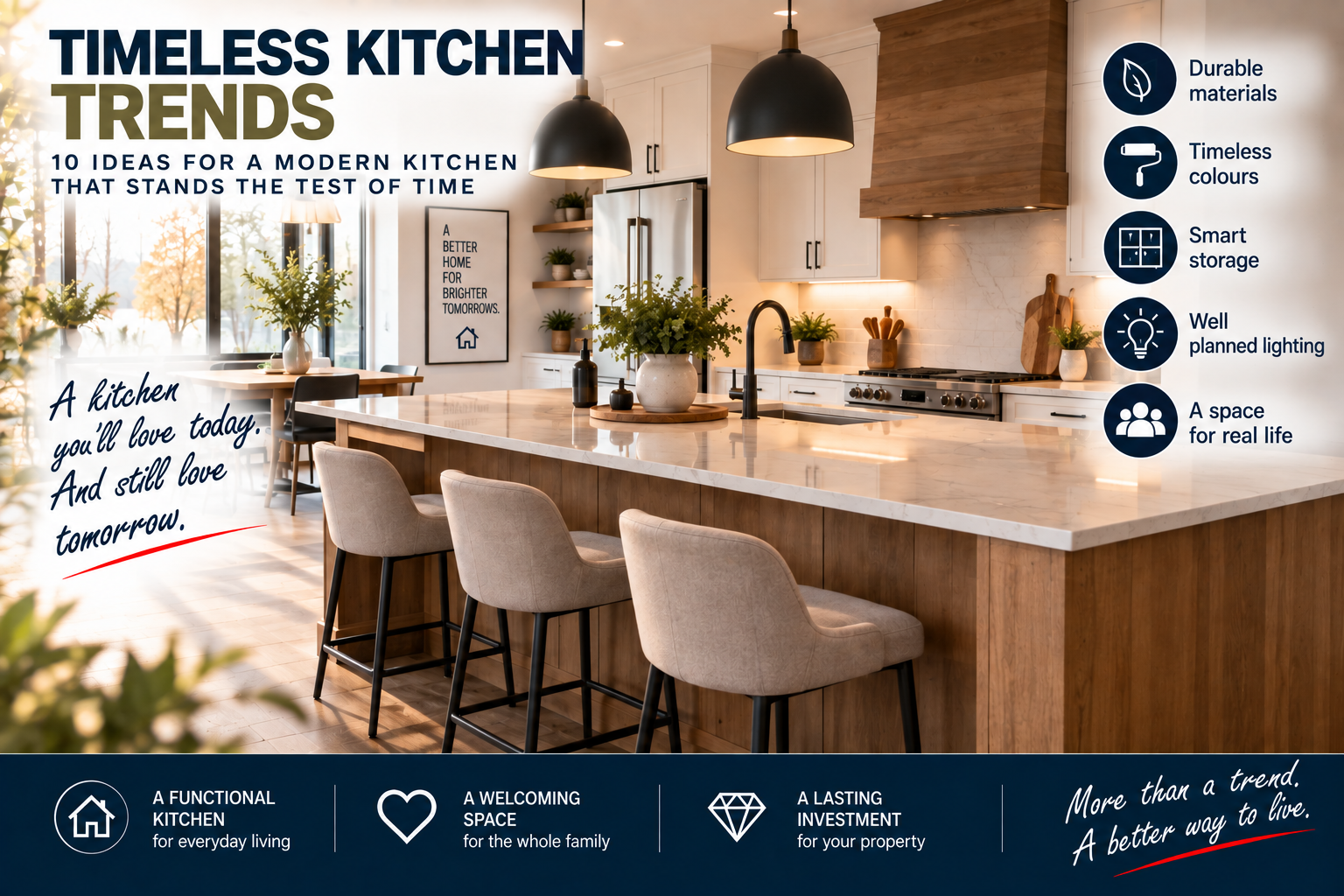
Timeless Kitchen Trends: 10 Ideas for a Modern Kitchen That Ages Well
You open your phone.
You look at a few kitchens.
Then a few more.
An hour later, you've saved a beige kitchen, a green kitchen, a wood kitchen, a minimalist kitchen and one with a massive stone island.
They're all beautiful.
But there's one question those photos can't really answer:
Which one will you still want to look at ten years from now?
Because a kitchen isn't a decorative pillow you replace when the trend changes.
The cabinets, countertops, flooring, electrical work, plumbing and island are much bigger decisions.
And much more expensive to redo.
So instead of asking:
“What's trending this year?”
Ask yourself a better question:
“What do I like today, what actually works for my life and what will still make sense when the next trend comes along?”
That's the difference between a kitchen that is simply trendy and one that ages well.
Here are 10 ideas for creating a modern kitchen built more around function, materials and consistency than a passing trend.
1. Warm minimalism is replacing the cold kitchen
A clean kitchen doesn't have to look like a showroom.
Minimalism that works well in a home is often much warmer.
Picture:
Simple lines.
Cabinets without excessive detailing.
Relatively clear countertops.
Wood.
A soft colour.
Warm lighting.
A few carefully chosen objects instead of a collection of accessories.
The difference matters.
Clean doesn't mean empty.
It means everything seems to have a place.
This approach also has a long-term advantage.
The fewer decorative details you incorporate that are strongly associated with a particular trend, the less likely your kitchen is to immediately reveal the year it was renovated.
Think about certain kitchens and bathrooms from the past.
Sometimes it only takes a few seconds to guess the era.
The problem wasn't necessarily the quality.
It was the accumulation of choices that were extremely tied to one specific moment.
In an older property in Saint-Lambert, for example, a modern kitchen does not necessarily need to erase the architectural character of the home to feel current. Simple lines and coherent materials can modernize the space without creating a contrast that feels disconnected from the rest of the property.
2. Natural materials bring a warmth that is difficult to date
Wood, stone and textures inspired by natural materials continue to have an important place in kitchens.
Why?
Because they add something that perfectly uniform surfaces can sometimes struggle to create:
Warmth.
You don't need an entirely wood kitchen.
A few elements can be enough:
-
wood cabinets or cabinet fronts;
-
a contrasting island;
-
shelving;
-
flooring;
-
stools;
-
accessories;
-
certain architectural details.
Wood works particularly well when combined with more understated surfaces.
Off-white.
Beige.
Stone.
Soft green.
Black used in moderation.
The goal isn't to turn the kitchen into a cottage.
It's to create a modern space that doesn't feel cold.
More importantly, a space where the materials aren't all fighting for your attention.
In a family home in Dollard-des-Ormeaux or Kirkland, this combination can also help modernize a larger kitchen while maintaining a warm atmosphere in a space used every day by the entire family.
3. Earthy colours are generally easier to live with than extreme colours
Colour is coming back into kitchens.
And that's a good thing.
But that doesn't mean you need to paint every cabinet in the most dramatic colour you can find.
More natural shades can add plenty of personality without completely dominating the room.
Think:
-
sage green;
-
olive green;
-
warm beige;
-
taupe;
-
brown;
-
terracotta used in moderation;
-
off-white;
-
warm grey.
If you love a very bold colour, ask yourself one question before putting it on 25 cabinet doors:
“Do I love this colour, or do I love this photo?”
They're not the same thing.
You look at a photo for a few seconds.
You're going to see your kitchen every morning.
Still not sure?
Use the colour on something that's easier to change.
A wall.
An island.
Stools.
Light fixtures.
Accessories.
You can give the kitchen plenty of personality without making the entire renovation dependent on one trend.
The more expensive a decision is to change, the more it deserves to be chosen with longevity in mind.
4. Hidden storage matters more than the number of cabinets
A beautiful kitchen without enough storage quickly becomes a cluttered kitchen.
And a huge kitchen with poorly designed cabinets can be surprisingly impractical.
Good storage isn't simply about quantity.
It's about access.
Think about what you use every day.
The coffee machine.
The toaster.
Pots and pans.
Spices.
Garbage bins.
Small appliances.
Baking sheets.
Containers.
Then ask yourself:
Where is each of these things actually going to live?
Not in the photo of the kitchen.
In your real kitchen.
On a Monday morning.
When one person is making breakfast while someone else is looking for a mug and a child is opening the pantry.
Useful solutions can include:
-
large drawers;
-
an integrated pantry;
-
vertical storage;
-
cabinets that extend to the ceiling;
-
interior drawers;
-
storage in the island;
-
a dedicated space for small appliances;
-
integrated recycling and garbage areas.
The best kitchen isn't the one that looks empty because nobody uses it.
It's the one that can be used every day and quickly put back in order.
In a condo in Verdun or Griffintown, this can become even more important. When space is limited, a few square feet of well-designed storage can be more useful than a dramatic feature that unnecessarily takes up valuable room.
5. The island should solve a problem, not create one
The kitchen island has become almost unavoidable in renovation projects.
But not every kitchen needs one.
More importantly, not every kitchen has enough space for a massive island.
An island can:
-
provide food preparation space;
-
add storage;
-
incorporate a sink;
-
provide seating;
-
create a gathering place;
-
add electrical outlets;
-
visually separate the kitchen from an open-concept area.
But it also needs to leave enough space to move around and comfortably use the cabinets and appliances.
Now imagine a kitchen with a spectacular island.
Then open the dishwasher.
Someone tries to walk behind you.
Another person opens the refrigerator.
Someone is sitting on a stool.
Everyone is blocking everyone else.
The island looks amazing.
The kitchen works poorly.
A smaller, well-proportioned island is better than a massive island that turns every meal into an obstacle course.
The size of the island should be determined by the space available.
Not by the size of the island you saved on your phone.
In Saint-Laurent, for example, the right solution can be completely different between the kitchen of a bungalow, a condo and a split-level home. A massive island may work perfectly in one layout and seriously interfere with circulation in another.
6. Countertops should be chosen for real life
The countertop is one of the most heavily used surfaces in a kitchen.
So it should be chosen based on more than a photo.
Quartz.
Granite.
Natural stone.
Porcelain or sintered surfaces.
Laminate.
Each material has its own characteristics, price and maintenance requirements.
Before choosing, ask practical questions:
-
Is it prone to staining?
-
Does it stand up well to the way you use your kitchen?
-
What maintenance does it require?
-
How does it react to heat?
-
Can it chip?
-
Can it be repaired?
-
Is the finish you like practical?
And most importantly:
Do you need the most expensive material to create a successful kitchen?
Not necessarily.
Imagine installing a beautiful, expensive countertop.
Then spending the next several years saying:
“Careful! Don't put that there!”
“Wipe that up right away!”
“Don't cut on that!”
“Watch the hot pan!”
At some point, you have to ask whether the material actually fits the way you live.
A countertop should serve your kitchen. Your kitchen shouldn't serve your countertop.
7. The backsplash can add character without controlling the entire kitchen
The backsplash is one of the most interesting places to add personality.
Why?
Because it generally covers less surface area than the cabinets or flooring.
That gives you a little more freedom.
Tile.
Stone.
Patterns.
Texture.
Large format.
Small tiles.
Tone-on-tone.
Contrast.
But be careful with the catalogue effect.
If the countertop already has dramatic veining, the cabinets are colourful, the floor is textured and the backsplash adds another strong pattern, the kitchen can quickly become visually busy.
One simple rule can help:
Decide which element should attract attention.
Then let the others play supporting roles.
A kitchen doesn't need four stars.
One can be enough.
8. Kitchen lighting should be designed in layers
A single ceiling light usually isn't enough to create an enjoyable kitchen.
Good lighting combines several functions.
General lighting
This illuminates the room.
Task lighting
This lights the areas where you actually cook, especially the countertops.
Ambient lighting
This creates a warmer atmosphere when you're not preparing a meal.
Decorative lighting
Pendant lights above the island, for example, can become an important design element.
One common mistake is thinking about lighting at the end.
Yet lighting can completely change how colours, materials and the size of a room are perceived.
Imagine two nearly identical kitchens.
Same cabinets.
Same countertop.
Same flooring.
In the first, one ceiling fixture lights the entire room.
In the second, the countertops are illuminated, the island has pendant lights and the atmosphere can be adjusted in the evening.
On paper, the kitchens are similar.
In real life, they can feel completely different.
A well-designed kitchen under poor lighting can look ordinary. A simple kitchen with good lighting can feel much more high-end.
9. Textures create depth without adding more colours
Want a simple kitchen without making it feel flat?
Work with texture.
For example:
Matte cabinets.
Natural wood.
A lightly textured backsplash.
Veined stone.
Metal.
Glass.
Fabric on the stools.
You can create plenty of visual richness while keeping the colour palette relatively limited.
That is often easier to age well than a kitchen where several strong colours compete for attention.
The key is restraint.
Two or three main materials can be enough.
You don't need to use every surface you like in the same room.
A timeless kitchen isn't necessarily a kitchen without personality. It's often a kitchen that knows when to stop.
In a property in Chambly or Carignan, for example, this kind of consistency can matter more to the visual longevity of the renovation than adding several materials simply because they are popular when the work is completed.
10. The best trend is still a kitchen designed around your daily life
This is the part inspiration photos rarely show.
How do you actually use your kitchen?
Someone who cooks every night doesn't have the same priorities as someone who frequently orders meals.
A family with three children doesn't use a kitchen the same way a couple does.
Someone who entertains regularly may want a large island.
Someone who works from home may want a small multipurpose area.
Before choosing materials, picture a normal day.
You walk in with grocery bags.
Where do you put them?
You make breakfast.
Where are the plates?
You open the dishwasher.
Can you still move around?
Two people are cooking together.
Is it comfortable?
The kids are doing their homework.
Where do they sit?
You have eight people over.
Where does everyone gather?
Now imagine that same day in the kitchen you're designing.
Does it still look as beautiful?
More importantly:
Does it still make as much sense?
The kitchen should be designed around these moments.
Not just around a photo.
In a family home in Sainte-Julie, for example, a generous work surface, accessible storage and enough room for several people to move around may provide far more everyday value than a spectacular finishing detail.
If your project goes beyond choosing finishes and also involves budgeting, the order of the work, contractor quotes or coordinating different trades, read my guide to renovating a house in Quebec.
Should you completely open the kitchen to the living room?
Not necessarily.
Open kitchens offer several advantages:
-
more light;
-
a greater sense of space;
-
better interaction with other rooms;
-
smoother circulation in certain layouts.
But there's another side you don't see as often in photos.
The dishes are visible.
Noise travels.
Cooking smells spread.
Clutter becomes part of the living room.
So before removing a wall, ask yourself whether you really want a completely open kitchen or simply:
A brighter kitchen that feels better connected.
Those aren't always the same thing.
Sometimes a partial opening or a change to the circulation can create the effect you want without completely changing the relationship between the rooms.
And if the wall is load-bearing or contains plumbing, electrical wiring or other important components, the project obviously becomes much more complex.
Don't start with the wall you want to remove. Start with the problem you're trying to solve.
When construction or renovation work is being done by a contractor, also verify that the contractor holds the required licence with the Régie du bâtiment du Québec.
Is a white kitchen outdated?
No.
A white kitchen isn't automatically outdated.
But white can feel cold when it's used everywhere without contrast or texture.
You can keep a light base and add:
-
wood;
-
stone;
-
warm lighting;
-
metal;
-
texture;
-
colour on the island;
-
natural accessories.
The problem usually isn't white.
It's the lack of depth.
Most importantly, don't replace a white kitchen you love simply because someone declared that another colour is now “trending.”
A trend should inspire you.
It shouldn't convince you to stop liking something you liked yesterday.
Do you need quartz to have a beautiful kitchen?
No.
Quartz is popular for good reasons, but it isn't mandatory.
Your countertop choice should take into account:
-
your budget;
-
how you use the kitchen;
-
your tolerance for maintenance;
-
the look you want;
-
durability;
-
the other materials in the kitchen.
A less expensive countertop that is well chosen can work perfectly in a balanced renovation.
The price of the material alone doesn't determine the quality of the design.
A cohesive, well-planned kitchen can be far more successful than a more expensive kitchen where every decision was made separately.
What is the most expensive mistake in a kitchen renovation?
Often, it isn't a colour.
It's a functional decision that is difficult to correct.
Moving plumbing unnecessarily.
Completely changing the layout without gaining anything meaningful.
Building an island that is too large.
Not having enough storage.
Forgetting electrical outlets.
Creating passages that are too narrow.
Installing insufficient lighting.
A colour can be repainted.
A handle can be replaced.
A light fixture can be changed.
Moving an entire kitchen is another story.
Here's a simple way to prioritize your decisions:
The more difficult and expensive something will be to change later, the more thought you should give it today.
Layout.
Circulation.
Plumbing.
Electrical.
Island dimensions.
Storage.
Then come the decisions that are easier to change.
Paint.
Handles.
Accessories.
Stools.
Decor.
Invest more thought in the decisions that are difficult to change.
Should you follow kitchen trends if you plan to sell your home?
With caution.
If you're renovating mainly for yourself and plan to stay for a long time, your personal taste should carry a lot of weight.
If you're thinking about selling soon, the logic changes.
You don't need to create a completely neutral kitchen.
But you should consider how it fits with:
-
the style of the property;
-
its location;
-
its price range;
-
the likely expectations of buyers;
-
the other renovations in the home.
Imagine an extremely luxurious kitchen in a property where the rest of the home needs major work.
The contrast can be dramatic.
But not necessarily in the way you want.
And spending $50,000 on a kitchen doesn't automatically mean the property is worth $50,000 more.
Buyers don't reimburse your renovation bills.
They compare your property with the other homes they could buy.
A renovation can improve a home's value and appeal without returning every dollar you invested.
In a market such as Saint-Lambert, the level of finish buyers expect may be different from that of a property in Chambly or Sainte-Julie. This is not about one area being better than another. The renovation simply needs to remain consistent with the property type, its price range and the homes buyers will actually compare it with.
If resale is your main objective, my guide Renovating Before Selling in Quebec: Which Home Improvements Actually Add Value? can help you evaluate the kitchen within the broader context of the property and buyer expectations.
Modern kitchens in Greater Montreal and on the South Shore: should you make the same choices everywhere?
Not necessarily.
A kitchen should respect the property it belongs to.
In a family home in Dollard-des-Ormeaux or Kirkland, storage, circulation and a large eating area may be especially important.
In a condo in Verdun or Griffintown, every inch of storage may matter more than having a massive island.
In Saint-Laurent, a kitchen in a bungalow, condo or split-level home may require completely different strategies.
On the South Shore, a property in Saint-Lambert, Chambly, Carignan or Sainte-Julie may also come with different layouts, architectural styles and expectations.
The design should therefore begin with the property itself.
Not the trend.
Kitchen trends that age well have something in common
They don't necessarily look like trends.
They look like good decisions.
A logical layout.
Well-planned storage.
Materials suited to the way the kitchen is used.
Thoughtful lighting.
Colours you genuinely like.
An island that is proportionate to the space.
A kitchen that fits the home.
So before choosing the next finish, ask yourself three questions:
Do I genuinely like this element?
Does it improve the way I use my kitchen?
Would I still choose it if I hadn't seen it everywhere online?
If the answer to all three is yes, you're probably much closer to creating a kitchen that will age well.
Because in the end, the best kitchen isn't the one that perfectly reflects a particular year.
It's the one that still works when that year is long gone.
A trend catches your attention today.
A good decision keeps working tomorrow.
The right decision. At the right time... For the right reasons.
Jonathan Cabana
Residential and Commercial Real Estate Broker
eXp Québec
Greater Montreal | South Shore
(514) 476-0730