
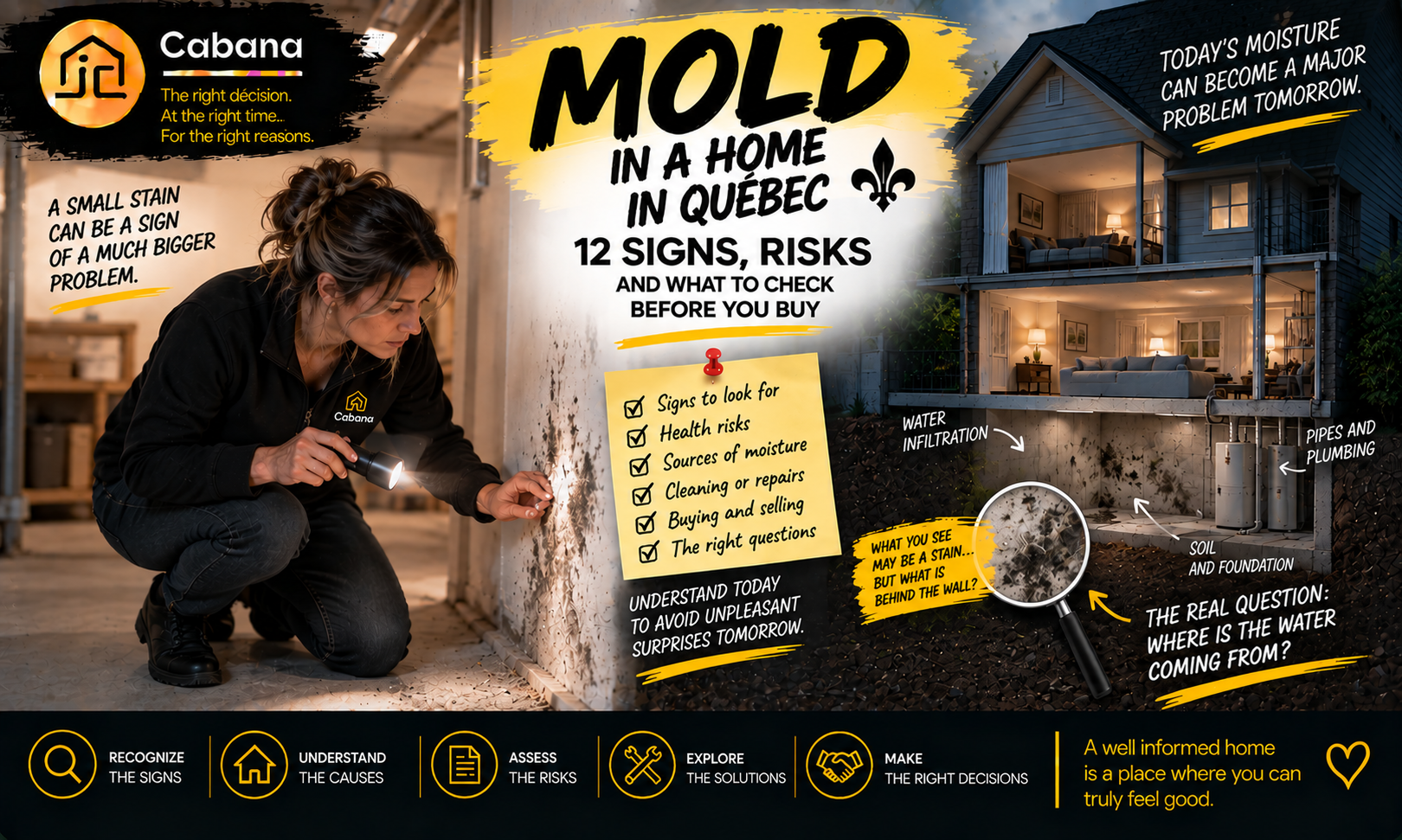
Mould in a Quebec Home: 12 Warning Signs, Hidden Risks and Things to Check Before Buying
You are viewing a house.
In one corner of the basement, you notice a few small dark patches near the bottom of a wall.
Nothing dramatic.
The seller tells you:
“It's just a little mould. It cleans up easily.”
Maybe.
But that is not the right question yet.
The real question is:
Why did the mould appear there in the first place?
Because you can clean a stain.
You can repaint the wall.
You can even replace a section of drywall.
But if water is still getting behind that wall, what have you actually solved?
A small area of mould caused by a one-time moisture problem that has already been corrected is not necessarily comparable to contamination that keeps returning because the underlying cause was never eliminated.
Same appearance.
Not necessarily the same cause.
Not necessarily the same repairs.
Not necessarily the same cost.
Not necessarily the same consequences.
And certainly not the same level of uncertainty.
That is why there are two reactions to avoid when you discover mould.
The first:
“It's nothing. We'll just clean it.”
The second:
“There's mould. We should avoid this house.”
Both reactions make the same mistake.
They make the decision before understanding the problem.
Before deciding, you need to understand what you are seeing, why it appeared, how far the problem may extend, what may be hidden and what actually needs to be corrected.
Here are 12 things to know about mould in a Quebec home, particularly before buying, selling or renovating a property.
1. What is mould?
Mould is a type of microscopic fungus that occurs naturally in the environment.
Mould spores can be present in the air and enter buildings.
The problem begins when indoor conditions allow mould to grow on materials.
And one of the essential ingredients for that growth is moisture.
Mould can grow on materials such as:
-
wood;
-
paper;
-
cardboard;
-
drywall;
-
certain insulation materials;
-
fabrics;
-
carpets;
-
various materials and finishes exposed to moisture.
Health Canada emphasizes the same underlying principle. Mould grows in damp or wet areas, and preventing its return requires correcting the underlying moisture problem.
That is why discovering mould should quickly lead to another question:
Where is the water or moisture coming from?
Because cleaning mould without correcting its source may simply create the conditions for it to return.
Put another way:
The mould is what you can see. The moisture may be the problem you actually need to solve.
And in a real estate transaction, that distinction can be significant.
A stain might require cleaning.
An active water problem behind a finished wall could involve opening the wall, removing materials, correcting the source, drying the assembly and rebuilding the finishes.
Same stain.
Potentially very different project.
2. What are the possible signs of mould in a house?
Mould does not always look the same.
You may notice:
-
black, greenish or other coloured patches;
-
a musty or earthy smell;
-
discoloured materials;
-
water stains;
-
recurring condensation;
-
swollen or deteriorated drywall;
-
finishes that are peeling away;
-
damp materials;
-
contamination that returns after cleaning.
But sometimes the problem is not immediately visible.
Mould can grow behind certain materials, inside walls or in other areas that are difficult to inspect.
Imagine a freshly painted basement.
The walls look immaculate.
New flooring.
New baseboards.
Fresh paint.
Everything looks finished.
But a musty smell remains.
What does the new paint tell you about what is behind the drywall?
Almost nothing.
A persistent odour without an obvious source therefore deserves further investigation.
But be careful not to make the opposite mistake.
A black patch is not automatically evidence of a catastrophic problem.
And a wall that looks clean is not automatically proof that nothing is happening behind it.
Observation is the beginning of the investigation.
Not necessarily the conclusion.
3. What health problems can be associated with mould?
People living in damp or mouldy environments may be more likely to experience certain health problems, including:
-
eye irritation;
-
nose and throat irritation;
-
coughing;
-
phlegm buildup;
-
wheezing;
-
shortness of breath;
-
worsening asthma symptoms;
-
certain allergic reactions.
Health Canada identifies effects including irritation of the eyes, nose and throat and worsening of asthma symptoms in connection with mould exposure.
Some people may be more sensitive than others.
This can include some children, seniors and people with respiratory conditions or significant allergies.
For people with severely weakened immune systems, some airborne moulds may also present particular risks.
But another premature conclusion should be avoided.
If someone is coughing in a home where mould is present, that does not automatically prove that mould is causing the cough.
Respiratory symptoms can have many causes.
A health problem should be assessed by a health professional. A building problem should be assessed as a building problem.
One should not be used to improvise a diagnosis of the other.
4. Is there a “safe” level of mould in a house?
There is no universal number comparable to Canada's 200 Bq/m³ radon guideline.
That difference matters.
You cannot simply obtain a number and ask:
“Am I below the limit?”
There are many types of mould, and people's responses to exposure can vary considerably.
There is therefore no single indoor concentration that universally establishes that a home is risk-free.
In many residential situations, the more useful process is to:
-
identify the mould or moisture problem;
-
understand its cause;
-
correct that cause;
-
clean or remove affected materials when necessary;
-
verify that the problem does not return.
That changes the way you should think about the issue.
You are not simply looking for a reassuring number.
You are trying to understand why conditions that allow mould to grow exist in this house.
5. Do you always need an air test to know whether there is mould?
No.
This is particularly important in a real estate transaction.
When mould growth is visible or a moisture problem is obvious, identifying the exact species of mould is generally not necessary before taking action.
You already know that something needs to be investigated and corrected.
Similarly, measuring mould concentrations in the air is not automatically necessary in every residential situation.
That does not mean specialized testing is never useful.
In more complex situations, further professional investigation may be appropriate.
In Quebec, the BNQ 3009-600 standard provides a reference framework for the investigation, diagnosis and remediation of mould contamination in residential buildings. The BNQ describes the standard as a framework for proper inspection, diagnosis and decontamination of mould growth in residential buildings.
But avoid this reasoning:
“Until an air test confirms mould, I don't have a problem.”
Imagine this instead.
You can see mould.
The drywall is damp.
Water is still getting in.
Is your first priority really to determine the scientific name of the mould?
Probably not.
Your first priority is to understand why the material is wet.
The test should help answer a question.
It should not become a substitute for asking the right one.
6. Is mould what damages the structure of a house?
This question requires some nuance.
Mould can contribute to the deterioration of certain materials.
But in many situations, the more important problem is what allowed the mould to grow:
persistent water and moisture.
Long-term water infiltration can affect:
-
wood;
-
drywall;
-
insulation;
-
finishes;
-
certain building assemblies;
-
other moisture-sensitive materials.
Wood that remains wet long enough can also experience other forms of deterioration, including rot.
It would therefore be too simplistic to say:
“The mould is destroying the structure.”
A better question is:
“What is the source of the moisture, how long has it existed and which materials have been affected?”
Because a small visible patch can sometimes be a symptom of a larger water problem.
What you see may be the consequence. Not necessarily the cause.
7. Where should you look for the source of moisture?
Start by thinking like water.
If you were the water, how did you get there?
Possible sources can include:
-
a plumbing leak;
-
foundation water infiltration;
-
a roof leak;
-
previous water damage;
-
flooding;
-
a sewer backup;
-
condensation;
-
excessive indoor humidity;
-
inadequate ventilation;
-
problems around certain windows;
-
materials that were not adequately dried after becoming wet.
In a basement, pay particular attention to places where water could enter or accumulate.
Around windows.
Near the bottom of walls.
Close to plumbing.
Inside enclosed spaces.
Around materials that appear to have been replaced.
And most importantly, do not ask only:
“How did you clean the mould?”
Ask:
“What was done to eliminate the source of the moisture?”
The first question tells you how the symptom was treated.
The second helps you determine whether the problem itself was actually corrected.
That difference matters.
Cleaning may cost very little.
Correcting the reason the wall keeps getting wet may be an entirely different project.
If the moisture appears connected to the foundation, drainage or water around the property, these 12 essential spring exterior checks after winter explain several exterior elements worth checking, including gutters, grading, drainage and the foundation.
8. Can you clean a small area of mould yourself?
In many limited situations, yes.
For small and certain medium-sized areas, homeowners can generally perform cleanup themselves when appropriate precautions are taken.
Depending on the situation, that can include:
-
gloves;
-
safety glasses or goggles;
-
a well-fitting disposable N95 respirator;
-
measures to limit the spread of particles;
-
proper cleaning of surfaces that can be cleaned.
And here is an important point:
Bleach is generally not necessary.
Health Canada recommends cleaning small amounts of mould with water and dish soap and states that bleach is not necessary. For large areas, or mould that repeatedly returns after cleaning, professional assistance should be considered.
But not every material can be treated the same way.
A hard surface that can be cleaned is not the same as drywall that has been deeply affected by moisture and mould.
Some heavily contaminated or damaged porous materials may need to be removed and replaced.
When contamination is extensive, keeps returning after cleaning or is associated with a significant water problem, professional assistance may be much more appropriate.
Again, the question is not only:
“Can I clean this?”
It is also:
“Why did this happen, and what will prevent it from coming back?”
9. What humidity level should you maintain inside a home?
Excessive humidity encourages mould growth.
Health Canada generally recommends maintaining indoor relative humidity between:
30% and 50%.
A hygrometer can help you monitor humidity levels.
Depending on the season and characteristics of the home, several measures may also be useful:
-
use bathroom exhaust fans;
-
properly use a kitchen range hood that vents outdoors;
-
use a dehumidifier when necessary;
-
repair leaks quickly;
-
address water infiltration;
-
maintain appropriate ventilation;
-
avoid leaving wet materials damp for long periods.
After water damage or flooding, speed matters.
Wet materials should be cleaned and dried as quickly as possible, ideally within 24 to 48 hours.
The longer materials remain wet, the more favourable the conditions become for mould growth.
It is a simple rule worth remembering:
Controlling mould starts with controlling moisture.
10. Can a small visible patch hide a much larger problem?
Yes.
But not automatically.
And that distinction matters.
Imagine two houses.
House A
A small patch appeared around a window after a condensation problem.
The cause was identified.
The problem was corrected.
The area was cleaned.
The mould did not return.
House B
A small patch appears near the bottom of a finished basement wall.
It has already been painted over twice.
A musty smell keeps returning.
Nobody knows what is happening behind the drywall.
Same amount of visible mould?
Maybe.
Same level of uncertainty?
Absolutely not.
In House A, you have a relatively clear history.
In House B, you have a visible symptom and several unknowns.
Those unknowns could eventually mean:
-
opening the wall;
-
removing drywall;
-
removing insulation;
-
investigating water infiltration;
-
correcting the source of moisture;
-
drying materials;
-
remediation;
-
rebuilding the finishes.
Or maybe not.
And that is precisely the problem. You do not know yet.
This is where buyers sometimes focus on the wrong thing.
They look at the size of the stain and try to estimate the size of the problem.
But the two are not necessarily proportional.
A five-centimetre stain does not tell you there are only five centimetres of affected material behind the wall.
Nor does it prove there is extensive contamination.
It tells you something deserves to be understood.
That is why you also want to know:
How long has it been there?
Does it keep coming back?
What is the source of moisture?
What is behind the material?
What has already been done?
A small patch does not automatically mean a major problem.
But a small patch does not automatically mean a small problem either.
11. What should a buyer check before buying a house that has had mould?
Start by asking for the history of the problem.
Not simply:
“Is there still mould?”
Instead, ask:
-
where the mould was found;
-
when it was discovered;
-
what caused the water or moisture;
-
whether that cause was corrected;
-
which materials were affected;
-
which materials were removed;
-
who completed the work;
-
whether invoices are available;
-
whether before-and-after photographs exist;
-
whether there is an expert report;
-
whether the problem has returned.
During a pre-purchase home inspection in Quebec, pay particular attention to signs of moisture.
But remember that a visual inspection has limitations.
A finished wall is still a finished wall.
An inspector cannot automatically see what is behind it.
If the observations or history raise enough questions, additional professional investigation may become appropriate depending on the circumstances and conditions of the transaction.
And this is where the consequence matters.
If you buy first and investigate later, you may discover that what looked like a cleaning project was actually an infiltration project.
Or a drainage project.
Or a plumbing project.
Or a demolition and reconstruction project.
Maybe none of those things will be necessary.
But before buying, wouldn't you rather know which problem you are actually agreeing to take on?
Your objective is not to prove that the house is perfect.
It is to understand what you are buying well enough to decide whether you are prepared to accept what comes with it.
12. What should a seller do if the house has had a mould problem?
Document it.
Keep:
-
reports;
-
invoices;
-
photographs;
-
documents relating to repairs of leaks or water infiltration;
-
documentation of remediation work;
-
details about materials that were removed or replaced;
-
available professional assessments.
In a Quebec transaction involving a real estate broker, the Declarations by the seller of the immovable form is used to provide relevant information about the condition and history of the property, to the best of the seller's knowledge. Water damage, previous problems, repairs and supporting documentation can all become relevant when completing and reviewing that history.
And avoid an answer such as:
“There was a little mould, but it's all fixed.”
Compare that with:
“Here is where the problem was discovered. Here is the source of moisture that was identified. Here is what was repaired. Here is the work that was completed and the documentation we have.”
Both answers could describe exactly the same house.
But they do not give the buyer the same information.
The first essentially asks the buyer to accept a conclusion.
The second allows the buyer to understand what happened.
A reassuring statement lasts a few seconds. Good documentation allows the situation to be analyzed.
And documentation can answer the questions that otherwise become uncertainty:
What happened?
Why did it happen?
What was opened?
What was removed?
What was repaired?
Who did the work?
Has the problem returned?
The more clearly those questions can be answered, the easier it becomes for someone to understand the property's history.
If you are preparing the property for sale, my guide to the documents needed to sell a house in Quebec can also help you organize reports, invoices and other supporting documents before the property goes on the market.
Is black mould always more dangerous?
Not necessarily.
The colour of mould alone is not enough to determine its health risk or the seriousness of the building problem.
Black mould is therefore not automatically a catastrophe.
And mould of another colour is not automatically harmless.
In practice, the more useful questions are often:
How extensive is the contamination?
What is the source of moisture?
How long has the problem existed?
Which materials are affected?
Does the problem keep returning?
Who is being exposed?
Do not let colour replace analysis.
Does mould automatically mean the walls need to be demolished?
No.
It depends on the situation.
A small amount of superficial mould on a cleanable surface is not the same as heavily contaminated drywall following prolonged water infiltration.
Some materials can be cleaned.
Others may need to be removed.
The Government of Quebec specifically identifies heavily water-damaged porous materials such as drywall, carpets and insulation among materials that may need to be discarded.
And sometimes a targeted opening may be recommended to understand the true extent of the problem.
The goal is not to demolish out of fear.
Nor is the goal to leave a wall closed simply because you would rather not know what is behind it.
The response should be proportional to what the observations and professional assessment justify.
Is a house with a history of mould automatically a bad house?
No.
Consider two properties.
House A
Five years ago, a plumbing leak caused a moisture problem.
The leak was repaired.
Affected materials were removed.
The work is documented.
No signs of recurrence have been observed since.
House B
There is a musty smell in the basement.
There are marks near the bottom of a wall.
The owner says:
“It's probably just normal basement humidity.”
No investigation.
No documentation.
No known cause.
Which house is automatically better?
There is not enough information to answer that question.
But which one contains more unknowns?
House B.
And that distinction is essential.
House A has a history.
You can review it.
You can understand the cause.
You can verify the work.
You can look for signs that the problem has returned.
House B gives you a current observation without an explanation.
A past problem that was documented and corrected can be analyzed. A current problem with an unknown cause first needs to be understood.
Sometimes buyers focus entirely on whether a property has ever had a problem.
A better question may be:
“If there was a problem, do I understand what happened and what was done about it?”
Because a property with a documented history and a property with no known history are not necessarily the same thing as a property with a good history and a property with a bad history.
Sometimes “we don't know” is the most important information in the file.
Does a negative air test guarantee there is no mould?
No.
A test result needs to be interpreted according to the method used, the context and the question you are trying to answer.
A one-time air sample does not suddenly turn every closed wall into an inspected surface.
It does not repair a leak.
It does not replace identifying the source of moisture.
And it does not make visible contamination irrelevant.
Imagine that an air test appears reassuring.
But the wall is still damp.
The stain keeps returning.
A musty smell remains.
Have you really answered the important question?
Not necessarily.
The test is a tool.
It is not permission to ignore what the building is showing you.
Can you simply paint over mould?
That does not solve the underlying problem.
New paint may temporarily improve the appearance.
But if moisture continues to support mould growth behind or beneath the finish, you have essentially hidden the symptom.
Imagine water getting behind a wall.
You clean it.
You repaint it.
Six months later, the stain returns.
The problem is not that you chose the wrong paint colour.
The problem is that you never eliminated the source of the water.
That distinction is particularly important when buying a recently renovated home.
A beautiful finish shows you the condition of the finish.
It does not automatically tell you the history of what is behind it.
Remember this rule:
Correct the cause before focusing on appearance.
10 questions to ask before buying a house where mould is suspected
Before making your decision, ask:
-
Where was the mould or moisture observed?
-
How long has the problem been known?
-
What is the source of the water or moisture?
-
Has that source been corrected?
-
Which materials were affected?
-
Were any materials removed or replaced?
-
Are reports, photographs or invoices available?
-
Has the problem returned after cleaning or repairs?
-
Is additional professional investigation recommended?
-
What still remains unknown?
That final question may be the most important.
Because what increases uncertainty in a real estate transaction is not necessarily the fact that a problem existed in the past.
Sometimes it is not being able to understand its current extent.
The stain is not always the real problem
Go back to the basement.
That small dark patch is still there.
Is it serious?
Maybe.
Maybe not.
At this point, you still do not have enough information to know.
And that is exactly the point.
The stain is an observation.
Not a complete diagnosis.
Visible mould is something that needs to be addressed.
But it can also be a clue.
A clue pointing to humidity.
A leak.
Water infiltration.
Condensation.
Previous water damage.
Or a problem that was never properly corrected.
So do not ask only:
“How do I remove the mould?”
Also ask:
“Why did it appear?”
“How much is actually affected?”
“Which materials are involved?”
“Was the source of moisture corrected?”
“What is still hidden or unknown?”
Because a patch only a few centimetres wide may be exactly what it appears to be.
A small problem.
Or it may be the only visible part of a much larger issue.
You should not minimize the first possibility or automatically assume the second.
You need to understand which one you are dealing with.
That is how you turn a concerning stain into a problem you can actually analyze.
And if you are buying a property, that distinction matters enormously.
A home that had a moisture problem in the past is not automatically a bad home.
But buying without understanding an active or recurring problem can turn a small patch at the bottom of a wall into a much larger project than expected.
So before you focus on removing the stain, understand what created it.
Before you focus on the appearance of the wall, understand what may be happening behind it.
Before you decide whether the house is right or wrong for you, understand what you are actually agreeing to take on.
Do not stop at what you can see. Understand why you can see it.
Then make your decision based on information rather than assumption.
The right decision. At the right time... For the right reasons.
Jonathan Cabana
Residential and Commercial Real Estate Broker
eXp Québec
Greater Montreal | South Shore
(514) 476-0730