
Living in Candiac on Montreal’s South Shore: Real Estate, Transportation, Neighbourhoods and Quality of Life
You are looking for a property on Montreal’s South Shore.
Candiac keeps appearing in your search.
You see tree-lined streets.
Single-family homes.
Condos.
Parks.
A commuter train station.
Access to Highways 15 and 30.
On paper, there is a lot to like.
But before asking:
“Is Candiac a good place to live?”
Ask a more useful question:
“Does this address in Candiac actually work with my life?”
Because in real estate, you are never buying only a municipality.
You are buying a property.
A street.
A daily commute.
An environment.
Ownership costs.
Advantages.
And certain compromises.
Candiac has characteristics that distinguish it from several other South Shore communities, including its extensive urban forest, parks, cycling network, commuter train station and ongoing development around public transit.
But none of those features automatically makes a particular property a good choice.
Understand the city. Then evaluate the address.
Why Live in Candiac?
Candiac is located in the Montérégie region on Montreal’s South Shore, near communities including La Prairie, Delson, Saint-Constant and Saint-Philippe.
The municipality is located near Highways 15 and 30 and has a commuter train station with park-and-ride facilities.
For a homebuyer, that location can be attractive.
But proximity to Montreal should never be measured only in kilometres.
Your actual experience will depend on where you need to go, when you travel and how you get there.
The same principle applies to parks and services.
A beautiful park on the other side of town does not provide the same everyday benefit as a green space you can reach on foot.
A municipal feature becomes a real estate advantage when it actually improves your daily life.
For a buyer comparing Candiac, La Prairie, Saint-Constant and Sainte-Catherine, differences in transportation, services and surroundings can matter much more than simply comparing asking prices.
Why Is Candiac Known for Its Trees?
This is one of Candiac’s more distinctive characteristics.
The City uses the expression “Ma ville sous les arbres,” or “My city under the trees,” to emphasize the importance of its urban forest.
According to the City of Candiac, approximately 17,000 trees are located on municipal rights-of-way and in public parks.
Thousands of trees throughout Candiac contribute significantly to the character of many established areas.
But there is an important distinction.
Buying in Candiac does not automatically mean buying on a mature, tree-lined street.
Different parts of the city can feel very different.
Newer developments may have a different character from neighbourhoods that have been established for decades.
When visiting a property, look at what actually surrounds it.
Are the trees on the property?
Are they on municipal land?
What is the backyard orientation?
How much privacy do they provide?
What maintenance could eventually be required?
Most importantly, how does the street actually feel when you walk through it?
Candiac’s green reputation is meaningful.
Your immediate surroundings are still what you are buying.
In an established part of Candiac, that experience can feel very different from a newer development, or from a comparable property in Saint-Constant or La Prairie. The specific street tells you what Candiac’s green reputation will actually mean in your daily life.
Parc André-J.-Côté and Maison Hélène-Sentenne: A Distinctive Side of Candiac
If you want to understand part of Candiac’s identity, Parc André-J.-Côté is a good place to start.
Located along the St. Lawrence River, this large public space combines nature, recreation and culture. It includes mature trees, outdoor spaces, recreational amenities and seasonal activities.
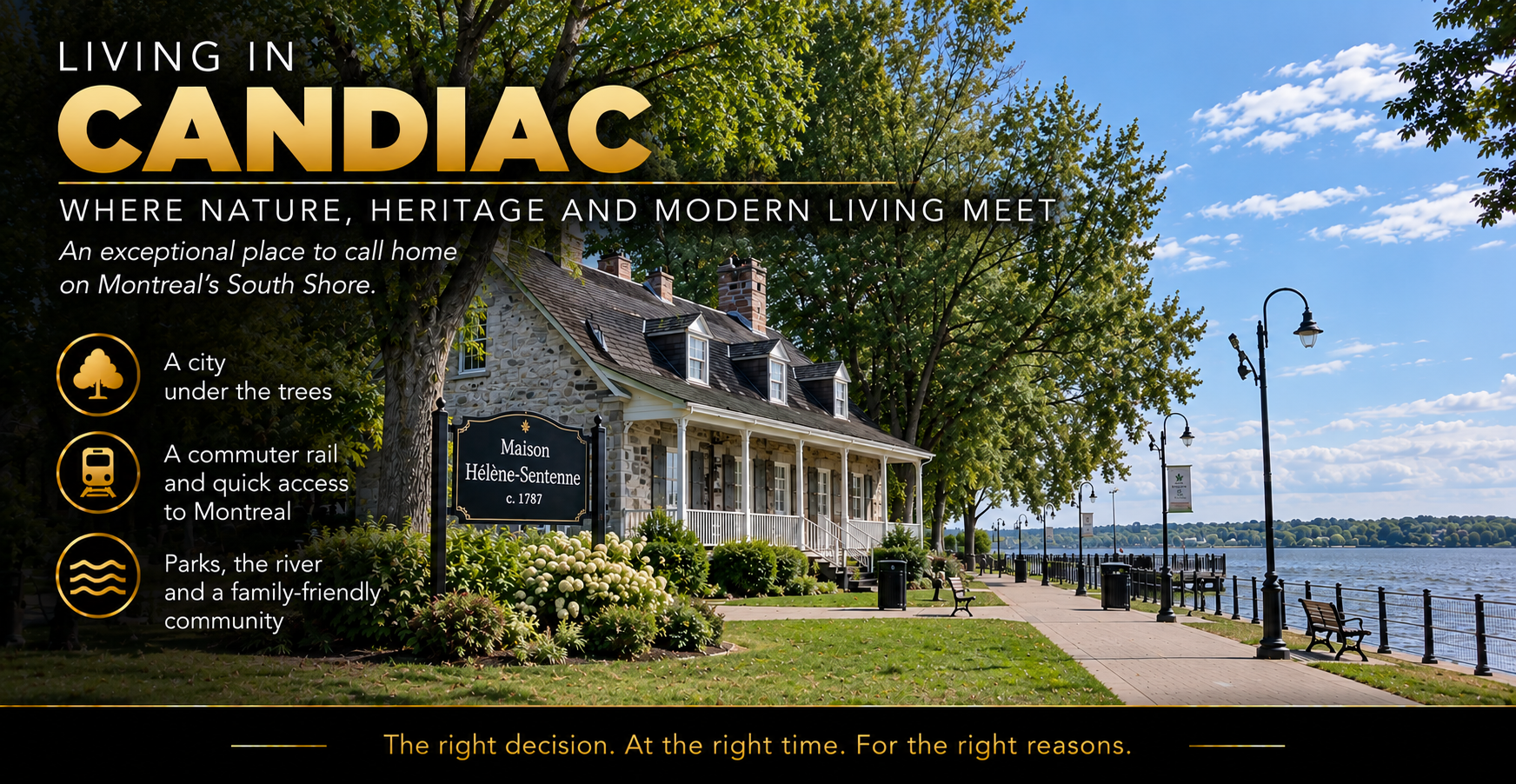
The park is also home to Maison Hélène-Sentenne, formerly known as Maison Melançon.
The heritage property, with a stone bearing the date 1787, has become a place dedicated to arts and culture and is part of Candiac’s historical identity.
It creates an interesting contrast.
A modern residential city.
Historic heritage.
A substantial tree canopy.
And the St. Lawrence River.
Should living near a beautiful park determine whether you buy a property?
No.
But it can affect your quality of life if that environment matches the way you actually live.
Ask yourself a simple question:
“Will I really use the things I like about Candiac?”
If you enjoy walking, cycling, green spaces or spending time near the river, certain areas may naturally offer more value to you.
If your priorities are different, other criteria should carry more weight.
An advantage only has value when it improves your life.
What Is the Real Estate Market Like in Candiac?
Candiac offers different types of housing, including single-family homes, condos and properties in newer developments.
You will easily find searches for:
“Candiac house prices”
or:
“Average house price in Candiac.”
Those statistics can help you understand the broader market.
They do not automatically determine what a particular property is worth.
A home’s value can be influenced by:
-
its specific area;
-
the street;
-
living space;
-
lot size;
-
age;
-
renovations;
-
overall condition;
-
garage;
-
basement;
-
layout;
-
proximity to certain infrastructure;
-
recent comparable sales.
A municipal median price is not an appraisal of your house.
Two properties only a few streets apart can offer very different realities and values.
To determine whether an asking price makes sense, you need to analyze the property itself and genuinely comparable transactions.
Is Candiac a Good Place for Families?
Candiac has several characteristics that may appeal to families.
The city includes schools and daycares, parks, sports facilities, a library, cultural facilities and community services.
But I would never buy a house simply because a municipality is described as “family-friendly.”
Ask more specific questions:
-
Which school currently serves the address?
-
What will the trip to school actually look like?
-
Which parks will you really use?
-
Could your children eventually get there easily?
-
Where will their activities take place?
-
How will your space requirements change?
-
Does the street fit the daily life you want?
A family with a baby may evaluate Candiac very differently from a family with three teenagers.
A city can work well for families in general without every property being right for yours.
For a family comparing Candiac, Saint-Constant and La Prairie, the school serving the address, children’s activities and daily transportation can therefore matter more than the name of the municipality.
Is Commuting Between Candiac and Montreal Convenient?
Candiac offers several transportation options.
Candiac station is part of exo’s Candiac commuter train line. The train ride between Candiac and Lucien-L’Allier station in downtown Montreal is approximately 40 minutes.
Current train service operates Monday through Friday. There is currently no train service on Saturday or Sunday.
Schedules can change, so always verify the service that applies to your situation before making a real estate decision based on the train.
The municipality also has bus services and infrastructure that can make it possible to combine different forms of transportation.
All of that matters.
But your commute is not simply the time you spend on the train.
Your commute starts at your front door.
It may include:
-
getting to the station or park-and-ride;
-
waiting;
-
the train or bus ride;
-
a connection;
-
travelling from your arrival point to work;
-
the return trip.
And if you drive, your experience will depend heavily on your destination and traffic conditions.
Do you work downtown?
In Brossard?
In Saint-Laurent?
In Montreal’s West Island?
Elsewhere on the South Shore?
“Montreal” is not one commute.
Do not choose a home based on a theoretical travel time.
Test the commute you will actually live.
For someone working in Saint-Laurent, for example, a property in Candiac can create a very different commuting experience from one closer to Montreal. For someone working in Brossard, the calculation may be different again. Your actual commute is part of the property you are buying.
Are Candiac’s Cycling Paths a Real Advantage?
For some buyers, absolutely.
Candiac has invested considerably in active transportation. The municipality currently reports 34 km of cycling routes and nearly 10 km of pedestrian trails.
You can review the municipality’s current information through the City of Candiac’s official portrait.
But just like parks, the value depends on how that infrastructure fits into your life.
Can you easily reach the cycling network from the house?
Could you use a bicycle for some everyday trips?
Could your children use the network?
Would it mainly be recreational for your household?
A cycling path you use three times a week has far more personal value than one that simply looks good on a map.
What Should Buyers Know About New Developments in Candiac?
Candiac continues to evolve, particularly around its train station.
The Candiac station TOD, or Transit-Oriented Development, is one of the major projects to watch.
Municipal planning covers approximately 54 hectares, with a residential potential of roughly 4,800 units, along with commercial space, local services, offices, public areas, parks and infrastructure designed to encourage active and public transportation.
The City currently reports 975 units built or under construction and another 3,839 units in the approval process, for a projected total of 4,814 units.
For a buyer, this type of development can create opportunities.
But it also raises questions.
If you are buying near an area undergoing transformation:
-
What exists today?
-
What is still only planned?
-
Which phases remain to be built?
-
How could traffic patterns change?
-
Which stores and services are actually open?
-
What type of density is planned around the property?
-
How long could construction and development continue?
A development rendering can look impressive.
But you are buying into the neighbourhood that exists today and the one that may exist tomorrow.
Both deserve attention.
The difference between an established part of Candiac and a developing area is also worth comparing with properties available in Saint-Constant, La Prairie or Sainte-Catherine, particularly if your priority is an already mature environment rather than a neighbourhood that will continue to evolve.
Existing Home or Newer Construction in Candiac?
This is a particularly relevant comparison in a city that combines established neighbourhoods with newer developments.
An existing home may offer:
-
a more mature street;
-
established trees;
-
a lot where the surroundings are already visible;
-
a neighbourhood whose current character you can observe.
A newer property may offer:
-
contemporary design;
-
newer materials and systems;
-
certain modern energy features;
-
a differently planned environment.
But “new” does not automatically mean “better.”
And “older” does not automatically mean “problem.”
Compare the condition of the building, applicable warranties, lot, density, costs, future work and surrounding environment.
If you are considering an existing property, my guide to pre-purchase home inspections in Quebec explains what an inspection can help you understand about the apparent condition of the building before you buy.
Buy the characteristics that meet your needs. Not the label attached to the year of construction.
Is Candiac a Good Option for Retirement?
It can certainly be one of the municipalities worth considering.
But retirement needs vary considerably.
One person may want a low-maintenance condo.
Another may want to keep a house and yard.
Someone else may prioritize proximity to stores and services.
Another person may care most about walking, recreation or staying close to family.
If you are considering Candiac for retirement, think long term.
Ask yourself:
-
Do you want stairs?
-
How much maintenance do you want to handle?
-
Will you need two cars?
-
Can you easily reach essential services?
-
Would the property remain practical if your mobility changed?
-
Do you plan to travel frequently and leave the property without significant maintenance?
The right retirement property is not simply a smaller property. It should make the life you want easier.
Candiac or Saint-Constant?
The two municipalities are close enough that buyers often compare them during a home search.
But they are not identical.
Candiac may attract your attention because of its tree canopy, parks, cycling network, road access, waterfront environment and development around its train station.
Saint-Constant has its own residential areas, train station, municipal facilities and distinct identity, including its railway heritage and Exporail.
Do not simply ask:
“Which city is better?”
Ask:
“Which property gives me the best combination of location, space, cost and quality of life for my needs?”
Compare actual properties.
At actual prices.
On actual streets.
Using your actual commute.
Candiac or La Prairie?
La Prairie is another natural comparison.
Depending on your search, a few kilometres can change the type of property available, access to services, your daily commute and the surrounding neighbourhood.
That is why I would not limit a search simply because a buyer started by saying:
“I absolutely want Candiac.”
Start with your criteria.
Budget.
Property type.
Space.
Commute.
Schools, when relevant.
Services.
Environment.
Then look at which addresses actually meet those criteria.
Choose your lifestyle before choosing your postal code.
Is Buying an Investment Property in Candiac a Good Idea?
Candiac’s growth and development projects can naturally attract the attention of real estate investors.
But a growing city does not automatically make every property a good investment.
Analyze:
-
purchase price;
-
financing;
-
potential income;
-
expenses;
-
taxes;
-
maintenance;
-
condo costs when applicable;
-
rental demand relevant to that type of property;
-
holding period;
-
resale scenario.
Municipal development can contribute to changes in an area.
It does not guarantee your return.
The right question is not: “Will Candiac increase in value?”
The question is:
“Does this property, at this price and under these assumptions, work with my strategy?”
Analyze the property. Not just the city.
Thinking About Selling a Property in Candiac?
A desirable municipality does not automatically determine the value of a home.
Suppose a neighbouring property is listed at a high price.
That does not mean your home is worth the same amount.
A listing price is not a sold price.
And even a completed sale is only useful if the property is sufficiently comparable.
When establishing a pricing strategy, consider:
-
recent comparable sales;
-
properties currently competing for buyers;
-
the specific area;
-
living space;
-
lot size;
-
property condition;
-
renovations;
-
garage;
-
basement;
-
characteristics specific to the location.
Then ask one essential question:
At this price, what other properties can the buyer choose instead?
Your home is not alone on the market.
It is competing for the same buyer’s budget.
In Candiac, that can also mean buyers comparing your property with homes in Saint-Constant, La Prairie or Sainte-Catherine, depending on their budget, commute and preferred property type.
That is the same principle I explain in my guide to pricing your home to sell in Quebec.
9 Questions to Ask Before Buying a Property in Candiac
Before making an offer to purchase, ask yourself:
-
Does my real commute work at the times I will actually travel?
-
Does this street provide the environment I picture when I think about Candiac?
-
Which parks, cycling paths and facilities will I genuinely use?
-
Which school currently serves this address if that matters to me?
-
Do I prefer an established area or a neighbourhood still being developed?
-
Which future projects could change the environment around the property?
-
Is the asking price consistent with genuinely comparable properties?
-
Will this property still meet my needs in five or ten years?
-
What advantages and compromises will a future buyer see if I eventually sell?
That last question can change the way you evaluate a property.
Because the things that make you hesitate today may become the same objections you encounter when you eventually sell.
So, Is Candiac Right for You?
Candiac has several distinctive characteristics on Montreal’s South Shore.
A significant urban forest.
Parks.
Parc André-J.-Côté and access to the St. Lawrence River.
Maison Hélène-Sentenne and local heritage.
An established cycling network.
A commuter train station and public transportation.
Access to Highways 15 and 30.
Established neighbourhoods.
New areas under development.
But no list can make the decision for you.
Go there.
Walk through the neighbourhood.
Test your commute.
Compare a mature street with a newer development.
Look at what is planned around the property.
Compare Candiac with Saint-Constant, La Prairie, Sainte-Catherine and other municipalities that fit your criteria.
Most importantly:
Choose an address, not simply a city’s reputation.
Because a good real estate decision is not the one that looks most impressive on paper.
It is the one that works with your life, your finances and your plans.
Understand First. Advise Second.
The right decision. At the right time... For the right reasons.
Jonathan Cabana
Residential and Commercial Real Estate Broker
eXp Québec
Greater Montreal | South Shore
(514) 476-0730