
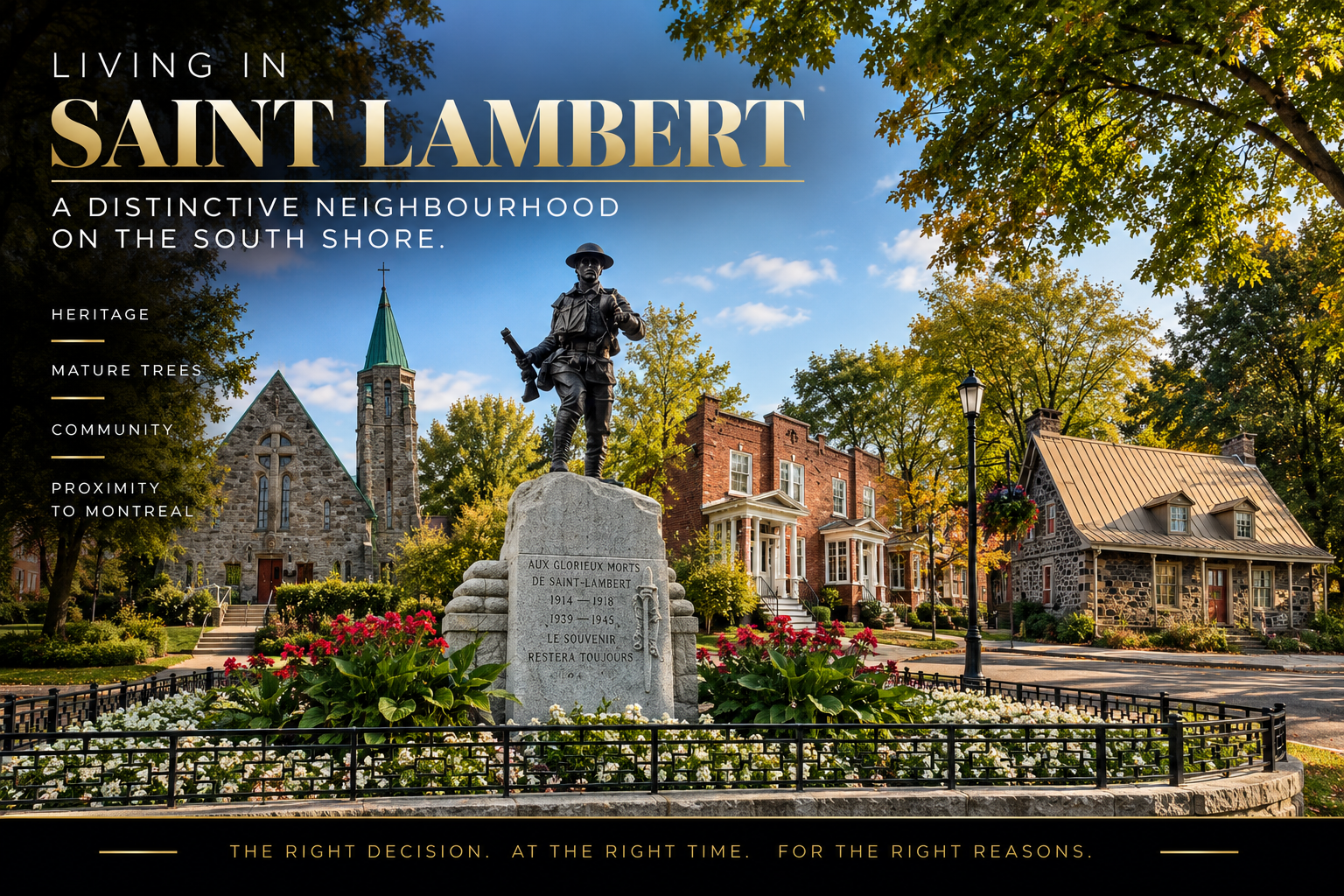
Living in Saint-Lambert on Montreal’s South Shore: Real Estate, Neighbourhoods, Transportation and Quality of Life
You find a property in Saint-Lambert.
A stone or brick house on a street lined with mature trees.
A condo.
An older property with architecture that immediately catches your attention.
Victoria Avenue is nearby.
Montreal seems close.
So does Brossard.
And unlike some newer areas of the South Shore, Saint-Lambert has an environment that cannot simply be recreated by building a new development.
Established streets.
Mature trees.
Homes from different eras.
Varied architecture.
A commercial core integrated into the city.
An identity built over generations.
All of that can make Saint-Lambert appealing.
But none of it tells you whether you should buy a particular property.
Before asking:
“Is Saint-Lambert a good place to live?”
ask a much more useful question:
“Does this particular address in Saint-Lambert actually work with my life?”
Because you are not buying Saint-Lambert’s reputation.
You are buying a property.
A street.
A lot.
An environment.
A commute.
Services.
Ownership costs.
Potential renovations.
And the compromises that come with that address.
Understand what attracts you to Saint-Lambert. Then determine whether the property actually gives it to you.
Why do buyers consider Saint-Lambert?
Saint-Lambert has a different character from many newer areas of the South Shore.
It is a mature, largely developed municipality.
And you can see it in the residential environment.
Older homes.
Established streets.
Mature trees.
Different architectural styles.
Condos and other types of housing.
A commercial core around Victoria Avenue.
Geographic proximity to Montreal, Longueuil and Brossard.
For some buyers, that combination is exactly what they are looking for.
For others, it may create compromises.
An older property may require more maintenance.
A mature lot may have considerations that a newer lot does not.
An address that looks convenient on a map may produce a very different commute from the one you imagined.
Do not choose Saint-Lambert for its image. Determine whether the property and address work with your priorities.
For a buyer comparing Saint-Lambert, Longueuil, Brossard and Saint-Bruno-de-Montarville, differences in property, building age, lot size and transportation can quickly become more important than the name of the municipality.
Built heritage and mature streets are part of Saint-Lambert’s identity
In Saint-Lambert, the city’s character does not come from a single landmark.
It comes from the entire environment.
Stone houses.
Brick buildings.
Properties from different eras.
Mature trees.
Streets that existed long before many of the South Shore’s newer developments.
That combination can create exactly the environment some buyers are looking for.
But architectural character never replaces an analysis of the building itself.
A property can be beautiful and still require significant work.
Before buying, understand what is behind the appearance.
How old is the property?
What work has already been completed?
Were the renovations documented?
Which components may be approaching the end of their useful life?
What is the condition of the foundation, roof, windows, plumbing and electrical system?
Are there relevant servitudes or restrictions?
What maintenance does the lot require?
A property’s character may be a reason to visit it. Its condition should determine how you analyze it.
This is one reason a pre-purchase home inspection in Quebec can become particularly important when an older property attracts your attention. The objective is not to find a perfect house. It is to better understand the building and the responsibilities you are considering taking on.
Does Victoria Avenue and downtown Saint-Lambert actually add value for you?
Saint-Lambert’s main commercial core is centred around Victoria Avenue.
Restaurants.
Shops.
Professional services.
Neighbourhood activity.
For some buyers, being able to integrate these destinations into their routine can have considerable value.
But “close to Victoria Avenue” can mean very different things depending on the address.
Ask yourself:
-
Can I realistically walk there?
-
Is this a trip I would make regularly?
-
Which businesses would I actually use?
-
Do I want to be very close to the activity or slightly removed from it?
-
Does the location fit my lifestyle, or does it simply sound attractive in a real estate listing?
A downtown area has more value when it becomes part of your daily life.
What is the Saint-Lambert real estate market like?
Saint-Lambert has a varied housing stock.
That variety is exactly why municipal averages become less useful when analyzing a specific property.
Two properties in the same municipality can differ significantly because of:
-
the street;
-
property type;
-
age;
-
architecture;
-
living area;
-
lot size;
-
condition;
-
renovations;
-
garage;
-
basement;
-
immediate surroundings;
-
recent comparable sales.
A renovated older house does not automatically compare with another older house simply because both are in Saint-Lambert.
The same applies to condos.
A municipal median describes a market. It does not appraise your house.
Statistics provide context.
Comparable sales bring the analysis back to the property.
Older house or condo in Saint-Lambert?
This decision should not begin with:
“Which is better?”
It should begin with:
“Which responsibilities do I actually want to take on?”
A house may provide more space, a lot, a particular layout or architectural character that appeals to you.
But you also assume direct responsibility for maintaining the property.
A condo can reduce some individual responsibilities.
But you then need to analyze:
-
condo fees;
-
the contingency fund;
-
financial statements;
-
meeting minutes;
-
planned work;
-
insurance;
-
condominium rules;
-
potential special assessments.
Compare the total cost and responsibilities. Not simply the asking price.
Buying an older house in Saint-Lambert: what should you check?
An older property can be beautiful.
It can also contain decades of renovations, maintenance and modifications.
Depending on the property, examine:
-
the foundation;
-
structure;
-
roof;
-
windows;
-
insulation;
-
electrical system;
-
plumbing;
-
drainage;
-
previous renovations;
-
available permits;
-
signs of water infiltration;
-
likely future work.
Age alone does not tell you whether a house is good or bad.
A well-maintained older property can be very different from another property of the same age that has received little investment.
Analyze the property. Not simply the year it was built.
Are mature trees always an advantage?
Tree-lined streets can be part of what attracts a buyer to Saint-Lambert.
But a mature tree deserves practical analysis too.
Look at:
-
its proximity to the house;
-
the branches;
-
the roots;
-
its condition;
-
its interaction with structures;
-
maintenance responsibilities;
-
rules that may apply to work or removal.
The same logic applies to the lot.
Drainage.
Slope.
Landscaping.
Fences.
Existing structures.
What gives a lot character also deserves your attention during property due diligence.
Is Saint-Lambert a good fit for families?
Saint-Lambert has schools, parks, sports facilities and different services.
But that does not mean every address works for every family.
The useful analysis begins with your routine.
Ask:
-
Which school serves this exact address?
-
How will the children get there?
-
Where are daycare and activities?
-
How much driving will be required each week?
-
Are the parks we would actually use convenient?
-
Does the property offer enough space for the coming years?
-
How will transportation needs change as the children become more independent?
A municipality can work for many families without every property working for yours.
Can you live in Saint-Lambert with one car?
Saint-Lambert is relatively compact, but whether your household can function with one vehicle still depends on your address and routine.
Look at your entire week:
-
work;
-
school;
-
daycare;
-
groceries;
-
activities;
-
appointments;
-
family;
-
recreation;
-
public transportation;
-
walking;
-
cycling.
Then ask the difficult question:
What happens when two people need to go somewhere at the same time?
An address that works perfectly for one household can be much less practical for another.
Your mobility depends on your real life. Not simply your proximity to Montreal.
What is transportation like between Saint-Lambert and Montreal?
Saint-Lambert is geographically close to Montreal.
But “close to Montreal” does not describe your commute.
Your destination matters.
Downtown Montreal is one scenario.
Brossard is another.
Longueuil is another.
Saint-Laurent is another.
Your schedule matters too.
And your mode of transportation can completely change the calculation.
If you plan to use public transportation, calculate the trip door to door:
-
walking or travelling to your departure point;
-
waiting time;
-
transit time;
-
transfers;
-
the final portion of the trip;
-
the evening return;
-
flexibility when your schedule changes.
If you drive, test the trip at the times you will actually need to make it.
Do not buy a theoretical commute. Test the one you are actually going to live with.
Is proximity to Montreal Saint-Lambert’s main advantage?
Not necessarily.
For some buyers, it may be extremely important.
For others, established streets, architecture, downtown Saint-Lambert, the type of property or the residential environment may matter more.
That is precisely why Saint-Lambert should not be reduced to simply being a suburb near Montreal.
Ask instead:
“If Montreal were not my main criterion, what would still make me choose this property?”
That question can reveal what you genuinely value.
Saint-Lambert or Brossard?
These two municipalities can appear in the same home search, particularly for buyers who want to remain close to Montreal.
But they can offer very different real estate experiences.
Compare:
-
property type;
-
building age;
-
lot;
-
the businesses and services you would use;
-
transportation;
-
commute;
-
ownership costs;
-
maintenance;
-
street environment.
For the other side of this comparison, my guide to living in Brossard on Montreal’s South Shore looks at Brossard’s neighbourhoods, housing, REM access and transportation considerations.
Do not ask which municipality is better.
Ask:
“What does my budget buy in each municipality, and what compromises come with those properties?”
Saint-Lambert or Boucherville?
For some buyers, Boucherville may also enter the search.
The comparison becomes useful because the property, lot, commute and relationship with Montreal can change.
An address in Saint-Lambert may position you differently in relation to central areas.
A property in Boucherville may respond to other priorities.
But the municipality’s name should not make the decision for you.
Compare real properties.
Then compare what your week would look like in each one.
Saint-Lambert or Saint-Bruno-de-Montarville?
Saint-Bruno-de-Montarville may also appear in searches for buyers considering several established South Shore municipalities.
Again, do not begin with a ranking.
Look at:
-
what your budget buys;
-
the type of house;
-
the lot;
-
the commute;
-
services;
-
maintenance;
-
activities;
-
long-term priorities.
Choose your criteria before choosing your postal code.
Does Saint-Lambert cost more than other parts of the South Shore?
A useful affordability comparison should not stop at the purchase price.
Look at the total cost of ownership.
That can include:
-
financing;
-
municipal and school taxes;
-
insurance;
-
heating;
-
maintenance;
-
renovations;
-
condo expenses, when applicable;
-
transportation;
-
the number of vehicles your household requires.
A less expensive property may require considerably more work.
A more expensive property may eliminate certain costs or compromises.
Or the opposite may be true.
Affordability is not simply the asking price. It is how the property fits into your actual budget.
Is Saint-Lambert a good place for real estate investment?
A desirable address does not automatically turn a property into a good investment.
Analyze the property as an investment.
Consider:
-
acquisition price;
-
financing;
-
realistic income;
-
expenses;
-
taxes;
-
maintenance;
-
applicable rules;
-
demand for that type of housing;
-
competing properties;
-
exit strategy.
Never assume proximity to Montreal guarantees future appreciation.
It does not.
The municipality provides context. The numbers need to support the strategy.
Thinking about selling a property in Saint-Lambert?
Saint-Lambert’s varied housing stock makes the selection of comparable properties particularly important.
A sale in your neighbourhood may be interesting without being truly comparable to your property.
Look at:
-
the street;
-
the lot;
-
living area;
-
age;
-
architectural style;
-
condition;
-
renovations;
-
garage;
-
basement;
-
distinctive features;
-
competing properties currently for sale;
-
recent comparable sales.
Then ask an essential question:
“At my asking price, what else can the buyer purchase in Saint-Lambert or nearby municipalities?”
Your property is not competing with an average.
It is competing with the buyer’s real alternatives.
What should you check before buying in Saint-Lambert?
Before making an offer, understand:
-
the property;
-
the street;
-
the lot;
-
the building’s age;
-
renovations;
-
services;
-
transportation;
-
ownership costs;
-
applicable restrictions;
-
comparable sales.
Then move beyond the data and test your daily life.
Visit the street in the morning.
Return near the end of the workday.
Spend time there on the weekend.
Walk to the places you think you would use.
Make your actual commute to work.
If Victoria Avenue attracts you, start from the property and see how it really fits into your routine.
Theoretical advantages become useful only when they work from your address.
10 questions to ask before moving to Saint-Lambert
Before making an offer, ask yourself:
-
Why do I specifically want to live in Saint-Lambert?
-
Does this address actually give me what I am looking for?
-
Do I want a house, a condo or simply an address in this municipality?
-
What work could this property require?
-
What will my actual daily commute look like?
-
Can we function with the number of vehicles we want to own?
-
Will we actually use downtown Saint-Lambert, the parks and nearby services?
-
Is the asking price supported by genuinely comparable properties?
-
Could Brossard, Boucherville, Saint-Bruno-de-Montarville or another municipality eliminate an important compromise?
-
Will this property still work if our employment, family or transportation needs change?
The final question matters.
A house can remain in the same place for a very long time.
Your life probably will not.
So, is Saint-Lambert a good place to live?
Saint-Lambert has several characteristics that may attract a buyer.
Established residential streets.
Mature trees.
Varied architecture.
A commercial core around Victoria Avenue.
Parks and municipal facilities.
Proximity to Montreal, Longueuil and Brossard.
But none of those characteristics automatically makes a particular property the right one.
Visit the street.
Test the commute.
Analyze the building.
Understand the lot.
Calculate the costs.
Compare the real properties available within your budget.
If Brossard is one of your alternatives, compare the property with the scenarios in my Brossard real estate and neighbourhood guide.
Most importantly:
Choose an address, not simply the name of a city.
Because Saint-Lambert can have a strong identity.
But your address will determine your daily life.
The right property is the one that works with your finances, transportation, responsibilities and the life you actually want to live.
The right decision. At the right time... For the right reasons.
Jonathan Cabana
Residential and Commercial Real Estate Broker
eXp Québec
Greater Montreal | South Shore
(514) 476-0730