
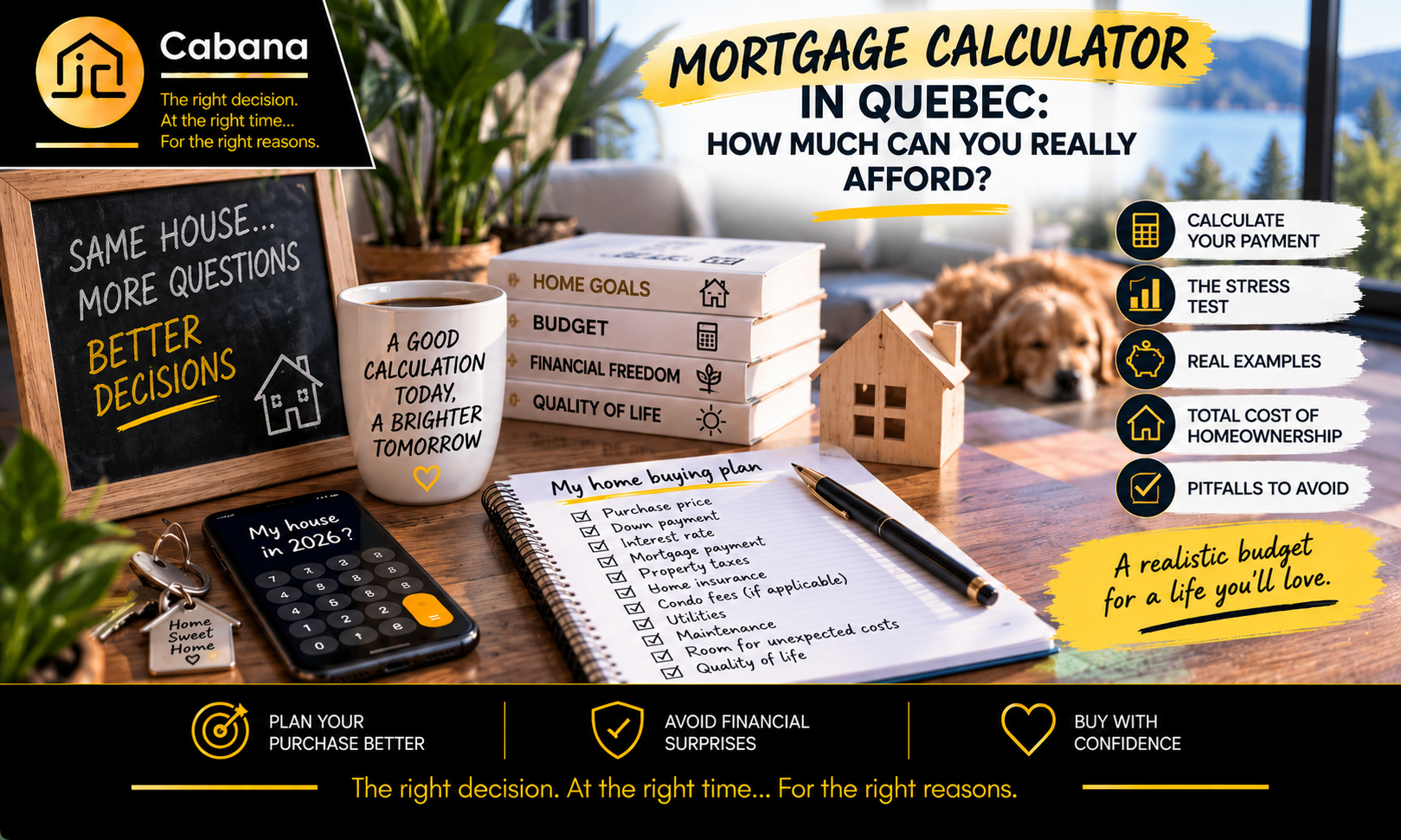
Mortgage Calculator in Quebec: How Much Home Can You Really Afford?
You find a house for $650,000.
You like it.
The neighbourhood works.
It has the bedrooms.
The yard too.
You are already starting to imagine your life in the property.
Where the couch will go.
Which bedroom the kids will have.
What you could do with the yard.
Then comes the question that ideally should have been asked before the showing:
“Can I actually afford this house?”
A mortgage calculator can help you answer part of that question.
It can estimate your payment based on the purchase price, down payment, mortgage rate, amortization period and payment frequency.
But there is an important distinction to understand:
Calculating a mortgage payment and determining how much home you can actually afford are two different things.
Your payment is a number.
Your ability to comfortably afford the property depends on your complete financial situation.
And the longer you wait to make that distinction, the more emotional the decision can become.
Because it is much easier to walk away from a $650,000 house while looking at a calculator...
than while standing in its kitchen already imagining yourself living there.
Here is how to use a mortgage calculator intelligently before you start looking for a home in Quebec.
How do you calculate a mortgage payment?
To estimate your mortgage payment, you generally need several variables:
-
the purchase price of the property;
-
your down payment;
-
the amount being financed;
-
the interest rate;
-
the amortization period;
-
the payment frequency.
Change one of those variables and your payment can change.
That is exactly what makes a mortgage calculator useful.
Instead of wondering abstractly whether you can buy a $500,000, $600,000 or $700,000 home, you can test different scenarios and see their actual effect on your payments.
But here is the trap:
Do not let the calculator answer a question it was not designed to answer.
It can show you a payment.
It does not know whether that payment will still allow you to travel.
Save.
Replace your car.
Absorb a major repair.
Or simply sleep comfortably when the other bills arrive.
Use a mortgage calculator before viewing homes
My Quebec mortgage calculator becomes especially useful before you seriously begin your property search.
Why?
Because adjusting your expectations while looking at numbers is much easier than doing it after falling in love with a house.
Test different scenarios.
For example:
Scenario A
Purchase price: $550,000
Down payment: $75,000
Rate: based on your scenario
Amortization: based on your financing
Then compare it with:
Scenario B
Purchase price: $625,000
Same down payment
Same assumed rate
Same amortization
The difference is no longer simply:
“This house costs $75,000 more.”
You can see what that additional $75,000 means for your financing.
For your payment.
And ultimately for your budget.
Then ask yourself another question:
“What would this higher payment prevent me from doing every month?”
That is where the calculation starts becoming genuinely useful.
Because $75,000 is a price.
But the additional payment is a consequence you will live with month after month.
For a buyer comparing properties in Saint-Laurent, Brossard, Longueuil or Candiac, this exercise can also show whether a higher purchase price in one location leaves enough room for the transportation, taxes and other costs associated with that specific address.
Mortgage payment vs. borrowing capacity: what is the difference?
This is probably the most important distinction in this article.
A mortgage calculator can show you what a payment might look like.
It does not approve your mortgage.
It does not check your credit.
It does not verify your income.
It does not necessarily know all your debts.
And it does not automatically determine whether a lender will finance your purchase.
Your borrowing capacity depends on factors such as:
-
your income;
-
existing debts;
-
car payments;
-
credit balances and obligations;
-
other financial commitments;
-
your down payment;
-
the rate used to qualify you;
-
costs associated with the property;
-
the lender's criteria.
So:
calculated payment ≠ automatically approved mortgage amount.
But there is a second distinction that matters just as much:
approved amount ≠ amount you should automatically spend.
The calculator helps you understand the numbers.
The mortgage analysis helps you understand what may be financed.
Your personal budget then needs to determine what is actually comfortable for you.
How does the mortgage stress test work?
In Canada, mortgage qualification is not necessarily based only on the interest rate you will actually pay.
For mortgages subject to the applicable stress test, borrowers must demonstrate that they can handle a payment calculated using a higher qualifying rate.
The qualifying rate is generally the higher of:
5.25%
or
your contractual mortgage rate + 2%.
Suppose, simply as an example, that your contractual rate is 4.25%.
Your contractual rate + 2% would be:
6.25%.
In that scenario, the qualifying rate would therefore be 6.25%, because it is higher than 5.25%.
That helps explain why someone may look at the payment associated with their mortgage rate and wonder:
“Why can't I borrow more?”
The lender is not looking only at the payment you expect to make today.
The qualification process is also designed to determine whether your finances can handle a more demanding scenario.
But remember this:
Passing the lender's test does not automatically mean passing your own financial test.
The lender evaluates your capacity according to its criteria.
You also need to evaluate your comfort according to your reality.
How much can you borrow to buy a home?
This is probably the question you would like to turn into one simple number.
For example:
“I earn $100,000 a year. How much can I borrow?”
Unfortunately, income alone is not enough.
Two households earning exactly the same income can have very different borrowing capacities.
Imagine two households that each earn $120,000 per year.
The first has:
-
little debt;
-
no significant car payment;
-
a solid down payment;
-
good cash reserves after the purchase.
The second has:
-
two car payments;
-
credit balances;
-
other monthly obligations;
-
a minimum down payment;
-
very little money left after the transaction.
Same income.
Completely different financial situations.
Your income matters. What your income already has to pay for matters too.
And even two households with exactly the same borrowing capacity may choose completely different budgets.
Why?
Because they do not necessarily have the same priorities.
GDS and TDS: why do your debts affect mortgage qualification?
You may hear the terms GDS and TDS ratios.
GDS means Gross Debt Service.
TDS means Total Debt Service.
Without turning this article into a mortgage-financing course, the important concept is fairly simple.
A lender does not look only at your mortgage payment.
It considers the relationship between your income and certain housing expenses, while also taking other financial obligations into account when evaluating your overall debt load.
That is why a car payment can affect how much home you can afford.
The same can apply to credit card debt, lines of credit, student loans and other financial obligations.
A house does not exist in a financial vacuum.
Every dollar already committed elsewhere is a dollar that may not be available to support your housing costs.
Down payment: how much do you need?
Your down payment directly affects the amount you need to finance.
For a home priced at $500,000 or less, the minimum down payment can start at 5%.
For a property priced above $500,000 but below $1.5 million, the minimum down payment is generally:
-
5% on the first $500,000;
-
10% on the portion above $500,000.
For a property priced at $1.5 million or more, a minimum down payment of 20% is generally required.
But here is the trap.
The minimum down payment is not necessarily the down payment that makes the most sense for your situation.
And putting down the maximum amount possible is not automatically the best decision either.
Why?
Because you will still need money after making your down payment.
So the real question is not only:
“How much can I put down?”
It is also:
“How much do I absolutely need to keep after my down payment?”
What changes when your down payment is less than 20%?
When your down payment is below 20% and the property and financing are eligible, mortgage loan insurance is generally required.
This insurance protects the lender if you default.
It is not insurance that pays your mortgage for you if your budget becomes tight.
The premium depends partly on the relationship between the amount borrowed and the property's value.
The premium can generally be added to the mortgage.
That is why comparing two down-payment amounts without considering the complete financing picture can be misleading.
A different down payment can change:
-
the amount borrowed;
-
the applicable insurance premium;
-
your payment;
-
the cash you have left.
And sometimes, the cash remaining after the transaction matters just as much as the amount you managed to put toward the property.
For a more detailed explanation of how that insurance affects the financing, see CMHC Mortgage Loan Insurance in Canada: Down Payment, Premiums and Rules Buyers Should Know.
Your mortgage payment is not your total monthly cost of homeownership
This is one of the most common mistakes.
You use the mortgage calculator.
It shows a mortgage payment of $2,900 per month.
You currently pay $2,500 in rent.
You think:
“For only $400 more per month, I could own a home.”
Not so fast.
Your mortgage payment is only one part of the cost of ownership.
Depending on the property, you may also need to budget for:
-
municipal taxes;
-
school taxes;
-
home insurance;
-
condo fees;
-
electricity and heating;
-
certain services depending on the property;
-
maintenance;
-
repairs;
-
a reserve for major expenses;
-
transportation costs associated with your new address.
Imagine that your mortgage really does cost $400 more than your rent.
But once taxes, insurance, maintenance and other expenses are included, the actual difference becomes much larger.
You have not necessarily made a bad decision.
You have simply discovered that you were comparing the wrong numbers.
The useful comparison is not:
rent vs. mortgage.
It is:
total cost of renting vs. total cost of owning.
That distinction becomes especially important when comparing a condo in Saint-Laurent or Brossard, a townhouse in Longueuil, or a single-family home in Candiac or Saint-Constant. The mortgage payment alone does not capture the different costs attached to each property type and address.
For a broader comparison, see Renting vs. Buying a Home in Quebec: Which Choice Costs More Over Time?.
How much money should you keep after your down payment?
This is a question more buyers should ask.
Suppose you have $90,000 available.
Does that mean you should put the entire $90,000 toward your down payment?
Not necessarily.
You may still need money for:
-
the notary;
-
the inspection;
-
property transfer duties;
-
adjustments;
-
moving;
-
furniture or appliances;
-
repairs;
-
your emergency reserve.
Before deciding how much of your available cash can actually go toward the down payment, you can use my Quebec Welcome Tax Calculator to estimate the property transfer duties that may need to remain in your acquisition budget.
A larger down payment can reduce your mortgage.
But draining your cash to reduce your mortgage can create another problem.
You could become the owner of a home while having almost no money left to actually be a homeowner.
Imagine an unexpected expense of several thousand dollars appearing two weeks after you move in.
The question is no longer:
“Did I manage to buy the house?”
You already bought it.
The question becomes:
“Do I still have enough financial room to absorb what comes with it?”
Those are not the same thing.
How does the mortgage rate affect your payment?
The interest rate can have a significant effect on your payment and the total cost of your financing.
That is why your mortgage calculation should not contain only one scenario.
Test several.
For example:
-
your current assumed rate;
-
that rate + 0.5%;
-
that rate + 1%;
-
an even more conservative scenario if your budget is tight.
Then ask:
“If the scenario changes, does my budget still work?”
This approach can help you avoid building your entire purchase around a single interest-rate assumption.
Because a budget that works only when every variable lines up perfectly leaves very little room when reality changes.
Fixed or variable mortgage rate: which should you use in your calculation?
Both.
Not because you should necessarily choose one or the other today.
But because the mortgage calculator can help you understand the effect of different rate scenarios.
Fixed and variable mortgage rates have different characteristics and risks.
The appropriate choice depends on factors such as your financial situation, tolerance for payment or rate changes, the terms available and your time horizon.
A calculator shows you the numbers.
It should not choose your mortgage product for you.
Use the simulations to understand the consequences of different scenarios.
Then make the financing decision based on your actual situation.
25-year or 30-year amortization: what changes?
A longer amortization period can reduce your periodic payment.
But that does not mean the financing becomes less expensive.
All else being equal, spreading repayment over a longer period generally means paying interest for longer.
For eligible insured mortgages, amortizations of up to 30 years are available to first-time homebuyers and buyers of new builds, subject to the applicable conditions.
The important thing is not to look only at:
“Which scenario gives me the smallest payment?”
Also ask:
“Which scenario fits my budget, and what does it cost over time?”
A smaller payment can improve your monthly cash flow.
But you should understand what you are getting in exchange and what it means over the life of the financing.
Monthly, biweekly or accelerated payments: which frequency should you choose?
Payment frequency can affect how your mortgage is repaid.
But there is one misconception worth clearing up:
Paying biweekly is not a requirement for having a good mortgage.
Depending on your contract, several payment frequencies may be available.
Accelerated payments can help you repay principal faster, but you need to understand exactly how the lender calculates those payments.
Choose a frequency that works with:
-
your pay schedule;
-
your budget;
-
your cash flow;
-
the terms of your mortgage.
The goal is not to choose the payment frequency that sounds best.
It is to choose one your budget can consistently maintain.
Mortgage calculator, prequalification and preapproval: are they the same thing?
No.
A mortgage calculator lets you test scenarios.
A prequalification can provide an initial idea of your borrowing capacity based on the information considered.
A mortgage preapproval can involve a more detailed analysis and help you structure your property search around the financing terms available to you.
But even a preapproval is not necessarily a final guarantee of financing for any property you choose.
The lender may still need to confirm that the property and transaction satisfy its requirements.
So:
mortgage calculator = planning
mortgage analysis = borrowing capacity
final approval = financing the transaction under the applicable conditions
Do not confuse these steps.
And especially do not confuse any of them with your comfortable personal budget.
“The bank approved me for $700,000. Should I buy at $700,000?”
Not necessarily.
This is probably one of the most important questions in this article.
The maximum amount a lender is prepared to finance reflects its qualification criteria.
It does not necessarily know all your personal priorities.
Maybe you want to:
-
travel;
-
continue investing;
-
have a child;
-
replace your vehicle;
-
start a business;
-
reduce your working hours;
-
renovate the property;
-
maintain a significant financial reserve.
Your mortgage limit is therefore not automatically your personal budget.
Imagine being approved for $700,000, but at that price almost all your monthly financial flexibility disappears.
You may be able to buy the property.
But what do you have to give up to keep it?
That is where the real decision begins.
The maximum amount you can borrow is not necessarily the maximum amount you should spend.
For a buyer choosing between Saint-Laurent, Brossard, Saint-Lambert or La Prairie, that distinction can also affect which property type or municipality creates the most comfortable overall budget.
The real test: what is left after the payment?
Start with your monthly net income.
Then subtract:
-
your estimated mortgage payment;
-
taxes;
-
insurance;
-
condo fees, if applicable;
-
utilities;
-
debt payments;
-
transportation;
-
food;
-
other recurring expenses;
-
savings;
-
a realistic maintenance allowance.
What is left?
Not on paper.
In your actual life.
Can you still go out?
Travel?
Save?
Absorb a repair?
Handle an increase in other expenses?
Or does every unexpected expense immediately become a problem?
That is where the calculation becomes personal.
Two buyers can be approved for the same amount.
One may feel completely comfortable with the payment.
The other may feel like they are working only to pay for the house.
Qualification tells you what can be financed. Your budget tells you what kind of life you actually want to live.
Can buying a less expensive home leave you wealthier?
It can.
Buying below your maximum limit can give you more financial flexibility.
You might use that flexibility to:
-
accelerate certain repayments;
-
invest;
-
build a reserve;
-
absorb higher expenses;
-
renovate;
-
travel;
-
reduce financial stress.
That does not mean you should always buy the cheapest property.
And it does not mean buying a more expensive property is necessarily a bad decision.
It simply means:
Your maximum price is not a target you need to hit.
If a $575,000 property meets your needs and leaves you with comfortable financial room, being approved for $650,000 does not automatically turn the additional $75,000 into money you need to spend.
Sometimes, the financial room you do not spend can be just as valuable as what you buy.
Use the mortgage calculator to test several scenarios
Before seriously beginning your property search, open my Quebec mortgage calculator and run at least a few simulations.
Test:
Scenario 1: your comfortable budget
A payment that leaves enough room to live, save and absorb unexpected expenses.
Scenario 2: your higher budget
A higher purchase price so you can see what you would need to sacrifice or adjust.
Scenario 3: a higher interest rate
To see how resilient your budget is.
Scenario 4: a different down payment
To understand the effect on your mortgage and remaining cash.
Then compare the scenarios differently.
Do not ask only:
“How much does each house cost?”
Ask:
“What does my financial life look like in each of these scenarios?”
Because the objective is not to find the highest number the calculator accepts.
The objective is to find the scenario your life accepts.
10 questions to ask before setting your home-buying budget
Before deciding on your price range, ask yourself:
-
What mortgage payment actually feels comfortable?
-
What would my total monthly cost of homeownership be?
-
How much can I put down without draining my cash reserves?
-
Have I budgeted for property transfer duties, the notary, inspection and moving?
-
What would a higher interest rate do to my budget?
-
Which debts are currently reducing my financial flexibility?
-
Do I have enough money for repairs and unexpected expenses?
-
Does my budget still allow me to save and live the way I want?
-
Have I obtained a financing analysis appropriate for my situation?
-
Am I buying according to my budget, or simply according to the maximum someone is willing to lend me?
The tenth question deserves serious thought.
A mortgage approval can give you a limit.
It cannot decide what standard of living you want to maintain after you buy.
Calculate before you fall in love with the house
It is much easier to be rational in front of a calculator than in the kitchen of a house you desperately want to buy.
So do the calculations first.
Test different prices.
Different down payments.
Different rates.
Different amortization periods.
Start with my Mortgage Calculator in Quebec and determine a price range that genuinely works for you.
Not only when everything goes perfectly.
A range that still leaves enough financial room when life does what it always does:
sometimes costs more than expected.
Then have your borrowing capacity and financing options validated by a qualified mortgage professional before structuring your property search around a specific amount.
Because the goal is not simply to obtain the largest mortgage possible.
It is not even simply to be able to buy the house.
The real goal is to buy the property...
and still feel good about your decision once the payments begin.
The house you love today still needs to work with your life after the excitement of buying it has passed.
So before asking:
“How much home can I buy?”
consider asking a better question:
“At what price can I buy while still maintaining the financial life I want?”
That is the number that should guide your search.
Whether you are searching in Saint-Laurent, Brossard, Longueuil, Candiac, Saint-Constant or elsewhere in Greater Montreal, the same principle applies. The right budget needs to account for the actual property, its location and the financial life you want to maintain after buying it.
The right decision. At the right time... For the right reasons.
Jonathan Cabana
Residential and Commercial Real Estate Broker
eXp Québec
Greater Montreal | South Shore
(514) 476-0730