
Living in Saint-Constant on Montreal’s South Shore: Real Estate, Transportation, Schools and Quality of Life
You are looking for a property on Montreal’s South Shore.
You find a house in Saint-Constant.
Three bedrooms.
A backyard for the kids.
Enough space for your home office.
The price fits your budget.
Everything seems to work.
But before asking whether you love the house, there is another question worth asking:
Does this address actually work with your life?
Because buying in Saint-Constant is not simply about buying a house.
You are also buying your morning commute.
The school serving your address.
The street where your children might play.
The stores and services you will use.
The time it takes to get to Montreal.
And the compromises you are willing to make for more space or a particular type of property.
Saint-Constant can be an interesting option for buyers who want to establish themselves on the South Shore while maintaining a connection to Montreal.
But that alone is not a reason to buy there.
The more useful question is:
Does Saint-Constant, and more importantly the specific property you are considering, fit your daily life, budget and plans?
Here is what I would examine before buying a house or condo in Saint-Constant.
Why Live in Saint-Constant?
Saint-Constant is located in Montérégie on Montreal’s South Shore, near Sainte-Catherine, Delson, Candiac and Saint-Philippe.
That location gives buyers options.
You can search for a home in Saint-Constant without necessarily limiting your search to municipal boundaries. A property only a few kilometres away could sometimes fit your needs better.
Saint-Constant offers residential neighbourhoods, parks, a library, an aquatic complex and a range of sports and community facilities.
Its cultural and sports hub brings together facilities that include the municipal library, youth pavilion, soccer and basketball fields, playgrounds, a skatepark and pump track. The City of Saint-Constant’s Cultural and Sports Hub page provides current information about these facilities.
But the existence of municipal amenities does not answer the most important question.
Will you actually use them?
A nearby aquatic facility may matter enormously to a family that swims every week.
It matters considerably less to someone who will never use it.
Quality of life is not a checklist of municipal facilities.
It is how well your surroundings fit the life you actually live.
For a buyer comparing Saint-Constant, Sainte-Catherine, Delson and Candiac, differences in services, transportation and the properties available can matter much more than simply comparing asking prices.
Exporail Gives Saint-Constant a Distinctive Identity
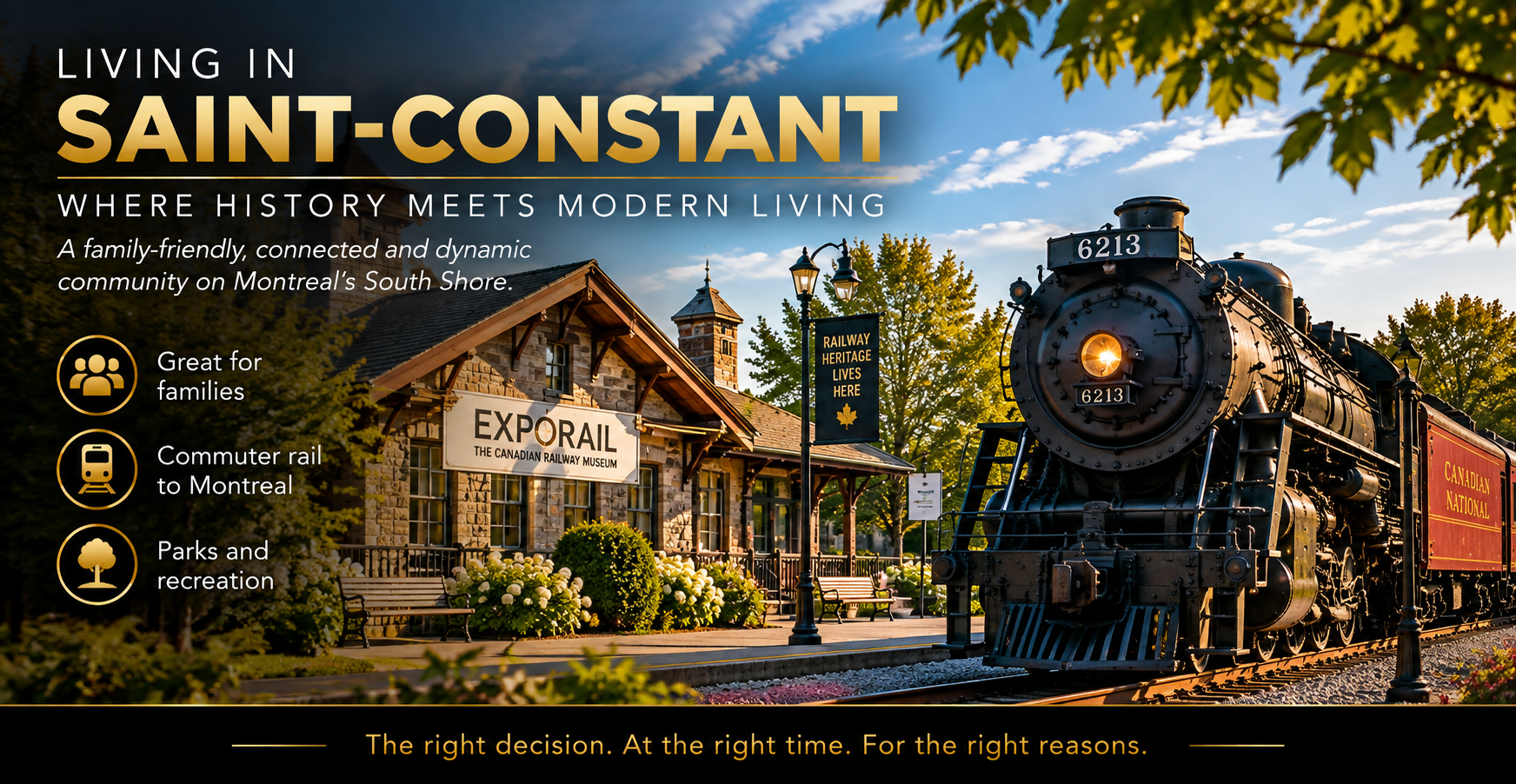
When looking at what distinguishes Saint-Constant from neighbouring South Shore communities, Exporail is difficult to overlook.
Exporail, the Canadian Railway Museum is located in Saint-Constant and is dedicated to preserving and presenting Canada’s railway history.
Locomotives.
Passenger cars.
Streetcars.
Historic railway equipment.
Should the presence of a railway museum determine where you buy a house?
Of course not.
But it illustrates something important when comparing municipalities:
Every community has an identity that goes beyond the price of its homes.
Sainte-Catherine has its connection to the St. Lawrence River and RécréoParc.
Saint-Constant has a different character, including its railway heritage, residential neighbourhoods and recreational infrastructure.
Understanding those differences helps you compare actual places to live rather than simply comparing real estate listings.
Is Saint-Constant a Good Place for Families?
This is often one of the first questions buyers with children ask.
But I would be cautious about answering it with a simple:
“Yes, Saint-Constant is a good city for families.”
A family with two young children may have very different priorities from a family with teenagers.
Look at your actual routine instead.
Ask practical questions:
-
Which school serves the address you are considering?
-
How easy is it to get there?
-
Where is childcare?
-
Which parks would your family actually use?
-
How long will it take to get to regular activities?
-
Does the street have the level of traffic you are comfortable with?
-
Will the house still work when your children are older?
Saint-Constant is served by the Centre de services scolaire des Grandes-Seigneuries, with several schools located in the municipality. École des Horizons has been in service since September 2025 and serves preschool and elementary students.
But there is an important reason to verify rather than assume.
School catchment areas can change.
The school service centre implemented changes to several Saint-Constant primary school catchment areas beginning with the 2025-2026 school year.
If attending a particular school is important to your purchase decision, do not assume the closest school on a map automatically serves the property.
Verify the current school catchment for the exact address before buying.
Centre de services scolaire des Grandes-Seigneuries is the appropriate source for current school information.
For a family comparing a home in Saint-Constant with a property in Sainte-Catherine or Candiac, this address-specific verification can change the comparison completely. A few kilometres between two properties can mean a different school catchment, commute and daily family routine.
What Is the Real Estate Market Like in Saint-Constant?
The Saint-Constant real estate market includes different types of residential properties, particularly single-family homes and condominiums.
You will probably come across searches such as:
“Average house price in Saint-Constant”
or:
“Median house price in Saint-Constant”
Market statistics can provide useful context.
But they can also be misunderstood.
Suppose a market report shows a particular median price for single-family homes.
That does not mean the house you are visiting is worth that amount.
Its value can be influenced by:
-
the street and neighbourhood;
-
living area;
-
lot size;
-
age of the property;
-
overall condition;
-
renovations;
-
number of bedrooms;
-
basement;
-
garage;
-
interior layout;
-
location-specific characteristics;
-
recent comparable sales.
Two houses in Saint-Constant can have very different market values.
A municipal median is not an appraisal of your house.
To determine whether an asking price makes sense, you need to examine the specific property and genuinely comparable transactions.
House or Condo in Saint-Constant?
The answer depends more on your lifestyle than on which type of property looks most attractive in a listing.
A single-family home may make more sense if you want:
-
a backyard;
-
more space;
-
storage;
-
greater privacy;
-
a property that can adapt as your family changes.
A condominium may be attractive if you prefer:
-
less exterior maintenance;
-
a more compact home;
-
different maintenance responsibilities;
-
a potentially different purchase price from a single-family home.
But be careful about comparing purchase prices alone.
A condo listed for less money is not automatically less expensive to own.
You should also examine condo fees, the contingency fund, maintenance records, meeting minutes, insurance, planned work and the possibility of special assessments.
Compare the real cost of ownership. Not just the asking price.
Can You Commute Between Saint-Constant and Montreal?
For some buyers, transportation is one of Saint-Constant’s most relevant characteristics.
The municipality has a commuter rail station on exo’s Candiac line, providing a rail option for travel between Saint-Constant and Montreal. Exo currently indicates an approximate travel time of 32 minutes between Saint-Constant station and Lucien-L’Allier station in downtown Montreal.
That can be useful.
But the time you spend sitting on a train is not your complete commute.
Your real commute starts at your front door.
You also need to consider:
-
the time required to reach the station;
-
waiting time;
-
transportation after arriving in Montreal;
-
possible connections;
-
your work schedule;
-
your return trip.
And if you drive, the calculation changes again.
Is your destination downtown?
Brossard?
Saint-Laurent?
Montreal’s West Island?
Another office somewhere on the South Shore?
“Montreal” is not one commute.
Do not buy a theoretical commute. Test the one you are actually going to live with.
If you need to be at work at 8:30 on Tuesday morning, try the trip on a Tuesday morning.
That tells you far more than checking an estimated travel time on Sunday afternoon.
For someone working in Saint-Laurent, for example, comparing a property in Saint-Constant with one closer to Montreal should not be based only on the purchase price. The real commute, at the hours you will actually travel, is part of what you are buying.
Schedules and service levels can change, so verify the current Saint-Constant station schedule with exo before making a real estate decision based on commuter rail service.
Do Parks and Recreation Really Affect Quality of Life?
They can.
Saint-Constant has numerous parks and recreational facilities, along with its aquatic complex and cultural and sports hub.
The aquatic complex currently has two pools, including a 25-metre competitive pool with 10 lanes and an 18-metre recreational pool.
For an active household, those amenities can have real value.
But look beyond the list of facilities.
Is the park you care about actually convenient from the house?
Could your children eventually get there easily?
Is the activity you want offered at a time that works with your schedule?
Is the facility close enough that you will use it regularly?
That is the difference between an amenity that exists and one that actually improves your daily life.
Do not buy a list of amenities. Buy an environment you will use.
What Should a Family Check Before Buying in Saint-Constant?
Here is a common scenario.
You walk into a house.
The kitchen is exactly what you wanted.
The basement is finished.
The bedrooms are a good size.
The backyard looks great.
You are already imagining where your furniture will go.
That is exactly when you need to examine what the listing photos cannot show you.
Before buying, look at:
-
traffic on the street;
-
noise at different times of day;
-
backyard orientation;
-
neighbouring properties;
-
parking;
-
the applicable school catchment;
-
your daily commute;
-
surrounding infrastructure;
-
relevant municipal projects;
-
specific constraints affecting the property or lot;
-
location characteristics that could affect your enjoyment or eventual resale.
That municipal-project check can be particularly useful. Saint-Constant currently identifies infrastructure and stormwater-management projects in different parts of the municipality, including planned retention basins and pumping stations. That is another reason to investigate the exact street and sector rather than relying on a general impression of the city.
Why?
Because many things inside a house can be changed.
Flooring.
Paint.
Cabinets.
The bathroom.
Even an entire kitchen.
You cannot move the lot.
Analyze the things you cannot change before falling in love with the things you can.
A home in Saint-Constant, Delson or Sainte-Catherine may look very similar on a real estate listing. Once you visit the area, the street, school catchment, commute and immediate surroundings can make the daily experience completely different.
Once the location works, you still need to understand the building itself. My guide to pre-purchase home inspections in Quebec explains what an inspection can help you understand before the property’s problems potentially become your responsibility.
Saint-Constant or Sainte-Catherine?
It is a natural comparison.
The municipalities are neighbours and can appeal to buyers with similar needs.
But they do not offer exactly the same environment.
Sainte-Catherine may appeal to someone who places significant value on the St. Lawrence River, RécréoParc and outdoor activities near the water.
Saint-Constant offers a different character, with its residential areas, municipal infrastructure, commuter rail station and railway heritage represented by Exporail.
But asking which municipality is “better” is probably the wrong question.
Ask instead:
Where can I buy the property that best fits my needs at a price I can reasonably afford?
Then compare the actual options.
Two houses.
Two streets.
Two commutes.
Two environments.
Two prices.
That is far more useful than comparing two municipalities in theory.
Saint-Constant or Candiac?
Candiac is another municipality worth considering when searching in this part of the South Shore.
Again, do not start with the assumption that one municipality needs to win.
Look at what is actually available when you are ready to buy.
Compare:
-
property type;
-
living space;
-
lot;
-
condition;
-
price;
-
taxes and ownership costs;
-
commute;
-
services that matter to your household;
-
compromises associated with each property.
My guide to living in Candiac on Montreal’s South Shore provides the same type of analysis for the other side of that comparison.
Your goal is not to find the municipality that wins a ranking.
Your goal is to find the address that works best for you.
Is Saint-Constant a Good Place to Invest in Real Estate?
Saint-Constant can certainly be one of the municipalities an investor analyzes.
But avoid a common shortcut:
An attractive municipality does not automatically make every property a good investment.
A real estate investment can depend on:
-
purchase price;
-
financing;
-
rental income when applicable;
-
expenses;
-
property taxes;
-
maintenance;
-
property type;
-
rental potential;
-
holding period;
-
resale strategy.
Two investors can buy in the same municipality and achieve very different results.
Why?
Because they did not buy the same property.
More importantly, they may not have paid the same price.
The better question is not:
“Is Saint-Constant a good investment?”
It is:
“Does this specific property, at this specific price, fit my investment strategy?”
Analyze the property. Not just the municipality.
Thinking About Selling a House in Saint-Constant?
Sellers can make the same mistake buyers make with municipal statistics.
A house down the street appears on the market at a certain price.
You might think:
“Mine must be worth about the same.”
Maybe.
Maybe not.
First, an asking price is not necessarily a sold price.
Second, even a completed sale needs to be genuinely comparable to your property before it becomes useful evidence.
A pricing analysis should consider factors such as:
-
recent comparable sales;
-
properties currently competing for buyers;
-
living area;
-
lot characteristics;
-
property condition;
-
renovations;
-
garage;
-
basement;
-
precise location;
-
features that distinguish your home.
And there is one question sellers sometimes forget:
At this price, what else can the buyer purchase?
Your house is not evaluated in isolation.
It competes with the other options available to the same buyer.
In Saint-Constant, that can mean buyers comparing your home with properties in Sainte-Catherine, Delson or Candiac, depending on their budget, commute and preferred property type.
That is the same principle I explore in my guide to pricing a home for sale in Quebec.
Are Saint-Constant Real Estate Statistics Enough to Price a Home?
No.
They provide context.
They do not replace a property-specific analysis.
Market statistics can help explain broader conditions, but your home has its own combination of characteristics.
A renovated home with a garage on a particular street does not automatically compare with a similar property requiring significant work elsewhere in Saint-Constant.
The market provides context. Comparable properties bring the analysis closer to your home.
8 Questions to Ask Before Buying a Property in Saint-Constant
Before making an offer, ask yourself:
-
Does my real commute work at the times I will actually be travelling?
-
Which school currently serves this address?
-
Will I actually use the parks, recreation and facilities that attract me to the area?
-
Do the traffic, noise and surroundings of this street fit what I want?
-
Have I investigated the specific constraints affecting the property and lot?
-
Does the asking price make sense compared with genuinely comparable sales?
-
Will this property still meet my needs five years from now?
-
If I eventually sell, what will future buyers see as its biggest advantages and objections?
That last question is particularly useful.
The compromises you accept today may become the objections your future buyer raises tomorrow.
So, Is Saint-Constant Right for You?
Saint-Constant can offer an interesting combination for someone who wants to live on Montreal’s South Shore:
-
residential neighbourhoods;
-
schools;
-
municipal facilities;
-
parks and recreation;
-
commuter rail access;
-
a distinctive railway heritage through Exporail.
But none of those characteristics means you should automatically buy there.
Visit the area.
Walk around the neighbourhood.
Test your commute.
Verify the school serving the address.
Visit more than one property.
Compare Saint-Constant with Sainte-Catherine, Delson or Candiac when it makes sense.
Look at what you gain.
Look at the compromises too.
And most importantly:
Do not simply choose Saint-Constant. Choose an address.
Because a good real estate decision is not about buying in the city with the most flattering ranking or reputation.
It is about finding a property that works with your life, finances and plans.
Understand First. Advise Second.
The right decision. At the right time... For the right reasons.
Jonathan Cabana
Residential and Commercial Real Estate Broker
eXp Québec
Greater Montreal | South Shore
(514) 476-0730